Owner’s manual

How to date a Craftsman table saw?
To date a Craftsman table saw, we start with the model and serial number on the saw, then compare the serial number format and any date markings to the documentation for that model. For Craftsman model 137.218100, the 137218100 owner's manual helps confirm the model family and era, even if it does not list a specific build date.
Look for a data label or metal plate in these common spots:
- On the rear of the saw cabinet or base
- On the side panel near the motor cover
- Under the extension wing or along the front rail
- Near the switch box or power cord entry
- On the stand (if your saw is mounted to one)
Write down both values exactly as shown:
- Model number (example: 137.218100)
- Serial number (letters and numbers)
Craftsman table saws have been built by different manufacturers over the years, so the serial number format is the best clue.
- If the serial number begins with 2 digits, those often represent the year (and sometimes the next 2 digits represent the week).
- If the serial number begins with letters, the letters often identify the manufacturer or plant, and the following digits may include a date code.
- If you have paperwork from the original purchase, the purchase date is the most reliable “in-service” date.
| What you have | What it tells you | Best next step |
|---|---|---|
| Model number only | Identifies the design family | Match it to the correct manual and parts list |
| Serial number only | Often contains a date code | Decode the first 2 to 4 characters |
| Manual/parts list | Confirms model and features | Compare specs and labels to your saw |
Knowing the approximate manufacture date helps us match the correct parts list, confirm blade guard and insert style, and avoid ordering look-alike components that do not fit your exact Craftsman table saw.
If you are also trying to confirm whether your saw is set up correctly for safe operation and adjustments, use the how to maintain a table saw guide alongside the manual.
Last updated: January 2026
Are all table saw arbor nuts the same size?
No. Arbor nuts are not all the same size or thread across table saws; they vary by saw design and arbor shaft. On the Craftsman 137218100, the arbor nut is designed to fit the saw’s arbor and is tightened using the supplied wrenches as shown in the 137218100 owner's manual.
Many 10-inch blades share a common arbor hole size, but that does not mean the arbor nut is universal. The nut must match the arbor shaft’s thread and the saw’s flange stack-up.
- Blade arbor hole size is often standardized by blade type (commonly 5/8 inch on many 10-inch blades).
- Arbor nut thread size and pitch are saw-specific.
- Arbor nut wrench size (the flats) can vary by manufacturer and model.
- Some saws use left-hand threads; others use right-hand threads.
- Flange design and thickness affect how the nut seats and clamps the blade.
We recommend confirming fit by using the model’s parts list and the blade-change procedure.
- Unplug the saw and set the switch to OFF.
- Remove the table insert and raise the blade to maximum height.
- Remove the arbor nut and flange, then reinstall them by hand to confirm smooth threading.
- Tighten the arbor nut by holding the arbor flats with an open-end wrench and turning the nut clockwise with a box-end wrench.
| Item | What it must match | What you can measure | What it affects |
|---|---|---|---|
| Saw blade arbor hole | Arbor diameter | Blade bore size | Whether the blade mounts |
| Arbor nut | Arbor shaft threads | Thread diameter and pitch | Whether the blade clamps safely |
| Blade flange | Saw’s arbor stack | Flange diameter and thickness | Blade runout and stability |
Using the wrong arbor nut can strip threads, prevent proper clamping, and increase vibration. Correct clamping helps the blade run true, improves cut quality, and reduces the chance of kickback.
For blade removal and installation steps specific to this saw, use the how to replace a table saw blade guide alongside the 137218100 owner's manual.
Last updated: January 2026
Can a 10 inch table saw rip a 4x4?
Yes. A 10-inch table saw like the Craftsman 137218100 can rip a 4x4 (actual size about 3-1/2 inches), but it typically takes two passes because most 10-inch blades do not have enough max cut depth to slice fully through a 4x4 in one cut.
Follow the operating and safety steps in the 137218100 owner's manual. Use a straight, dry 4x4 and keep the cut controlled.
- Set the rip fence parallel to the blade; lock it firmly.
- Raise the blade to about 1/8 inch above the top of the workpiece for each pass.
- Keep the work tight to the fence; feed against blade rotation.
- Use push sticks or push blocks to keep hands out of the blade path.
- After the first pass, turn the saw off; wait for the blade to stop.
- Rotate the 4x4 and make the second pass to finish the rip.
The manual calls out several checks to make before every use. These are especially important when ripping thicker stock.
- Blade is tight on the arbor
- Fence is locked and parallel to the miter gauge grooves
- Blade guard is installed and working properly
- Bevel angle lock knob is tight
- Safety glasses are worn
Exact maximum depth varies by saw design and blade, but these are typical ranges for 10-inch table saws.
| Blade size | Typical max depth at 90 degrees | 4x4 in one pass? |
|---|---|---|
| 10 inch | ~3 to 3-1/8 inches | Usually no |
| 12 inch | ~4 inches (varies) | Often yes |
Ripping a 4x4 pushes the saw harder and increases kickback risk if the wood twists, binds, or the fence is out of alignment. A controlled two-pass rip keeps the blade exposure lower and helps you maintain stable feed pressure.
If your cuts are wandering or not square, use table saw bad angle cuts to correct alignment and technique.
Last updated: January 2026
Is the Craftsman table saw any good?
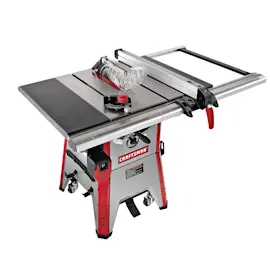
Yes. The Craftsman table saw model 137218100 is a solid DIY and light-shop saw with practical capacity and speed; it’s built to handle common rip cuts and crosscuts when it’s assembled, aligned, and used with the right blade and safety accessories (see the 137218100 operator’s manual).
From the manual specs, this saw is designed for typical home projects and jobsite-style work where portability and straightforward setup matter.
- 10-inch blade size for common lumber and sheet goods
- 5000 RPM no-load speed for clean cuts with a sharp blade
- 24-inch right-side rip capacity (with fences)
- Up to 3-inch cut depth at 90° for standard dimensional lumber
- Includes key basics like a rip fence and miter gauge
Most “good vs. bad” feedback on table saws comes down to alignment and technique. If the fence isn’t parallel to the blade, or the blade isn’t square to the table, you’ll see burning, wandering cuts, or bad angles.
- Verify blade-to-miter-slot alignment before precision work
- Square the blade at 90° and 45° and re-check after moving the saw
- Use a clean, sharp blade matched to the material (rip vs. crosscut)
- Support long boards to prevent twisting and fence pressure
- Use a push stick for narrow rips (the manual includes a push stick plan)
| Feature | What it means for you |
|---|---|
| 24-inch right rip capacity | Handles many plywood rips with proper support |
| 3-inch max depth at 90° | Cuts through typical 2x material in one pass |
| 2-1/2-inch max depth at 45° | Strong for bevel cuts on common stock |
| 44 lb net weight | Portable, but benefits from stable support |
If your cuts are inconsistent, these guides target the most common causes.
A table saw can feel “not very good” when the fence, blade, and bevel stops are slightly out of adjustment. Once tuned, a 10-inch, 5000 RPM saw like the Craftsman 137218100 reliably handles everyday woodworking tasks.
Last updated: January 2026