

How do I know the size of the compressor?
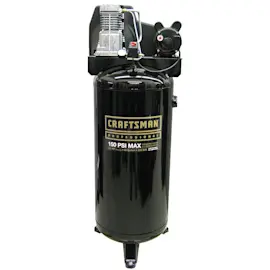
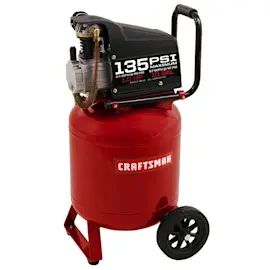
For the Craftsman 10217316 two-stage two-cylinder tank-type air compressor, “size” is best determined by matching your tools’ air demand (CFM at a given PSI) and duty cycle needs; the exact CFM/PSI and tank capacity for this specific model cannot be confirmed from the model-specific information available here.
What “compressor size” usually means
Most customers mean one (or more) of these:
- Air delivery (CFM) at a stated pressure (often 90 PSI or 40 PSI)
- Maximum pressure (PSI) the tank can reach
- Tank capacity (gallons), which affects run time between cycles
- Motor power (HP or running amps), which affects recovery time
- Duty cycle (how long it can run without overheating)
How to size it to your tools (practical method)
- List every air tool you plan to use.
- Note each tool’s required CFM at its working PSI.
- Use the highest-demand tool (or add demands if tools run together).
- Add a safety margin so the compressor is not running constantly.
Quick sizing rule of thumb
- Single tool at a time: target tool CFM + 25%
- Multiple tools at once: target total CFM + 25% to 50%
| Your use case | What to prioritize | What it affects most |
|---|---|---|
| Short bursts (nailers, staplers) | Tank gallons | Fewer starts/stops |
| Continuous tools (DA sander, grinder) | CFM at working PSI | Keeps up without pressure drop |
| High-pressure needs | Max PSI and regulator quality | Stable tool performance |
Where to find the numbers on the compressor
Check the data plate (often on the tank or near the motor/pump) for CFM, max PSI, volts/amps, and tank size. If the label is missing or unreadable, use how to find your appliance model number (and what it means for parts) to confirm you are matching specs and parts to 10217316.
Why it matters
Correct sizing prevents low tool performance, excessive cycling, overheated motors, and premature wear on components like the pressure switch, check valve, and pump.
Last updated: January 2026
What oil to use in a Craftsman air compressor?
For the Craftsman 10217316 two-stage two-cylinder tank-type air compressor, we typically recommend non-detergent air compressor oil (often SAE 30 in warmer conditions). Because oil specs can vary by pump design and operating temperature, confirm the exact viscosity and fill level for your unit using the model’s identification information (see how to find your appliance model number (and what it means for parts)).
Recommended oil type (what to buy)
Use oil made for oil-lubricated reciprocating air compressor pumps.
- Non-detergent compressor oil (preferred)
- SAE 30 non-detergent is common for many Craftsman pumps in normal to warm shop temps
- SAE 20 non-detergent may be used in colder conditions on some pumps
- Synthetic compressor oil can be acceptable if it matches the required viscosity and is rated for compressor use
- Avoid automotive engine oils that contain detergents unless the compressor manufacturer explicitly allows it
What not to use
Detergent oils can hold contaminants and moisture differently than compressor oil, which is not ideal for many compressor pumps.
- Multi-viscosity automotive oils (example: 10W-30) unless specifically approved
- Used oil or unknown oil
- Hydraulic fluid, ATF, or gear oil
Quick selection guide
| Shop temperature (typical) | Common choice | Notes |
|---|---|---|
| Cold conditions | SAE 20 non-detergent | Helps with easier starts on some pumps |
| Moderate to warm conditions | SAE 30 non-detergent | Common all-around choice |
| Wide temp swings or heavy duty use | Synthetic compressor oil | Must match viscosity requirement |
Why it matters
Correct compressor oil helps protect the pump (pistons, bearings, and valves), reduces carbon buildup, and improves reliability. The wrong oil can increase wear, cause hard starting, and shorten pump life.
Helpful tips when changing oil
- Unplug the compressor and let the pump cool before servicing
- Drain old oil fully, then refill to the correct level on the sight glass or dipstick (if equipped)
- If the oil looks milky, the compressor may be accumulating moisture; increase tank draining frequency and check storage conditions
Last updated: January 2026
Will a 6 gallon air compressor run an impact gun?
Yes, a 6-gallon air compressor can run an impact gun (impact wrench) for short bursts, but it typically will not keep up for continuous use because most impacts need more sustained airflow (CFM) than small compressors can deliver. For your Craftsman 10217316, we cannot confirm the exact tank size or CFM from model-specific information here, so you will need to match your tool’s CFM-at-90-PSI requirement to the compressor’s delivered CFM rating.
What to check on your compressor and impact gun
- Impact gun air demand: look for CFM (often listed at 90 PSI) on the tool label or spec sheet.
- Compressor delivered CFM: use the compressor’s delivered CFM rating (not just “displacement”).
- Pressure settings: set the regulator to the tool’s rated pressure (commonly 90 PSI at the tool).
- Hose and fittings: use a larger hose (often 3/8-inch) and high-flow couplers to reduce pressure drop.
- Duty cycle and heat: if the compressor runs constantly, pause to prevent overheating.
Practical expectations with a 6-gallon tank
A 6-gallon unit often works best for:
- Lug nuts and small fasteners (intermittent use)
- Short DIY tasks with cool-down time
- Compact 3/8-inch drive impacts
It often struggles with:
- Repeated heavy fasteners without pauses
- Long sessions where pressure cannot recover
- High-torque 1/2-inch impacts that need steady airflow
Quick comparison: what matters most
| Item | What it affects | Typical symptom when undersized |
|---|---|---|
| Delivered CFM | Sustained torque | Weak hits, stalling |
| Tank size | Burst duration | Frequent waiting for refill |
| Hose diameter | Pressure at the tool | Noticeable power loss |
| Recovery time | Work pace | Compressor runs nonstop |
Why it matters
When the compressor cannot meet the impact gun’s airflow needs, torque becomes inconsistent and the compressor may run continuously, increasing heat and wear on the pump and motor.
For general DIY safety and planning before repairs or electrical checks, we recommend are diy appliance repairs safe.
Last updated: January 2026