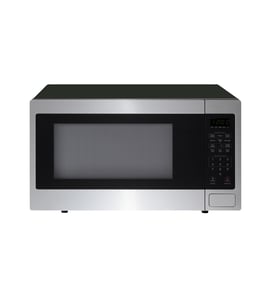
What is the standard size for a countertop microwave?
Most countertop microwaves fall into a “standard” footprint of about 21 to 24 inches wide, 12 to 16 inches tall, and 15 to 20 inches deep. For your KitchenAid KCMS1655BSS, use those ranges to plan space, then confirm the exact cutout and clearance you have on the counter.
Typical countertop microwave size ranges
These ranges cover compact, mid-size, and larger countertop units:
- Width: 15 to 25 inches (most common: 21 to 24 inches)
- Height: 10 to 18 inches (most common: 12 to 16 inches)
- Depth: 12 to 20 inches (most common: 15 to 20 inches)
- Capacity: about 0.5 to 2.2 cubic feet (most common: 1.1 to 1.7 cubic feet)
Quick sizing guide (what to buy for your space)
| Your need | Typical capacity | Typical width | Best fit for |
|---|---|---|---|
| Small counter, light use | 0.5 to 1.0 cu. ft. | 15 to 20 in. | Dorms, apartments |
| Everyday family use | 1.1 to 1.7 cu. ft. | 21 to 24 in. | Most kitchens |
| Large dishes, big plates | 1.8 to 2.2 cu. ft. | 24 to 25 in. | Large households |
What to measure before you choose a “standard” size
Measure your available space and allow room for airflow and door swing:
- Counter space width where the microwave will sit
- Depth from the wall to the front edge of the counter (include plug clearance)
- Height to cabinets or shelves above
- Door swing clearance so the door opens fully
- Ventilation space around the sides and back (avoid tight enclosures)
Why it matters
A microwave that is “standard size” can still be a poor fit if the depth is too large, the door hits a backsplash, or ventilation is blocked. Proper sizing helps prevent overheating, nuisance shutoffs, and cramped usability.
Related help
If you are shopping because your microwave runs but does not warm food, use our troubleshooting steps in why is my microwave not heating.
Last updated: January 2026
Does KitchenAid make a countertop microwave?
Yes. KitchenAid makes countertop microwaves, and the KitchenAid KCMS1655BSS is a countertop microwave model. If you are shopping for parts or confirming fit, matching the full model number on your unit to KCMS1655BSS is the fastest way to ensure compatibility.
How to confirm you have a countertop model
A countertop microwave is designed to sit on a counter or shelf and plug into a standard outlet (not permanently mounted like an over-the-range unit).
- Look for the model tag showing KCMS1655BSS on the microwave
- Check that the unit sits on feet and is not bolted to cabinetry
- Confirm it uses a standard power cord and outlet
- Verify the turntable system is installed and rotates freely
Parts you will commonly replace on KCMS1655BSS
If your microwave runs but has turntable issues (rattling, not rotating, tray slipping), these are common countertop-microwave wear items:
Quick part-to-symptom guide
| Symptom | Most likely area | What to check first |
|---|---|---|
| Tray not turning | Turntable drive system | Tray support seated correctly, shaft engaged |
| Grinding or wobble | Tray support or tray | Cracks, warping, debris under support |
| Tray slips or jumps | Shaft or support | Worn coupler tabs, misalignment |
Why it matters
Countertop microwaves like the KitchenAid KCMS1655BSS rely on a simple turntable drive system for even heating. Keeping the tray, support, and shaft in good condition helps prevent uneven cooking and reduces noise and vibration.
Last updated: January 2026
What is the average life of a countertop microwave?
Most countertop microwaves last 7 to 10 years with normal home use. For a KitchenAid countertop microwave like KCMS1655BSS, lifespan depends most on how often you run it, how well it stays ventilated, and whether the door and turntable system stay in good working order.
Typical lifespan ranges
- Light use (a few minutes/day): 10 years
- Average use (multiple cycles/day): 7 to 10 years
- Heavy use (many cycles/day): 4 to 7 years
- Commercial-style use: replace sooner; countertop units are not built for that duty cycle
What usually ends a microwave’s life
Many microwaves stop being worth repairing due to common wear items and electrical failures, not because the cabinet “wears out.” Watch for:
- No heat or weak heating
- Intermittent power, dead display, or random shutoffs
- Door not closing firmly or the unit running only when the door is pressed
- Loud grinding or a turntable that stops rotating
- Burning smell, arcing, or scorch marks (stop using immediately)
If your turntable is the issue on KCMS1655BSS, these model-matched parts are the first places we look:
| Symptom | Common cause | Model-matched part to check |
|---|---|---|
| Tray not turning | Worn support or coupler/shaft | Microwave turntable tray support W10451792 or shaft turn WPW10451789 |
| Tray wobbles or drags | Cracked or warped tray | Microwave glass tray WPW10451786 |
How to help your KCMS1655BSS last longer
- Keep the air vents clear; do not push the microwave tight against a wall.
- Wipe spills quickly so food does not carbonize and cause arcing.
- Do not run it empty; it stresses internal components.
- Use microwave-safe containers; avoid metal trim and foil.
- If it stops heating, follow a proven diagnostic path like why is my microwave not heating.
Why it matters
A microwave that is clean, well-ventilated, and not forced to run with a damaged door or turntable system typically reaches the full 7 to 10 year service life with fewer nuisance failures.
Last updated: January 2026


