Owner’s manual
 Error Codes


Are LG stainless steel refrigerators magnetic?
Many LG stainless steel refrigerators, including the LG LFXS26596S, are only partly magnetic: a magnet may stick to some areas (often the doors) but not others, depending on the stainless panel construction and any fingerprint-resistant coating. For model-specific care and finish guidance, use the LFXS26596S owner's manual.
What to expect with magnets
- Weak hold is common: thin decorative stainless panels can reduce magnet strength.
- Mixed results by surface: doors may behave differently than side panels.
- Coatings can matter: smudge-resistant finishes can change how well magnets grip.
- Handles and trim vary: magnets typically do not stick well to plastic or some trim pieces.
- Use light magnets: heavy clips can slide and scratch the finish.
Quick test (safe for the finish)
- Clean and dry a small spot first.
- Try a small magnet in 3 places: upper door, lower door, and a side panel.
- If it sticks, gently tug downward to see if it slides.
Magnet choice guide
| Magnet type | Best use | Risk to finish |
|---|---|---|
| Small flat souvenir magnet | Notes, reminders | Low |
| Strong neodymium magnet | Temporary hold only | Medium (can snap/scratch) |
| Magnetic dry-erase board | Usually not recommended | Medium to high (sliding) |
Why it matters
If magnets slide or require strong pull to remove, they can leave scuffs on stainless steel. Using lighter magnets and keeping the surface clean helps protect the LG finish and keeps doors looking uniform.
Last updated: February 2026
What is the most common problem with LG refrigerators?
Cooling problems are the most common issue we see with LG refrigerators like model LFXS26596S, typically showing up as warm fresh food temperatures, a freezer that is not holding temp, or inconsistent cooling. Ice maker and water dispenser issues are also frequent, often tied to water supply, filters, or airflow.
Most common symptoms to watch for
- Fresh food section is warm but freezer seems OK (or the reverse)
- Temperature swings, food spoiling faster than normal
- Unusual fan noise, clicking, or buzzing during operation
- Ice maker not producing ice or producing small/hollow cubes
- Water dispenser flow is slow or sputters
Quick checks we recommend first (before parts)
Use these steps to narrow the problem fast; they apply well to LG bottom-mount designs.
- Confirm the unit is not in Demo/Display Mode (the control panel can be toggled; see the LFXS26596S owner's manual)
- Make sure doors fully close and seals are making full contact
- Verify vents inside the refrigerator are not blocked by food packages
- If dispenser flow is weak or ice is discolored, check the filter and water supply
- If the refrigerator is not cooling at all, check the breaker/GFCI and power supply
Common causes and what they affect
| Issue area | What you notice | Parts that are often involved on this model |
|---|---|---|
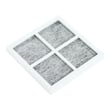
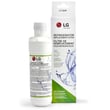
| Water filtration | Slow water, odd taste/odor, discolored ice | LG lt1000p refrigerator water filter ADQ74793501 |
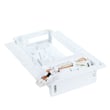
| Ice maker system | No ice, clumping, dispenser issues | Ice maker assembly (AEQ72909602) - refrigerator ice maker part by LG AEQ72909602 |
| Airflow and heat removal | Warm temps, long run times | Refrigerator condenser fan motor EAU65058502 |
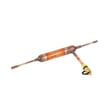
| Defrost system | Frost buildup, reduced airflow | Refrigerator defrost heater MEE63545708 |
Why it matters
Cooling and airflow problems can quickly lead to food spoilage and can also make the ice maker and dispenser act up. Starting with control settings, door sealing, and filter condition prevents unnecessary part replacement and helps you pinpoint the real failure.
Last updated: February 2026
Why is my LG bottom freezer not freezing?
If your LG LFXS26596S bottom-freezer refrigerator is not freezing, the most common causes are a freezer temperature set too warm, doors not sealing or closing tightly, or restricted airflow from frequent door openings or frost buildup. Start by confirming the freezer is set to 0 °F (-18 °C) and the door closes tightly (see the LFXS26596S owner's manual).
Quick checks that fix many “not freezing” complaints
- Set the freezer to 0 °F (-18 °C); adjust one increment at a time and wait for temperatures to stabilize.
- Make sure the freezer door closes fully; warm, humid air entering the compartment raises temperature and creates frost.
- Reduce long or frequent door openings; this quickly warms the freezer.
- Avoid overloading; leave space for air to circulate around packages.
- If you see heavy frost on the back wall or inside panels, do a full manual defrost (unplug and leave doors open) and then monitor.
Airflow and sensor related causes
Poor airflow and incorrect temperature sensing can prevent proper freezing even when the compressor is running.
- A failed freezer temperature sensor can misread temperatures and cause weak cooling; the model uses a thermistor-style sensor such as the refrigerator temperature sensor 6500JB2002X.
- If the condenser fan is not running, the sealed system cannot reject heat effectively; check for a stalled or noisy fan like the refrigerator condenser fan motor EAU65058502.
What to expect (normal targets)
| Item | Normal target | What it means if off |
|---|---|---|
| Freezer setpoint | 0 °F (-18 °C) | Warmer settings reduce freezing and ice production |
| Door closure | Tight seal, no gaps | Leaks cause warming, frost, and soft food |
| Loading | Air gaps around food | Packed items block vents and slow freezing |
Why it matters
A freezer that runs warm usually points to an airflow, door-seal, or control issue. Fixing those first prevents unnecessary part replacement and helps the refrigerator maintain stable temperatures for safe food storage.
Last updated: February 2026
Why is my LG refrigerator not making ice on the lower part?
If your LG LFXS26596S isn’t making ice in the lower ice bin, the most common causes are the icemaker being OFF, the freezer temperature being set too warm (target 0°F), a blocked ice-detecting sensor, or a water supply issue such as a partially closed shutoff valve or a clogged filter. Use the LFXS26596S owner's manual troubleshooting steps to confirm each item.
Quick checks that fix most “no ice” problems
- Confirm the icemaker ON/OFF is set to ON.
- Make sure the freezer is set to 0°F (-18°C) for normal ice production.
- Check that the ice bin is seated correctly and not overfilled.
- Inspect the ice-detecting sensor area for frost or debris; keep it clean.
- Verify the house water shutoff valve is fully open and the supply line is not kinked.
- Replace the water filter if it’s older than about 6 months or water flow is slow (this model uses the LG lt1000p refrigerator water filter ADQ74793501).
What to expect after changes (timing matters)
After you correct a setting or restore water flow, ice production is not instant.
| Situation | What’s normal for this model | What to do |
|---|---|---|
| New install or water just connected | Up to 24 hours to reach temp; icemaker begins producing around 48 hours | Wait and keep doors closed as much as possible |
| Ice bin was emptied | About 90 minutes for more ice; about 24 hours to refill the bin | Give it time before replacing parts |
| First use after long downtime | First ice and water can contain odor/particles | Discard the first bin of ice and flush water per the manual |
Why it matters
The lower ice system depends on two things: a cold-enough freezer and steady water flow. If the freezer is even a few degrees warm or the filter is restricted, the icemaker can stop cycling or produce little to no ice.
When a part is likely involved
If the freezer is at 0°F, the icemaker is ON, the sensor is clear, and water flow at the dispenser is weak or intermittent, we focus on the water path:
- Filter restriction: replace LG lt1000p refrigerator water filter ADQ74793501
- Water supply not opening correctly: test/replace LG refrigerator water inlet valve AJU72992601
- Ice maker itself not cycling: consider ice maker assembly (AEQ72909602) - refrigerator ice maker part by LG AEQ72909602
Last updated: February 2026