Error Codes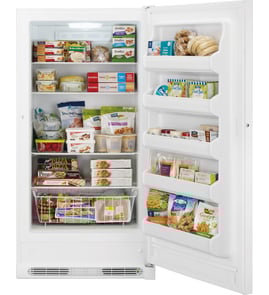

Where is the model number on a Kenmore upright freezer?
On a Kenmore upright freezer like model 5649237080, the model number is printed on a rating label inside the cabinet or on the exterior cabinet near the base or back. We use that model number to match the correct parts and diagrams for your exact freezer.
Look for a paper or foil rating label in these spots:
- Inside the freezer on a side wall (often near the front)
- On the ceiling of the freezer compartment
- Behind the lower kick plate or toe grille (front, near the floor)
- On the back of the cabinet near the power cord
- Along the door frame edge (open the door and check the perimeter)
The label usually includes several identifiers. Record them exactly as shown.
| Label item | Why it matters for parts |
|---|---|
| Model number | Matches diagrams and compatible replacement parts |
| Serial number | Helps identify production run details |
| Electrical ratings (V/Hz/A) | Useful when troubleshooting power or control issues |
- Use a flashlight and check high and low; upright freezers often place labels on the ceiling or near the base.
- If you see multiple numbers, prioritize the one labeled Model.
- If the label is worn, take a close-up photo and zoom in to read it.
Kenmore freezer parts can vary by revision even within the same product family. Using the exact model number (for example, 5649237080) prevents ordering the wrong door gasket, thermostat, control, or shelf hardware.
For more help identifying the correct model number format, use how to find your appliance model number (and what it means for parts).
Last updated: February 2026
How to tell how big a freezer is upright?
To tell how big your Kenmore upright freezer model 5649237080 is, we measure its capacity (cubic feet) and its outside dimensions (height, width, depth). Capacity tells you storage space; dimensions tell you whether it will fit your room and doorway.
Use a tape measure and record in inches:
- Height: floor to top of cabinet (include hinges only if they stick up)
- Width: widest point across the cabinet
- Depth: front of door to back of cabinet (note depth with handle if it protrudes)
- Door swing space: measure how far the door needs to open to access drawers/shelves
- Ventilation clearance: leave space behind and above for airflow (common need for freestanding freezers)
| What you’re checking | Measure from | Why it matters |
|---|---|---|
| Doorway fit | narrowest doorway/hallway | prevents delivery problems |
| Final location | wall to wall space | confirms it physically fits |
| Depth | front of door/handle to back | avoids blocking walkways |
| Clearance | back/top/sides | helps cooling performance |
If you do not have the rated capacity label handy, we estimate interior volume using the inside measurements.
- Measure interior height, width, and depth (in inches).
- Multiply:
H x W x Dto get cubic inches. - Convert to cubic feet: divide by 1,728.
- Example: 48 x 20 x 18 = 17,280 cubic inches; 17,280 / 1,728 = 10.0 cu ft
Most upright freezers list capacity and key dimensions on the model and serial tag or product label. If you need help confirming the model number before ordering parts or looking up specs, use how to find your appliance model number (and what it means for parts).
Capacity helps you compare storage space between freezers, while outside dimensions and clearance prevent installation issues like poor airflow, door interference, or a freezer that will not fit through the doorway.
Last updated: February 2026
What's the average lifespan of an upright freezer?
Most upright freezers last 10 to 15 years. With steady indoor temperatures, clean condenser airflow, and good door-seal habits, many units can reach 15 to 20 years before major sealed-system or compressor issues make replacement more practical.
| Freezer type | Typical lifespan | What usually ends it |
|---|---|---|
| Upright freezer (most homes) | 10 to 15 years | Compressor wear, refrigerant leaks, control failures |
| Upright freezer (well maintained, indoor) | 15 to 20 years | Sealed-system efficiency loss, repeated repairs |
| Garage or hot/humid location | 7 to 12 years | Overwork from heat, corrosion, higher run time |
- Room temperature: Heat makes the compressor run longer and hotter.
- Airflow around the cabinet: Blocked vents and dust buildup raise operating temps.
- Door gasket condition: Leaks cause frost, longer run times, and higher energy use.
- Defrost performance: Heavy frost reduces cooling and stresses the system.
- Power quality: Surges and repeated outages can damage controls and the compressor start circuit.
- Keep the freezer indoors when possible and avoid tight enclosures.
- Vacuum dust from the lower front or rear intake area every few months.
- Check the door seal: close a dollar bill in the door; if it slips easily, the gasket may be weak.
- Keep it reasonably full (frozen items help stabilize temperature), but do not block interior vents.
- If you see recurring frost or warm temps, use a multimeter to test electrical parts safely (see how to use a multimeter to test electrical parts video).
A freezer near the end of its typical lifespan often shows up as temperature swings, excessive frost, louder running, or nonstop cycling. Catching airflow and gasket problems early can prevent compressor overwork and extend the life of your Kenmore 5649237080.
Last updated: February 2026
What causes an upright freezer to stop freezing?
When a Kenmore upright freezer like model 5649237080 stops freezing, the most common causes are poor airflow from heavy frost buildup, a failed defrost system, a problem in the compressor start circuit (relay/capacitor), or a temperature control issue. Start with simple checks (power, settings, door seal) before electrical testing.
- Confirm the freezer is plugged in and the outlet has power (try a lamp).
- Make sure the temperature control is set colder and not in an “off” position.
- Check the door gasket for gaps, rips, or areas not sealing; warm air leaks quickly stop proper freezing.
- Look for heavy frost on the back wall or shelves; that often points to a defrost problem.
- Verify the freezer is not overpacked; blocked vents prevent cold air circulation.
| Symptom | Most likely cause | What to do next |
|---|---|---|
| Runs constantly but not cold | Dirty condenser, low airflow, sealed-system issue | Clean coils, improve clearance; if still warm, service is needed |
| Thick frost, then warming | Defrost heater/thermostat/timer/control issue | Defrost fully, then troubleshoot defrost circuit |
| Clicking every few minutes, won’t start | Start relay or start capacitor | Test start components; replace if failed |
| No sound, no cooling | Control, wiring, or power issue | Check outlet, cord, control setting; inspect wiring |
- Unplug the freezer before removing panels or touching wiring.
- Defrost test: If you see heavy frost, unplug and leave the door open 12 to 24 hours (towels ready). If it cools normally afterward, the defrost system is the leading suspect.
- Listen and feel: A running compressor usually hums and gets warm. Repeated clicking suggests a start-device problem.
- Basic electrical checks: If you use a multimeter, follow a proven process for continuity and resistance checks.
- For meter basics, use our guide: how to use a multimeter to test electrical parts video
- For wiring damage checks, use: how to repair broken or damaged wires video
A freezer that is not freezing can be a simple airflow or door-seal issue, but it can also be an electrical start failure that prevents the compressor from running. Catching the root cause early helps prevent food loss and avoids repeated overheating or icing.
Last updated: February 2026
Why is my upright freezer leaking water on the floor?
Water on the floor around your Kenmore 5649237080 upright freezer almost always comes from condensation or defrost water that is not draining or evaporating correctly. The most common causes are a clogged defrost drain, a cracked or overflowing drain pan, or warm, humid air leaking in through the door gasket.
- Defrost drain blocked by ice or debris: Water backs up and can spill out of the cabinet.
- Drain pan out of position or damaged: Defrost water misses the pan or leaks through cracks.
- Door gasket not sealing: Extra moisture enters, creating more frost and more meltwater.
- Freezer not level: Water can run toward the front instead of into the drain system.
- Items touching the back wall: Can interfere with airflow and increase frost buildup.
- Unplug the freezer and protect the floor with towels.
- Check where the water starts:
- Front edge of cabinet: often leveling or door seal.
- Under the center: often drain pan.
- Inside bottom of freezer: often a drain/ice blockage.
- Inspect the door gasket: close a dollar bill in several spots; steady resistance means a good seal.
- Verify leveling: most upright freezers work best when slightly tilted back so the door self-closes.
- Look for ice at the bottom interior: if present, defrost fully (door open, power off) and then restart.
| Symptom | Likely cause | Best next step |
|---|---|---|
| Small occasional moisture near door | Humidity, brief door openings | Improve seal habits, wipe dry |
| Puddle after heavy frost | Drain restriction | Full defrost, then monitor |
| Constant puddle under unit | Drain pan issue | Inspect pan position/condition |
| Water plus poor cooling | Air leak or system issue | Check gasket, airflow, condenser area |
Leaks are usually a drainage or sealing problem; fixing it prevents recurring ice buildup, protects flooring, and helps the freezer maintain stable temperatures and efficient run time.
For safe DIY checks involving electrical testing, use our guide: how to use a multimeter to test electrical parts video.
Last updated: February 2026