Owner’s manual





What is the average life of a Maytag dryer?
A Maytag dryer like model MED7230HW2 typically lasts 10 to 15 years with normal household use. Keeping airflow strong (lint screen and venting) and replacing common wear parts when symptoms show up are the biggest factors in reaching the high end of that lifespan.
What affects dryer lifespan the most
- Restricted venting (crushed hose, long vent run, clogged outdoor hood)
- Lint buildup in the exhaust duct or inside the cabinet
- Overloading (extra strain on the drum, rollers, belt, and motor)
- Frequent high-heat cycles with poor airflow (overheats thermostats and fuses)
- Delaying small repairs until they cause bigger failures
Maintenance that helps MED7230HW2 last longer
We recommend following the cleaning and venting guidance in the MED7230HW2 dryer installation and care manual.
- Clean the lint screen before every load
- Use 4-inch heavy metal venting (avoid plastic or foil)
- Keep the vent path as short and straight as possible
- Clean the full vent system at least every 2 years (more often with heavy use)
- Keep the dryer level so the drum support system wears evenly
Common wear items worth fixing (and examples for this model)
If your dryer starts squealing, thumping, or taking longer to dry, these parts are common culprits.
| Symptom | Often related to | Example compatible part for MED7230HW2 |
|---|---|---|
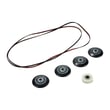
| Thumping or rumbling | Drum support rollers | Dryer drum support roller WPW10314173 |
| Squealing or belt slack | Idler pulley | Dryer idler pulley W10837240 |
| No heat or shuts off from overheating | Thermal cut-off protection | Whirlpool dryer thermal cut-off fuse kit (352-degree f) 280148 |
Why it matters
Good airflow keeps operating temperatures stable, which reduces stress on the heater circuit, motor, thermostats, and safety fuses. That typically means fewer breakdowns and a longer overall service life.
Last updated: January 2026
What is the most common problem with Maytag dryers?
For the Maytag MED7230HW2 dryer, the most common problem we see is poor drying performance caused by restricted airflow (a clogged lint screen, lint buildup in the housing, or a blocked or crushed exhaust vent). Airflow issues can also contribute to overheating-related shutdowns. For venting and maintenance basics, see the MED7230HW2 dryer manual.
Most common issues (and what they look like)
- Restricted airflow: long dry times, weak airflow at the outside hood, hot cabinet
- No heat or stops heating: overheating protection may open after poor venting
- Noise or drum issues: rumbling, thumping, squealing from wear in the drum support system
- Inconsistent auto-dry results: moisture sensor contamination or failure
- Won’t start: door switch or power supply problems (especially on electric models)
Quick checks we recommend first
- Clean the lint screen before every load; wash it with a nylon brush periodically if residue builds up.
- Check the vent hose behind the dryer for kinks, crushing, or excessive length.
- Make sure the outside vent hood opens fully and is not packed with lint.
- Run a timed dry cycle and confirm strong airflow outside.
- If the dryer is noisy, inspect the drum support system for wear.
Common symptom-to-part mapping (MED7230HW2)
| Symptom | Most likely area | Example compatible part for this model |
|---|---|---|
| Long dry times | Venting or lint restriction | Dryer flexible vent hose 4396010RP |
| Rumbling or thumping | Drum support rollers | Dryer drum support roller WPW10314173 |
| Squealing | Idler pulley system | Dryer idler pulley W10837240 |
| Auto cycles inconsistent | Moisture sensing | Dryer moisture sensor WP3387223 |
Why it matters
Airflow restrictions do more than slow drying; they raise operating temperatures, which can shorten the life of heating and safety components and increase the chance of nuisance shutdowns.
Related DIY help
Last updated: January 2026
Is 6.7 cubic feet a big dryer?
Yes. A 6.7 cubic foot dryer is considered large capacity for most households. For Maytag model MED7230HW2 specifically, the validated document we have is an installation and care manual and it does not list the drum capacity, so we can’t confirm whether this exact model is 6.7 cu. ft. from that model-specific document.
What “6.7 cu. ft.” means in everyday use
A 6.7 cu. ft. drum is typically roomy enough for family-size loads and many bulky items, as long as you avoid overpacking.
- Handles larger mixed loads (jeans, towels, sweatshirts)
- Better tumbling when you leave space at the top of the drum
- Fewer loads compared with standard-capacity dryers
- Bulky items dry best when dried one at a time or with a few small items
For airflow and venting practices that affect real-world drying performance, follow the venting and maintenance guidance in the MED7230HW2 installation and care manual.
Large vs extra-large: practical size guide
Capacity labels vary by brand, but these ranges are a helpful rule of thumb.
| Dryer size label | Typical drum size range | Best for |
|---|---|---|
| Compact | Under 4.5 cu. ft. | Small spaces, light loads |
| Standard | 5.0 to 6.5 cu. ft. | Most households |
| Large | 6.6 to 7.4 cu. ft. | Families, bulky items |
| Extra-large | 7.5 cu. ft. and up | Very large loads, king bedding |
Why it matters
Capacity only helps if the dryer can move air well. A restricted vent can make even a large dryer take much longer and run hotter than it should.
If your MED7230HW2 takes too long to dry
These steps improve airflow and drying time on most Maytag dryers.
- Clean the lint screen before every load
- Use 4-inch heavy metal venting (avoid plastic or foil)
- Keep the vent run short with minimal elbows
- Make sure the vent hose isn’t crushed behind the dryer
- Clean the full vent system periodically
If you need to replace a damaged vent connection, consider a compatible dryer flexible vent hose, 5-ft 4396009RP.
Last updated: January 2026