Owner’s manual
 Error Codes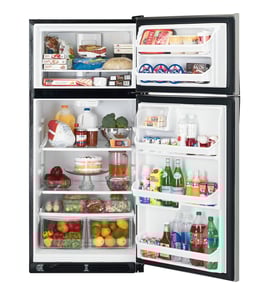

Are top mount or bottom mount fridges better?
Top-mount and bottom-mount refrigerators are both “better” depending on what you value most. For an LG top-mount like model LTC19340SW, a top-mount design typically costs less to buy and maintain, while bottom-mount models usually put fresh-food items at eye level and can feel easier to organize day to day.
Quick comparison (what most homeowners notice)
| Feature | Top-mount (freezer on top) | Bottom-mount (freezer on bottom) |
|---|---|---|
| Fresh-food access | You bend more often | More at eye level |
| Freezer access | Easier to reach | You bend more often |
| Upfront cost | Typically lower | Typically higher |
| Repair complexity | Often simpler | Often more complex |
| Space/footprint | Usually compact-friendly | Often deeper/taller |
When a top-mount is the better choice
- You want a straightforward, budget-friendly refrigerator layout.
- You use the freezer frequently (frozen foods are easier to reach).
- You prefer fewer “extras” that can add cost over time.
- You need a fridge that fits tighter kitchen spaces.
- You want simpler door hardware and alignment adjustments (common on top-mount designs).
For door alignment and leveling guidance that applies to your LG LTC19340SW, use the steps and diagrams in the owner's manual.
When a bottom-mount is the better choice
- You use fresh food more than frozen food and want it at chest or eye level.
- You like wide refrigerator shelves and easier visibility of everyday items.
- You prefer freezer drawers/baskets for organization.
Why it matters
The “best” style is the one that matches how you cook and how your kitchen is laid out. Choosing the right configuration reduces door-open time, improves temperature stability, and can help prevent common issues like door seal wear and uneven cooling.
Last updated: February 2026
What are the disadvantages of a top mount fridge?
Top-mount refrigerators like the LG LTC19340SW put the freezer on top and the fresh-food section below; the main disadvantages are less convenient access to everyday refrigerated items, fewer premium storage features, and fewer built-in dispenser options compared with many bottom-freezer designs. See the owner's manual for your model’s exact features and adjustments.
Common disadvantages (what most owners notice)
- More bending for fresh food: the refrigerator compartment is lower, so you reach down more often.
- Less “at-eye-level” organization: deli drawers and wide pantry drawers are less common on many top-mount layouts.
- Fewer exterior dispenser options: many top-mount models do not include through-the-door water or ice.
- Freezer space can feel tighter: top freezers often have less usable width for large boxes.
- Door-swing clearance matters: in tighter kitchens, the upper freezer door can be awkward if space is limited.
Quick comparison: top mount vs. bottom freezer
| Feature | Top mount (freezer on top) | Bottom freezer |
|---|---|---|
| Access to fresh food | Lower, more bending | Higher, easier daily access |
| Organization features | Often simpler | Often more “premium” storage |
| Cost to buy/repair | Often lower | Often higher |
| Energy use | Often efficient | Varies by model |
When a “disadvantage” becomes a real problem
- If you have back or knee discomfort, the lower fresh-food access is the biggest day-to-day drawback.
- If you store lots of tall bottles or wide platters, you may feel the layout limits sooner.
- If you want a dispenser, check whether your specific LTC19340SW configuration supports it; models without a dispenser still may use internal water components such as a refrigerator water inlet valve 5220JA2009D for an ice maker or internal water supply (if equipped).
Why it matters
Choosing the right refrigerator style affects daily ergonomics, food visibility (which reduces waste), and how well the storage layout fits your household’s habits.
Last updated: February 2026
What is the most common problem with an LG refrigerator?
The most common LG refrigerator complaint is not cooling or inconsistent cooling. On the LG LTC19340SW top-mount refrigerator, the most frequent root causes are airflow and temperature-control issues (dirty condenser area, a failing fan, a bad temperature sensor, or a defrost drain icing up), which can all lead to warm temperatures.
Most common symptoms customers notice
- Fresh food section is warm but freezer seems OK
- Freezer is warm and ice cream is soft
- Temperature swings (too warm, then too cold)
- Clicking or humming with poor cooling
- Water pooling inside the refrigerator or under the unit
Common causes (and what to check first)
We recommend starting with the quick checks below before replacing parts:
- Airflow blocked: keep packages away from vents; do not overpack shelves.
- Condenser area dirty: vacuum dust from the condenser coils and the condenser fan area.
- Door not sealing: check for gaps, torn gasket, or a door that is out of alignment.
- Defrost drain icing/clog: if you see water or ice buildup, inspect the drain path.
- Temperature sensing issue: a drifting sensor can cause erratic cooling.
Parts that commonly relate to cooling problems on LTC19340SW
If basic cleaning and airflow checks do not fix the issue, these model-matched parts are often involved:
| Problem pattern | Likely system | Example model-matched part |
|---|---|---|
| Temps swing or unit runs too long | Temperature sensing/control | Refrigerator sensor 6500JB2001B |
| Warm temps with poor heat removal | Condenser airflow | Refrigerator condenser fan motor EAU61644105 |
| Water/ice buildup near bottom, then cooling issues | Defrost drain | Refrigerator drain tube 5251JA3003D |
| No start or repeated clicking with no cooling | Start components | Compressor start relay (match by model) |
Why it matters
When an LG refrigerator is not cooling, food safety and compressor workload become the big concerns. Fixing airflow, sealing, and defrost drainage early helps the refrigerator hold steady temperatures and prevents longer run times that can shorten the life of major components.
Where to confirm settings and diagnostics
For the correct temperature settings, control features, and model-specific checks, use the owner's manual.
Last updated: February 2026
How long to let a refrigerator sit after laying it down?
For an LG LTC19340SW top-mount refrigerator, we recommend letting it sit unplugged upright for 24 hours after it has been laid on its side. This gives compressor oil time to drain back where it belongs, helping prevent hard starting, poor cooling, or compressor damage when you power it back on.
Quick rule of thumb (based on how it was moved)
- Laid fully on its side: wait 24 hours
- Only tilted briefly (a few minutes) and not fully horizontal: wait 4 to 6 hours
- Transported upright the whole time: you can plug it in once it is in place and level
- Not sure how long it was on its side: wait 24 hours
Before you plug it in (best practices)
- Set the refrigerator in its final spot and level it (front-to-back and side-to-side).
- Make sure the doors close and seal properly.
- If it has a water line, confirm the supply is on and check for leaks at the valve and tubing connections.
- After plugging in, allow 24 hours to reach stable temperatures (typical targets: 37°F fresh food, 0°F freezer).
Why the wait matters
When a refrigerator is laid down, compressor oil can migrate into the sealed system lines. Powering up too soon can cause the compressor to run without proper lubrication or to struggle on startup, which can shorten compressor life.
If it won’t cool or it clicks after moving
Use this checklist:
| Symptom after restart | Most common cause | What to do next |
|---|---|---|
| Clicking every few minutes | Start device struggling | Unplug, wait longer; if it continues, check the start components |
| Runs but not cooling | Airflow or control issue | Verify vents are clear; confirm settings; allow full 24 hours |
| Water under fridge | Defrost drain shifted or clogged | Inspect drain path and drain tube |
If you’re chasing a water puddle after the move, the refrigerator drain tube 5251JA3003D is one common part involved in drain routing on this model.
Model-specific reference
For handling, leveling, and startup guidance specific to LG LTC19340SW, use the owner's manual.
Last updated: February 2026