Installation guide
 Owner’s manual
 Error Codes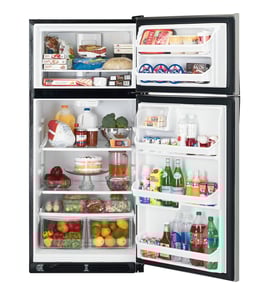




What are the disadvantages of a top mount fridge?
A top-mount refrigerator like the Frigidaire FFHT1826LW0 puts the freezer at eye level and the fresh-food section lower, so daily fridge access usually means more bending. Top-mount designs also tend to offer fewer convenience features than many bottom-freezer styles.
Common disadvantages (what most owners notice)
- More bending for fresh food: the refrigerator compartment is below the freezer.
- Less “grab-and-go” organization: fewer wide pull-out drawers and fewer door-in-door style options.
- Fewer built-in features: many top-mount models skip external water and ice dispensing.
- Freezer-first layout: if you use fresh food more than frozen, the layout can feel backwards.
- Narrower shelf access: some items are harder to see and reach in the lower section.
What to check on your FFHT1826LW0 to reduce the downsides
We recommend using the setup and adjustment steps in the FFHT1826LW0 installation guide to make the layout feel better day-to-day.
- Level the cabinet so doors close consistently and shelves sit square.
- Confirm door seals close fully on all sides.
- Set fresh food and freezer controls, then wait 24 hours before changing again.
- Adjust crisper humidity controls for produce storage.
Quick comparison: top-mount vs bottom-freezer
| Feature | Top-mount (like FFHT1826LW0) | Bottom-freezer |
|---|---|---|
| Fresh-food access | Lower, more bending | Higher, easier access |
| Freezer access | Higher, easier access | Lower, more bending |
| Typical features | Simpler, fewer add-ons | Often more feature-rich |
| Organization style | More basic bins/shelves | More drawers and pull-outs |
Why it matters
Layout affects how often the doors stay open and how easily you can keep food organized. Better organization and proper leveling can help temperatures stay steadier and reduce wasted energy.
Last updated: January 2026
Are top mount or bottom mount fridges better?
Top-mount and bottom-mount refrigerators are both good choices; the better option depends on how you use your Frigidaire FFHT1826LW0 and what matters most (ergonomics, freezer access, and energy use). In many homes, top-mount models win on efficiency and simplicity, while bottom-mount models win on everyday fresh-food convenience.
Quick comparison (what most shoppers notice)
| Feature | Top-mount refrigerator (freezer on top) | Bottom-mount refrigerator (freezer on bottom) |
|---|---|---|
| Fresh-food access | You bend more for fridge shelves and crispers | Fridge items sit closer to eye level |
| Freezer access | Easiest access to frozen foods | More bending for freezer drawers |
| Energy use (typical) | Often lower due to simpler airflow and design | Often slightly higher depending on features |
| Repairs and parts | Typically fewer complex components | More designs include drawers, rails, and added features |
When a top-mount is the better fit
- You want a straightforward refrigerator with fewer “extras” to maintain.
- You use the freezer often and want it at a comfortable height.
- You prefer a design that is commonly more energy-efficient.
- You want easier door removal and leveling steps to stay simple during installation.
For model-specific setup details like leveling, clearances, and door sealing checks, follow the FFHT1826LW0 installation guide.
When a bottom-mount is the better fit
- You use fresh-food items (milk, produce, leftovers) more than frozen foods.
- You want less bending for the refrigerator compartment.
- You like wide refrigerator shelves at eye level for meal prep and organization.
Why it matters (comfort, food quality, and operating cost)
Choosing the layout that matches your habits helps you keep doors open for less time, maintain steadier temperatures, and reduce strain on your back and knees. For a top-mount like the FFHT1826LW0, good door sealing and proper leveling also help prevent warm air leaks that can increase run time.
Practical tip for top-mount owners
If you are sticking with a top-mount layout, we recommend:
- Keep frequently used items on the middle shelves.
- Use crispers for produce to reduce moisture loss.
- Confirm the cabinet is level and the doors seal on all sides after moving the unit.
Last updated: January 2026
What is the upper part of a fridge called?
On the Frigidaire FFHT1826LW0 top-mount refrigerator, the upper compartment is the freezer. It’s the section designed to keep foods frozen, and it often houses the ice maker (if your model is equipped) and freezer temperature control.
What the freezer does
The freezer compartment is built to maintain temperatures cold enough for long-term storage.
- Freezes and stores food safely for longer periods
- Helps chill the fresh food section by supporting overall cooling performance
- May include an ice maker and signal arm (on equipped models)
- Works with the refrigerator’s airflow system to distribute cold air
Common names you may see
Different documents and parts diagrams can use slightly different terms.
| What you call it | What it usually means | Where you’ll see it |
|---|---|---|
| Freezer | Upper frozen-food compartment | Owner’s manual, labels |
| Freezer compartment | Same as freezer | Manuals and guides |
| Freezer section | Same as freezer | General troubleshooting |
Tips for using the freezer efficiently
These basics help prevent temperature swings and frost issues.
- Keep the freezer door closed as much as possible
- Avoid blocking vents with boxes or bags
- Set controls and then wait 24 hours before making more adjustments
- Confirm the freezer door seals tightly on all sides
- If an ice maker is installed, keep it OFF until the water supply is connected and leak-free
Why it matters
Knowing the correct name helps when you’re reading troubleshooting steps, adjusting controls, or ordering parts for the right compartment. For model-specific operating details (controls, door removal, normal sounds), use the FFHT1826LW0 installation guide.
Last updated: January 2026
What is the most common problem with a Frigidaire refrigerator?
Cooling problems are the most common issue we see with Frigidaire refrigerators, including the Frigidaire FFHT1826LW0. Typical symptoms are warm fresh food, soft ice, or temperature swings; the most frequent causes are restricted airflow, dirty coils, a weak evaporator fan, or a door that is not sealing tightly.
Quick checks that fix many “not cooling” complaints
- Confirm the controls are set correctly; after changing settings, wait 24 hours before making more adjustments (a normal range is often 3 to 5 on models with an LED display). See the FFHT1826LW0 installation guide.
- Make sure the door seals completely to the cabinet on all sides.
- Verify the refrigerator is level side-to-side and tilted about 1/4 inch (6 mm) front-to-back.
- Avoid overpacking; blocked vents reduce airflow between the freezer and fresh food section.
- Clean condenser coils (usually underneath or behind); dust buildup is a top cause of poor cooling.
Most common causes and what you’ll notice
| What’s happening | What you’ll notice | Common next step |
|---|---|---|
| Airflow restricted | Warm fridge, freezer OK or frosty back wall | Clear vents, reduce load, check for frost buildup |
| Door not sealing | Moisture, frost, longer run times | Inspect gasket, clean sealing surfaces |
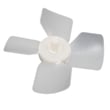
| Evaporator fan issue | Warm fridge, weak airflow, unusual fan noise | Inspect fan area; consider fan motor/blade |
| Defrost system issue | Heavy frost on freezer back panel | Check heater and defrost thermostat |
Parts that often relate to cooling symptoms (model FFHT1826LW0)
If you find frost buildup or weak airflow, these model-matched parts are commonly involved:
- Refrigerator evaporator fan motor 241854301
- Refrigerator evaporator fan blade 5308000010
- Refrigerator defrost heater 242044008
- Refrigerator defrost bi-metal thermostat 5303918202
Why it matters
A refrigerator that cannot move air correctly or cannot seal tightly runs longer, wastes energy, and struggles to hold safe food temperatures. Leveling and door sealing checks are fast, no-parts steps that prevent many repeat cooling problems.
Related help
If your Frigidaire has a display or is showing a fault, use our Frigidaire refrigerator error codes reference to narrow the problem to cooling, defrost, or sensor issues.
Last updated: January 2026