Owner’s manual
 Error Codes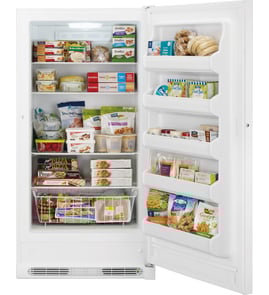




Is there a reset button on a Kenmore upright freezer?
Kenmore upright freezers like model 2539200182 typically do not have a dedicated “reset” button. The practical reset is to cycle power (unplug, wait, then plug back in) and then re-set the cold control to your normal setting; follow the steps in the owner's manual.
How to reset the freezer safely (power cycle)
- Turn the cold control to OFF (or the warmest setting if your control has no OFF).
- Unplug the freezer by gripping the plug (do not pull the cord).
- Wait 5 minutes to let the control and compressor fully stop.
- Plug the freezer back into its own grounded 3-prong outlet.
- Set the cold control back to your normal number (higher number = colder).
- Allow about 4 hours to cool thoroughly before adding unfrozen food.
If you are trying to reset after a “no power” or “alarm” situation
This model uses a power signal light to show power to the freezer. If the light is out, check these common causes first:
- Household power failure or tripped breaker
- Loose or disconnected power cord
- Failed signal light/bulb
- Outlet controlled by a wall switch (avoid using one)
Quick check table
| What you see | Most likely cause | What to do |
|---|---|---|
| Freezer warm, light off | No power to unit | Check outlet and breaker, then power cycle |
| Light off, freezer seems to run | Signal light failed | Follow manual steps for light replacement |
| Runs constantly, temps high | Door not sealing or frequent openings | Inspect door seal, level cabinet, limit openings |
Why it matters
A true “reset” is mainly about restoring stable power and correct temperature control. Power cycling also protects the compressor from rapid restarts, which can cause clicking and poor cooling.
Last updated: February 2026
What is the average lifespan of an upright freezer?
Most upright freezers last 10 to 15 years. With steady indoor use, good airflow around the cabinet, and basic upkeep (cleaning, correct temperature setting, and a tight door seal), many units can reach 15 to 20 years of service.
Typical lifespan ranges
| Upright freezer condition | What we typically see | What helps most |
|---|---|---|
| Average household use | 10 to 15 years | Stable room temperature, clean condenser area |
| Well maintained, indoor location | 15 to 20 years | Good door seal, fewer long door openings |
| Harsh conditions (hot garage, dusty area) | 7 to 12 years | Better ventilation, less heat exposure |
What shortens (or extends) lifespan
We see the biggest lifespan swings come from heat, humidity, and how hard the sealed system has to work.
- Hot room or garage placement makes the compressor run longer.
- Frequent or long door openings add moisture and raise internal temperature.
- Door not sealing (gasket issues or cabinet not level) increases run time and frost.
- Warm food loads force longer recovery cycles.
- Poor airflow around the freezer traps heat and stresses components.
Maintenance habits that pay off
These steps match the operating guidance for the Kenmore 2539200182 and help reduce wear.
- Set the cold control only as cold as needed (higher number means colder).
- Keep packages from blocking the door so it closes tightly.
- Limit door openings in high humidity to reduce frost buildup.
- Keep the freezer in a cool, dry place and away from heat sources.
- For long storage or downtime: unplug, defrost, clean, dry, and block the door open to prevent odors.
Why it matters
A freezer that runs longer than normal (because of heat, air leaks, or heavy loading) puts extra hours on the compressor and sealed refrigeration system. Reducing run time is the simplest way to protect long-term reliability.
For model-specific operating tips and care details, use the owner's manual.
Last updated: February 2026
Where is the model number on a Kenmore upright freezer?
On Kenmore upright freezer model 2539200182, the model and serial number label is located inside the freezer on the upper left side wall. This is the quickest place to check when you need parts, service information, or the correct manual.
Where to look first (fastest check)
- Open the freezer door and look along the upper left interior side wall
- Look for a rating label with both model and serial numbers
- Use a flashlight; labels can be hard to read in low light
- Write the numbers down exactly as shown (including any dots or dashes)
Other common label locations (if the label is missing or covered)
If you do not see it on the upper left interior wall, upright freezers often place the label in one of these spots:
- On an inside side wall near the front opening
- On the ceiling of the freezer compartment
- Behind the kick plate (lower front grille area)
- On the back exterior panel
Why the model number matters
The model number ensures we match the correct Kenmore upright freezer parts and diagrams. Even small model changes can affect fit for items like wiring, panels, or door hardware.
What you should record
| What to record | Why it helps |
|---|---|
| Model number | Identifies the exact freezer version for parts lookup |
| Serial number | Helps confirm production run details for service and compatibility |
| Purchase date (if known) | Useful for maintenance history and planning repairs |
For additional identification details and safety information, use the owner's manual.
Last updated: February 2026
What causes an upright freezer to stop freezing?
An upright freezer like Kenmore model 2539200182 usually stops freezing because it is not getting steady power, the cold control is set incorrectly, the door is not sealing, or airflow is restricted by warm food loads or frequent door openings. Use the checks in the owner's manual first.
Quick checks we recommend first
- Confirm the freezer has power (interior light or power signal light behavior can help).
- Verify the cold control setting; higher numbers make it colder.
- Make sure packages are not preventing the door from closing tightly.
- Reduce door openings, especially in high humidity.
- Avoid loading too much unfrozen food at once (limit about 3 lb per cubic foot until the first load freezes).
- Keep the freezer in a cool, dry location and away from heat sources.
Cold control and loading: what “normal” looks like
The manual guidance for this model is:
| Item | What to do | What to expect |
|---|---|---|
| Initial cool down | Set cold control to #1 | Allow about 4 hours before adding food |
| Fine tuning | Adjust after a few days | Ice cream should be firm (too soft = colder; too hard = warmer) |
| Warm food load | Add in stages | Heavy warm loads can temporarily raise temps |
When it points to a part or sealed-system issue
If the cold control is set correctly, the door seals well, and airflow is not blocked but temperatures keep rising, the problem is often in the refrigeration system or electrical start components.
Common suspects include:
- Compressor start components (relay or run capacitor)
- Cold control (thermostat) not calling for cooling
- Frost or airflow restriction from door leaks or frequent openings
- Wiring problems (inspect connectors and harness routing)
If you are testing electrical parts, use safe meter practices; our how to use a multimeter to test electrical parts video is a good starting point.
Why it matters
A freezer that is not freezing can thaw food quickly and can also run longer than normal, which increases wear on components like the compressor and electrical start parts. Catching door-seal and control-setting issues early prevents bigger failures.
Last updated: February 2026
How many cubic feet is a Kenmore freezer model 2539200182?
The exact cubic-foot capacity for Kenmore upright freezer model 2539200182 is listed in the product specifications in the 2539200182 owner's manual. Use that spec when planning food storage and when following the manual’s loading guidance based on “per cubic foot.”
How to find the capacity in the manual
- Open the 2539200182 owner's manual and look for a Specifications section
- Scan for terms like “capacity,” “cu. ft.,” or “cubic feet”
- If the manual lists multiple versions, match your unit using the complete model number on the rating label
- Use the capacity number to follow the manual’s freezing guidance (it references pounds of unfrozen food per cubic foot)
Where to find the model label on the freezer
The manual indicates the model and serial information is located inside the freezer, commonly on the upper left interior side.
Why cubic feet matters
Capacity affects how much unfrozen food you can add at one time, how quickly the freezer pulls down to temperature, and how you organize airflow around shelves and packages.
Typical upright freezer capacity ranges (for planning)
| Upright freezer size class | Typical capacity (cu. ft.) | Common use |
|---|---|---|
| Compact | 3 to 6 | Small spaces, overflow |
| Mid-size | 7 to 14 | Smaller households |
| Full-size | 15 to 21 | Most households |
| Extra-large | 22+ | Bulk storage |
Last updated: February 2026