Installation guide
 Owner’s manual
 Error Codes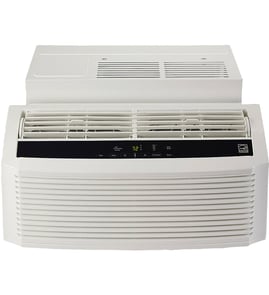



What are the most common issues with 25370062011?
The most common issues we see with the Kenmore 25370062011 room air conditioner are poor cooling, water leaking or not draining, unusual noise or vibration, and power or control problems. Many of these come down to airflow restrictions, drainage setup, or electrical supply issues outlined in the owner's manual.
- Not cooling well: Dirty air filter, blocked front grille, iced evaporator coil from restricted airflow, or incorrect mode/temperature setting.
- Unit runs but room stays warm: Undersized unit for the space, hot air recirculating, or condenser airflow blocked at the rear.
- Water leaking indoors: Unit not tilted slightly outward, clogged drain path, or a mis-seated chassis in the sleeve/window kit.
- No power or intermittent operation: Tripped breaker, loose plug, bad outlet, or a control board/thermostat issue.
- Rattling, buzzing, or vibration: Loose mounting hardware, fan blade rubbing, or debris in the blower wheel.
- Icing on the front or coil: Low airflow (filter/coil) or running in cool outdoor conditions.
- Confirm the unit is on Cool mode and set at least 5 degrees below room temperature.
- Clean or replace the air filter; verify the front intake is not blocked.
- Make sure the unit has proper rear clearance for condenser airflow.
- Verify the unit is installed with a slight outward tilt so condensate drains outside.
- Reset power: unplug for 1 minute (or switch breaker off/on), then restart.
- If icing occurs, run Fan Only until fully thawed, then address airflow.
| Symptom | More likely maintenance | More likely repair needed |
|---|---|---|
| Weak cooling | Filter/airflow issue | Sealed system or compressor problem |
| Leaking inside | Tilt/drain path issue | Cracked pan or internal drain issue |
| Won’t turn on | Breaker/outlet issue | Control, cord, or internal wiring issue |
Airflow and drainage problems can quickly lead to icing, water damage, and higher energy use. Catching a clogged filter or poor installation angle early prevents repeat failures and protects the compressor.
For installation-related causes (tilt, bracket, sleeve fit), follow the installation guide for the correct mounting and drainage setup.
Last updated: March 2026
What is the average lifespan of 25370062011?
A Kenmore room air conditioner like model 25370062011 typically lasts 10 years with normal seasonal use and basic maintenance (clean filter, clear airflow, and proper storage). Heavy run time, poor airflow, and dirty coils shorten life; good care extends it.
Most room air conditioners fall into a predictable range based on use and upkeep:
- Typical lifespan: 10 years
- Shorter lifespan drivers: clogged filter, restricted vents, dirty coils, low airflow
- Longer lifespan drivers: regular cleaning, correct window installation, stable power supply
- High-stress conditions: extreme heat, continuous operation, salty coastal air
- Storage impact: off-season storage in a dry area reduces corrosion
Use this as a practical baseline for the 25370062011.
| Task | How often | Why it helps |
|---|---|---|
| Clean or replace air filter | Every 2 to 4 weeks in season | Prevents icing, improves airflow and efficiency |
| Clean evaporator and condenser coils | 1 to 2 times per season | Reduces strain on the compressor |
| Clear the outdoor side (rear) airflow | Monthly | Prevents overheating and short cycling |
| Verify unit tilt and drainage | At installation and mid-season | Prevents water leaks and corrosion |
For model-specific care notes and cleaning guidance, follow the owner's manual.
These symptoms often show up as the sealed system and fan components wear:
- Cooling is weak even with a clean filter and clear airflow
- Unit ices up repeatedly
- Compressor cycles rapidly (short cycling)
- Fan motor is noisy or the fan speed surges
- Higher electric bills for the same comfort level
Knowing the expected 10-year lifespan helps you decide whether to repair a fan, control, or electrical issue versus planning a replacement, especially if performance problems are frequent.
Last updated: March 2026
What size room will a 2.7 kW air conditioner cool?
A 2.7 kW room air conditioner is roughly comparable to about 9,000 BTU/h cooling capacity, which typically cools about 300 to 400 sq. ft. in an average room. For your Kenmore 25370062011, the best match still depends on sun exposure, insulation, and ceiling height; use the sizing guidance in the 25370062011 owner’s manual.
Use this as a practical starting point for a window or room air conditioner:
- 250 to 300 sq. ft.: works well for shaded rooms, good insulation, 8 ft ceilings
- 300 to 400 sq. ft.: typical target range for 2.7 kW in average conditions
- 400+ sq. ft.: often needs a higher-capacity unit, especially with sun or open floor plans
- Add capacity if the room has west-facing sun, high ceilings, or many occupants
- Reduce expectations if doors are open to other rooms (cool air spreads out)
The Kenmore 25370062011 manual emphasizes that capacity must fit the room size for efficient, satisfactory operation. These common factors explain why two “same size” rooms can cool very differently:
| Room condition | What happens | What to do |
|---|---|---|
| Strong sun exposure | Heat load rises fast | Close blinds during peak sun; choose a higher capacity if needed |
| Poor insulation or air leaks | Cool air escapes; warm air enters | Weather-strip; close fireplace damper and registers |
| Heat sources (cooking, electronics) | Extra heat offsets cooling | Limit heat-producing appliances during hottest hours |
| Blocked airflow | Unit cannot circulate air | Keep furniture, drapes, and blinds clear of the front |
If the 2.7 kW unit is too small for the space, you will usually see one or more of these:
- Runs almost constantly but the room stays warm
- Cools near the unit but not across the room
- Filter loads up quickly due to heavy runtime
- Comfort improves only at night (lower outdoor heat load)
Correct sizing helps the air conditioner cool evenly, control humidity better, and avoid excessive runtime. The manual also notes that newer, higher-efficiency units may run longer while still using less total energy, so runtime alone is not always a problem.
Last updated: January 2026