Error Codes



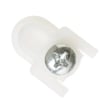
How to remove bottom grille on GE refrigerator?
On the GE GNE25JYKFFFS bottom-mount refrigerator, the bottom grille (base grille/toe grille) is typically held in place by a couple of screws and/or retaining tabs. We remove it by taking out the screws first, then pulling the grille straight out to release the tabs.
Steps to remove the bottom grille
- Unplug the refrigerator (or switch off power at the breaker) for safety.
- Open both fresh food doors so you have room to work.
- Look along the top edge of the grille for screws.
- Remove the screws with a Phillips screwdriver.
- Pull the grille forward evenly from both sides to release any retaining clips.
- If it feels stuck, gently flex the grille near the ends while pulling forward (do not pry hard against painted metal).
What to check if it will not come off
- Confirm all visible screws are removed.
- Check for hidden tabs near the corners that need a straight-out pull.
- Make sure the grille is not caught under the cabinet edge.
- If the refrigerator is sitting low, raise the front leveling legs slightly to create clearance.
- If the grille is warped, pull from the center first, then work outward.
Quick reference
| What you see | What it usually means | What to do |
|---|---|---|
| 2 screws across the top | Screw-mounted grille | Remove screws, then pull straight out |
| No screws visible | Clip-in grille | Pull straight out at both ends |
| Grille hits the floor | Low leveling legs | Raise front leveling legs slightly |
Why it matters
We often remove the bottom grille to clean condenser coils, inspect the condenser fan area, or access lower components. Removing it correctly helps prevent broken tabs and keeps airflow through the machine compartment unobstructed.
For related GE refrigerator troubleshooting content, see GE refrigerator error codes.
Last updated: January 2026
What are the advantages of bottom-mount refrigerators?
A bottom-mount refrigerator like the GE GNE25JYKFFFS keeps fresh-food shelves higher up, so we reach everyday items with less bending. The freezer stays in a pull-out drawer below, which can make frozen storage easier to organize and access.
Key advantages you’ll notice day to day
- Fresh food at eye level: easier access to produce, drinks, and leftovers.
- Less bending: fewer trips down low for the most-used compartment.
- Freezer drawer organization: baskets and dividers help separate items.
- Wide refrigerator section: often better visibility across shelves and bins.
- Convenient upgrades: many bottom-mount models support features like filtered water and ice.
Trade-offs to consider
Bottom-mount designs are a great fit for many kitchens, but there are a few common considerations:
- You may bend more often for frozen foods.
- Freezer drawers can feel heavier when fully loaded.
- Door swing and drawer clearance matter in tight spaces.
Quick comparison
| Feature | Bottom-mount (like GNE25JYKFFFS) | Top-freezer |
|---|---|---|
| Most-used items | Fresh food | Frozen food |
| Bending frequency | Usually less | Usually more |
| Freezer access | Pull-out drawer | Swing door + shelves |
| Organization style | Baskets/dividers | Shelves/door bins |
Why it matters
Choosing a bottom-mount refrigerator is mostly about ergonomics and habits. If we use the refrigerator section far more than the freezer, keeping fresh food higher can make daily cooking and snacking more comfortable.
Helpful next steps
- For general care and efficiency tips, see how to use your refrigerator efficiently.
Last updated: January 2026
What is the most common problem with a GE refrigerator?
The most common problems we see on GE refrigerators like model GNE25JYKFFFS are cooling complaints (fresh food section warm, freezer not holding temp) and ice maker or water dispenser issues. Many cases trace back to airflow restrictions, fan problems, temperature sensing, or water supply components such as the GE refrigerator water filter XWFE.
Most common symptoms (and what they usually point to)
- Fridge warm, freezer OK: restricted airflow, evaporator fan issue, or a stuck air damper
- Both sections warm: dirty condenser area, condenser fan problem, or sealed system/compressor issue
- Ice maker slow or no ice: clogged filter, low water pressure, frozen fill path, or inlet valve issue
- Water dispenser weak: filter restriction, air in the line, or inlet valve problem
- Temps swing up and down: temperature sensor (thermistor) or control board logic issues
Quick checks we recommend first (DIY-friendly)
- Confirm temperature settings; allow 24 hours after changes.
- Make sure vents inside the refrigerator are not blocked by food.
- Clean dust from the condenser area (unplug first).
- Check door sealing and closing; a poor seal can cause long run times and warm temps.
- If water or ice is affected, replace the filter and purge air from the dispenser.
Parts that commonly relate to these problems on GNE25JYKFFFS
| Problem area | What fails most often | Example compatible part for this model |
|---|---|---|
| Temperature sensing | Thermistor reads wrong temp | GE profile refrigerator temperature sensor WR55X10025 |
| Airflow and heat removal | Condenser fan not moving air | Refrigerator condenser fan WR60X10209 |
| Water and ice supply | Valve not opening fully or leaking | Refrigerator water inlet valve WR57X30890 |
Why it matters
Cooling and ice maker problems can look “random,” but they usually come from a few core systems: airflow, temperature feedback, and water supply. Starting with simple checks helps you avoid replacing parts that are still good.
Last updated: January 2026
Where is my drain pan on my GE refrigerator?
On the GE GNE25JYKFFFS bottom-mount refrigerator, the drain pan is typically located at the bottom rear of the cabinet near the compressor area, where warm air helps evaporate defrost water. On many newer GE designs, the pan is not intended to be removed for routine cleaning.
How to locate it safely on model GNE25JYKFFFS
- Unplug the refrigerator.
- Pull the unit straight out a few inches (protect the floor).
- Look at the lower back area near the compressor and condenser fan; the drain pan is usually positioned underneath the drain outlet.
What to watch for:
- A shallow plastic pan sitting on rails or a bracket
- A pan tucked above the compressor cover area
- Limited access because the pan is designed to stay in place
When you should (and should not) try to remove the pan
On this model, we cannot confirm from model-specific documentation whether the drain pan is removable; GE commonly uses fixed pans on modern bottom-mount units.
- OK to do: inspect with a flashlight, vacuum dust, wipe what you can reach
- Avoid: forcing panels or bending refrigerant lines
- Best practice: if odor or heavy buildup is present and access is tight, have a technician handle deeper disassembly
If you have water under the refrigerator
Water on the floor is often caused by a clogged defrost drain, not the drain pan itself. If the drain is restricted, water can overflow inside and leak out.
Common checks:
- Clear ice or debris at the freezer drain opening
- Flush the drain with warm water (small amounts)
- Inspect the drain tube for kinks or blockage
If you suspect a drain restriction, the compatible drain components for this model include the refrigerator drain tube WR02X11426 and the drain trough assembly WR17X24814.
Quick symptom guide
| Symptom | Most likely area | Typical next step |
|---|---|---|
| Musty odor near back | Drain pan area | Clean what’s reachable; improve airflow |
| Water under crisper/freezer | Defrost drain path | Clear drain opening and tube |
| Water on floor front | Drain overflow or door seal issue | Check drain first, then door gaskets |
Why it matters
The drain pan is part of the defrost water management system. Keeping the drain path clear helps prevent leaks, odors, and ice buildup that can affect cooling performance.
Last updated: January 2026