Error Codes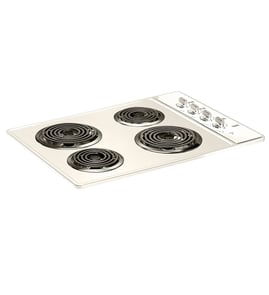



Can you replace the glass top on a GE stove?
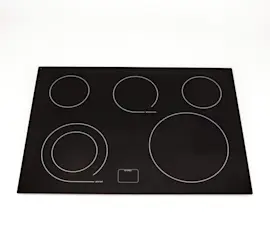
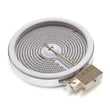
Yes. On a GE glass cooktop or radiant electric cooktop like model JP360BV1BB, the glass cooktop surface can be replaced as an assembly; the job is very doable if you work carefully, shut off power at the breaker, and transfer the heating elements and mounting hardware to the new glass.
What you need before you start
- Correct replacement glass for your exact model (JP360BV1BB)
- Phillips and flat screwdriver, nut driver
- Painter’s tape and a towel/blanket to protect the counter
- Work gloves (glass edges can be sharp)
- A helper (the glass can be awkward to handle)
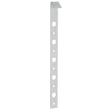
A common related part during a glass-top replacement is the hold-down hardware, such as the brkt hold dn WB2K5328.
Basic replacement steps (high level)
- Turn off power at the breaker (cooktops are typically 240V).
- Remove knobs and access the underside (lift out if it is a drop-in, or open access from below if installed over a cabinet).
- Label and disconnect element wires as needed.
- Remove mounting brackets/clips and lift off the damaged glass.
- Move elements and brackets to the new glass, then reinstall and reconnect wiring.
- Restore power and test each element on low, then medium.
Troubleshooting after replacement
If the new glass is installed but a burner will not heat, these are the most common causes:
- Loose or miswired element connection
- Failed surface element (often discovered during the repair)
- Failed infinite switch/control
- Pinched wire harness under the cooktop
| Symptom | Most likely check first | Example part for JP360BV1BB |
|---|---|---|
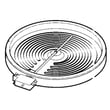
| One burner dead | Element wiring and element | Halogen element WB30T10099 |
| Burner stuck on high | Infinite switch/control | Control element WB23M8 |
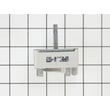
| Dual burner not switching | Selector switch | Selector switch WB24X449 |
Why it matters
A cracked glass top can worsen quickly from heat and cookware weight. Replacing the glass restores safe, stable cookware support and helps protect the radiant elements and wiring underneath.
Last updated: February 2026
Is GE cooktop good?
Yes. GE electric cooktops like model JP360BV1BB are a solid, dependable choice for everyday cooking, with good heat control and widely available replacement parts. Overall quality depends most on correct installation, cookware fit, and keeping the glass surface and controls in good condition.
What “good” means for a radiant GE cooktop
A 30-inch radiant cooktop is usually considered “good” when it delivers consistent heating, responsive control knobs, and long-term serviceability.
- Heats evenly without cycling too aggressively on medium settings
- Controls adjust smoothly (no dead spots or sudden jumps)
- Surface stays easy to clean without permanent haze or scratches
- Indicator lights work correctly so you know when the top is hot
- Common wear parts are replaceable without replacing the whole cooktop
What to check if performance seems off
If a burner won’t heat, overheats, or won’t regulate, the most common causes are the surface element or the control switch.
| Symptom | Most common cause | Example part for JP360BV1BB |
|---|---|---|
| Burner does not heat | Failed radiant/halogen element | Halogen element WB30T10099 |
| Burner stuck on high or won’t regulate | Worn element control switch | Cooktop element control switch, 3,000-watt WB24X29364 |
| Hot surface light not working | Failed indicator light | Indicator light WB25K5029 |
Why it matters
A “good” cooktop is one you can keep safe and consistent over time. With a radiant glass cooktop, small issues like a weak switch or failing element can turn into uneven cooking, nuisance cycling, or overheating, so replacing the right part early protects the glass top and improves day-to-day results.
Last updated: February 2026
Is there a glass cooktop that doesn't scratch?
No. Every glass-ceramic surface on a GE JP360BV1BB radiant cooktop can scratch if cookware is dragged, grit is trapped under a pan, or spills are heated onto the surface. Some premium glass-ceramic materials are more scratch-resistant, but “scratch-proof” cooktops do not exist in normal kitchen use.
What actually causes scratches (and how to prevent them)
- Lift pans; do not slide them, especially cast iron.
- Wipe the cooktop before cooking to remove sand, salt, and sugar crystals.
- Keep pan bottoms clean and dry; stuck-on grease acts like abrasive.
- Avoid cookware with rough or warped bottoms.
- Clean spills quickly once the surface is cool enough to work safely.
Best cleaning approach for daily use
For JP360BV1BB, the safest routine is a non-abrasive cleaner plus a scraper for cooked-on residue.
- Use a cooktop cleaner made for glass-ceramic surfaces: glass clnr PM10X310.
- For stuck-on food, use a razor scraper designed for cooktops: rzr bld scrp WX10X302.
- Use a soft paper towel or microfiber cloth; avoid scouring pads and powdered abrasives.
| Situation | What to use | What to avoid |
|---|---|---|
| Light haze, fingerprints | Cooktop cleaner + soft cloth | Abrasive pads, gritty cleaners |
| Burned-on spots | Scraper at a low angle + cleaner | Metal spatulas, knives |
| Sugar melt, plastic | Scrape carefully as soon as safe | Letting it re-harden and reheat |
When scratches are “normal” vs. a part problem
Most scratches are cosmetic and do not mean the heating element is failing. Replace parts when you see functional issues such as a burner not heating, cycling erratically, or a control that will not regulate heat.
Common related parts for heating performance (not scratch repair):
- Halogen element WB30T10099
- Control element WB23M8
- Cooktop element control switch, 3,000-watt WB24X29364
Why it matters
Scratches and baked-on residue can create hot spots, make cleaning harder, and increase the chance of permanent discoloration. Using the right cleaner and scraper helps protect the glass and keeps radiant elements heating evenly.
Last updated: February 2026
Should I get a 30 or 36 inch cooktop?
For a GE JP360BV1BB, you are already in the 30-inch cooktop size; a 36-inch cooktop is the better pick only if you regularly need more burner spacing and larger pan capacity. Most kitchens choose 30-inch for easier fit and more counter space.
Quick decision guide
- Choose 30-inch if you want the simplest replacement fit, more counter space, and you typically cook with 1 to 3 pans at a time.
- Choose 36-inch if you often run 3 to 5 pans at once, use oversized cookware (griddles, stockpots), or want more space between hot pans.
- If you are replacing an existing cutout, match the cutout size first; countertop modifications usually cost more than the cooktop.
- If you are upgrading for performance, compare element sizes and wattage, not just overall width.
- If your current cooktop has heating issues, a repair (element or switch) can restore performance without changing sizes.
Fit and installation: what usually changes
Even though cooktops are labeled 30-inch or 36-inch, the countertop cutout and cabinet clearance are what decide whether the swap is easy.
| What you compare | 30-inch cooktop (typical) | 36-inch cooktop (typical) |
|---|---|---|
| Counter space impact | Leaves more usable counter | Reduces counter space |
| Pan spacing | Tighter | More room between pans |
| Replacement difficulty | Often easiest | Often requires cutout changes |
| Electrical needs | Often similar, sometimes lower | Often similar, sometimes higher |
Why it matters
Cooktop width affects daily usability (pan crowding, heat exposure to nearby handles) and the total project cost. A 36-inch unit can feel like a big upgrade, but only if your cooking style actually uses the extra space.
When repairing your JP360BV1BB makes more sense
If your main reason for considering a different size is poor heating or inconsistent control, check the common failure parts first:
- A burner not heating or cycling oddly can point to a failed radiant element like the halogen element WB30T10099.
- A burner that only works on high, will not turn off, or has dead settings often points to a bad infinite switch such as the cooktop element control switch, 3,000-watt WB24X29364.
- If the surface stays hot but the indicator is wrong, the hot surface light circuit can be involved (model-specific diagnosis varies).
Last updated: February 2026
What are the four basic types of electric cooktops?
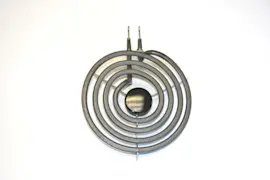
Electric cooktops are commonly grouped into four types based on how they create heat: coil (exposed element), radiant smooth-top (glass-ceramic), halogen radiant (a faster radiant variant), and induction (magnetic heating). Your GE JP360BV1BB is a radiant-style electric cooktop.
Quick breakdown of the 4 types
- Coil (exposed element): Metal coil sits above the surface; durable and budget-friendly.
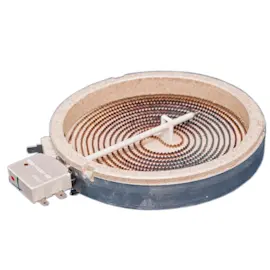
- Radiant smooth-top: Heating element sits under a glass-ceramic top; heats cookware by radiant heat.
- Halogen radiant: Uses halogen lamps under glass; typically responds faster than standard radiant.
- Induction: Uses electromagnetic energy to heat the pan directly; requires induction-compatible cookware.
How they compare (what you will notice day to day)
| Type | Cookware requirement | Speed/response | Surface style | Typical pros | Typical tradeoffs |
|---|---|---|---|---|---|
| Coil | Any flat-bottom pan | Medium | Exposed coil | Simple, easy to service | Harder to wipe clean |
| Radiant smooth-top | Flat-bottom recommended | Medium | Smooth glass | Easy to clean, common | Glass can scratch, slower cool-down |
| Halogen radiant | Flat-bottom recommended | Medium-fast | Smooth glass | Faster heat-up than standard radiant | Still heats the glass surface |
| Induction | Magnetic (a magnet sticks) | Fast | Smooth glass | Very responsive, efficient | Cookware compatibility, higher cost |
Why it matters
Knowing the cooktop type helps you choose the right cookware, set expectations for heat-up and cool-down time, and troubleshoot symptoms. For example, a radiant or halogen smooth-top can look “off” while still being hot, so indicator lights and safe handling are important.
Related parts you might see on this model
If you are identifying what style you have or diagnosing a heating issue on JP360BV1BB, these parts are commonly involved:
- Halogen element WB30T10099 (surface heating element)
- Control element WB24X29364 (infinite switch that regulates heat)
- Indicator light WB25K5029 (hot surface/on indicator)
Last updated: February 2026
What is the error code F153 on a GE Profile cooktop?
On the GE JP360BV1BB radiant cooktop, error code F153 points to a problem in the burner temperature-sensing circuit, most commonly an open sensor circuit associated with that surface element. In practice, the fix is usually replacing the affected radiant element or the related control switch.
What F153 usually means
F153 is typically triggered when the cooktop’s control cannot read the expected temperature feedback for a specific burner.
Common causes include:
- A failed radiant element with an open sensor circuit
- A loose, burned, or broken wire connection at the element or harness
- A failed infinite switch (surface element control)
- Heat damage or corrosion at terminals/connectors
Quick checks we recommend (power off)
Turn off the breaker before touching wiring; cooktops use high voltage.
- Reset power: turn the breaker off for 1 minute, then back on
- Identify which burner triggers the code (note the knob position and element)
- Inspect wiring to that element for discoloration, melted insulation, or loose spade terminals
- Check the element terminals for cracks, arcing marks, or looseness
- If you have a meter, use how to use a multimeter to test electrical parts video to check for an open circuit on the suspect element and verify wiring continuity
Parts that commonly solve F153 on this model
If the code consistently follows one burner, the radiant element or its control is the most likely repair.
| Symptom pattern | Most likely cause | Example part for JP360BV1BB |
|---|---|---|
| F153 appears only when one burner is used | Failed radiant element/sensor circuit | Halogen element WB30T10099 |
| Burner heat is erratic, cuts in and out, or won’t regulate | Failed infinite switch | Control element WB23M8 or cooktop element control switch, 3,000-watt WB24X29364 |
Why it matters
An open sensor circuit can make the cooktop mismanage heat on that burner (no heat, runaway cycling, or shutdown). Fixing the root cause helps restore normal temperature control and prevents repeated fault codes.
Last updated: February 2026
Which brand of electric cooktop is best?
The best electric cooktop brand is the one that matches your cooking style, service expectations, and budget. For a GE cooktop like model JP360BV1BB, GE is a strong “best overall” choice when you want widely available parts and straightforward radiant performance; premium brands often add power, precision, and design upgrades.
How we recommend choosing a “best” brand
Focus on the features that change day-to-day cooking results and long-term ownership:
- Cooking technology: radiant electric (glass top) vs. induction
- Power and control: fast boil, low simmer stability, dual/expandable elements
- Reliability and parts access: availability of elements, switches, indicator lights, glass top
- Service network: local technician familiarity and support
- Fit and finish: knob feel, layout, glass durability, trim style
Brand comparison (quick guide)
| What you prioritize | Brands that commonly fit | What to watch for |
|---|---|---|
| Best value and easy ownership | GE, Whirlpool, Frigidaire | Fewer premium features, simpler controls |
| Feature-rich mainstream | GE Profile, Café, KitchenAid, LG | Higher cost, more complex electronics |
| High-end performance and design | Bosch, Wolf, JennAir, Viking | Premium pricing, parts and service can cost more |
| Fastest response and efficiency | Induction-focused lines across brands | Requires induction-compatible cookware |
If you already own GE JP360BV1BB
If your cooktop heats unevenly, won’t regulate temperature, or a burner won’t turn on, the “best brand” question often becomes a repair vs. replace decision. On this model, common serviceable items include the surface element and control switches, such as the halogen element WB30T10099 and a surface element switch like the control element WB23M8.
Signs your current cooktop is worth repairing
- Only one element is failing (others heat normally)
- Knob turns but heat cycles incorrectly (often a switch issue)
- Glass is intact and mounting is solid
- You like the layout and don’t want countertop modifications
Why it matters
Cooktops are long-term installs; the “best” brand is the one you can live with and maintain. Choosing a brand with accessible parts and familiar service often reduces downtime and total cost of ownership.
Last updated: February 2026
Why is my GE Profile induction cooktop burner not working?
On the GE JP360BV1BB electric cooktop, a “burner not working” problem is usually caused by a failed surface element, a bad element control switch, or a loose/burned wire connection. We start by confirming the cookware and settings, then test the element and switch for continuity.
Quick checks first (no disassembly)
- Make sure the control knob is fully turned on (not between settings).
- Try a different pan and a different burner to compare results.
- If the burner heats intermittently, stop using it and let the cooktop cool; intermittent heating often points to a failing switch or connection.
- If the glass top is dirty or has residue, clean it with glass clnr PM10X310 and re-test.
What usually fails on this model
Most “one burner dead” complaints come down to the heating element or the switch that feeds it.
| Symptom | Most likely cause | What to check next |
|---|---|---|
| One burner never heats | Failed radiant/halogen element | Inspect and test the element (continuity) |
| Burner heats only on high or cycles oddly | Worn control switch | Test/replace the correct switch |
| Burner works sometimes when you wiggle the knob | Loose/burned wiring at switch | Inspect terminals for heat damage |
| Hot surface light behavior is wrong | Indicator circuit issue | Check indicator light WB25K5029 and wiring |
Parts that commonly solve it
Use the part that matches the burner position and wattage.
- Surface element options: halogen element WB30T10099, halogen element WB30T10045, or halogen element WB30T10043
- Switches that commonly fail: control element WB23M8, control element WB23M9, selector switch WB24X449, or cooktop element control switch, 3,000-watt WB24X29364
Why it matters
A weak element control switch or overheated wire connection can create excessive heat at the terminals, which can damage the harness and cause repeated failures. Fixing the root cause helps the GE cooktop heat evenly and safely.
Last updated: February 2026
Why is my GE electric cooktop not turning on?
If your GE JP360BV1BB electric cooktop is completely dead (no heat on any element), the most common causes are a tripped breaker, a loose or burned power connection, or a failed internal control component. Start by confirming correct power at the supply, then inspect wiring and switches.
Quick checks first (no parts needed)
- Reset the dedicated cooktop breaker by switching it fully OFF, then ON.
- Confirm the cooktop is on a proper 240V circuit (many radiant cooktops will not heat on 120V).
- If the cooktop has indicator lights, note whether any light comes on when a knob is turned.
- Look for signs of a power issue: flickering lights, burning smell, or a hot/loose junction box.
- If only one burner will not heat, skip to the “Single element not heating” section.
What to test (power and controls)
Turn off power at the breaker before opening any panels.
- Verify supply voltage at the cooktop junction box (or receptacle if it plugs in). A missing leg of power can make the cooktop appear “on” but not heat.
- Inspect wire connections for heat damage or looseness; repair any burned terminals and replace damaged wire.
- Check the element control switches for continuity when turned on. A failed switch can prevent an element from energizing.
Helpful DIY reference: how to use a multimeter to test electrical parts video
Single element not heating (cooktop has power)
If the cooktop powers up but one burner stays cold, the issue is usually the surface element or its control switch.
- For a failed radiant/halogen element, replace the matching element.
- For an element that only heats on high, cycles incorrectly, or will not turn off, suspect the control switch.
Common part matches for JP360BV1BB symptoms
| Symptom | Most likely part type | Example part for this model |
|---|---|---|
| One burner will not heat | Surface element | Halogen element WB30T10099 |
| Burner heat is erratic or stuck | Element control switch | Control element WB23M8 |
| Dual element will not switch sizes | Selector switch | Selector switch WB24X449 |
Why it matters
A cooktop that will not turn on is often a power-supply problem, but a cooktop that has power and still will not heat usually points to a failed surface element, selector switch, or element control switch. Testing in the right order prevents unnecessary part replacement.
Last updated: February 2026