Owner’s manual
 Error Codes




Can you have a gas stove with electric?
Yes. You can have a range that uses gas for the cooktop and electricity for the oven; it’s commonly called a dual fuel range. Your GE JB645DK6BB is an electric range (electric cooktop and electric oven), so it is not a dual fuel model.
What “dual fuel” means (and what your model is)
A dual fuel range combines two energy sources:
- Gas cooktop for fast flame response and visual control
- Electric oven for steady, even baking temperatures
- Typically requires a gas line connection plus a 240V electrical supply
By comparison, the GE JB645DK6BB is designed to run on electric power only. For operating details and safety guidance, use the JB645DK6BB owner’s manual.
How to tell what you have in your kitchen
Use this quick checklist:
- If the cooktop has burner caps and grates, it’s gas
- If the cooktop has a smooth glass top with radiant elements, it’s electric
- If the oven has a glow igniter and gas burner, it’s a gas oven
- If the oven heats with electric elements, it’s an electric oven
Options if you want “gas on top, electric in the oven”
If you’re shopping for dual fuel performance, these are the practical paths:
- Replace the range with a dual fuel range (gas + electric)
- Confirm your home has (or can add) a gas supply at the range location
- Confirm you have the correct electrical circuit for the new range
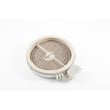
- If you stay with electric, consider performance upgrades like replacing a weak radiant element (for example, the GE range dual radiant surface element, 6 to 9-in WB30X24111 when the correct burner stops heating properly)
Quick comparison
| Range type | Cooktop | Oven | Typical hookups |
|---|---|---|---|
| All-gas | Gas | Gas | Gas line + 120V |
| All-electric (like JB645DK6BB) | Electric | Electric | 240V |
| Dual fuel | Gas | Electric | Gas line + 240V |
Why it matters
Fuel type affects installation requirements, cookware performance, and repair parts. Matching the correct range type helps prevent wiring or gas-connection issues and ensures you buy the right components for heating and controls.
Last updated: February 2026
How many amps does a GE electric range use?
Most GE electric ranges like model JB645DK6BB are designed for a 240-volt circuit and typically draw about 30 to 50 amps, depending on the range’s total wattage and which heating elements are running. For the exact electrical rating for your unit, check the specs in the JB645DK6BB owner’s manual.
Typical amperage you’ll see (what it means)
Electric ranges cycle the bake element, broil element, and radiant surface elements on and off, so the actual draw changes during cooking.
- 30 amps: common for lower-wattage ranges
- 40 amps: very common for many 30-inch freestanding ranges
- 50 amps: used when the range has higher total wattage or more powerful elements
- Higher draw moments happen when multiple surface elements plus the oven are heating at the same time
Quick check: breaker size vs. what you have
Use this as a practical reference when you look at your home’s electrical panel.
| What you see at the panel | What it usually indicates | What to do |
|---|---|---|
| 30A double-pole breaker | Range is on a 30A circuit | Confirm the range rating in the manual and on the rating plate |
| 40A double-pole breaker | Common setup for many ranges | Usually correct for many 30-inch electric ranges |
| 50A double-pole breaker | Higher-capacity circuit | Often used for higher-wattage ranges |
Where to find the exact rating for JB645DK6BB
We use two reliable places to confirm the correct amperage for your specific range:
- The rating plate (often behind the oven door or storage drawer area)
- The electrical specifications section in the JB645DK6BB owner’s manual
- Your home’s breaker size (helps confirm the circuit, not the appliance rating)
Why it matters
Correct amperage protects the wiring and helps prevent nuisance breaker trips. It also ensures the range heats properly when you use the oven and multiple radiant surface elements together.
Last updated: February 2026
Is GE profile considered high end?
Yes. GE Profile is widely considered GE’s higher-end mainstream line; it typically adds more cooking features, upgraded finishes, and more advanced controls than standard GE models, while still sitting below GE’s true luxury lines.
How this relates to your GE JB645DK6BB range
Your GE JB645DK6BB is a GE freestanding electric range model (JB645 series). Whether it is branded “GE” or “GE Profile,” you can still use the same practical yardsticks to judge where it lands: cooking performance, control features, and available accessories listed in the JB645DK6BB owner’s manual.
What usually makes GE Profile feel “high end”
- More advanced oven modes (often convection or enhanced baking features)
- More precise electronic controls and expanded settings
- More premium exterior styling and handle/knob design
- More connectivity or smart features on many models
- More feature-rich cooktop configurations (elements, power levels, indicators)
Quick comparison (typical positioning)
| GE line | Typical market position | What you usually get |
|---|---|---|
| GE (standard) | Value to mid-range | Core cooking functions, straightforward controls |
| GE Profile | Mid- to high-end mainstream | More features, upgraded design, more advanced controls |
| Café / Monogram | Premium to luxury | Pro styling, specialty features, higher-end build and options |
Why it matters when buying parts or troubleshooting
For parts and repairs, the “Profile” label matters less than the exact model number. We always recommend matching parts and procedures to JB645DK6BB so fit, wiring, and control compatibility stay correct.
Common examples on this model include cooktop and control components such as the GE range surface element control switch WB24X25013 and radiant elements like the GE range dual radiant surface element, 6 to 9-in WB30X24111.
Last updated: February 2026
What is the difference between a regular GE and GE profile?
GE Profile is GE’s step-up line; it typically adds more premium styling, upgraded controls, and more feature options than standard GE For your GE JB645DK6BB electric range, the core cooking basics stay similar, but Profile models more often include convenience and design upgrades.
What you usually get with GE Profile vs standard GE
- More advanced control features (more cooking modes and settings)
- More premium finishes and design details
- More convenience features (for example, enhanced oven controls or added indicators)
- More model-to-model feature variation (more configurations and options)
- Higher typical price point
How to compare models the right way
The most accurate comparison is feature-by-feature, not brand-name-only. We recommend checking:
- Oven capacity and rack positions
- Cooktop element sizes and whether any are dual elements
- Self-clean options and door lock behavior
- Control type (knobs vs touch controls) and display style
- Included accessories and recommended cleaners
Use the JB645DK6BB owner’s manual to confirm the exact features and operating details for your range.
Quick comparison (typical)
| Category | Standard GE | GE Profile |
|---|---|---|
| Styling | Practical, straightforward | More premium look and finishes |
| Features | Essential cooking functions | More feature-rich configurations |
| Controls | Basic to mid-level | More advanced, model-dependent |
| Price | Lower | Higher |
Why it matters
When you’re shopping parts, accessories, or troubleshooting steps, the exact model number matters more than the product line name. A standard GE range and a GE Profile range can use different control boards, surface elements, or door parts even if they look similar.
Last updated: February 2026