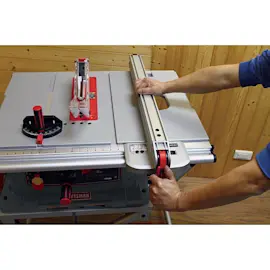
Owner’s manual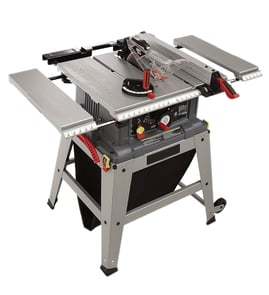

Are all table saw arbor nuts the same size?
No. Arbor nuts are not universal; the size and thread direction depend on the saw’s arbor design. On the Craftsman 137218760 10-inch table saw, you remove and reinstall the arbor nut during blade changes, so matching the nut to this exact model matters for safe blade clamping (see the 137218760 owner's manual).
What’s usually standardized (and what isn’t)
Many 10-inch table saw blades share a common arbor hole size, but that does not mean the arbor nut is the same across saws.
- Blade arbor hole: Commonly 5/8 inch on many 10-inch saw blades
- Arbor nut thread size/pitch: Varies by manufacturer and model
- Thread direction: Some saws use left-hand threads to resist loosening
- Flange design: Inner/outer flange thickness and diameter vary
- Wrench size: The nut’s hex size can differ even when threads are similar
How to confirm the correct arbor nut for Craftsman 137218760
We recommend using the model-specific parts breakdown and the manual’s blade-change procedure to identify the correct hardware and how it installs.
- Unplug the saw and remove the table insert
- Raise the blade to maximum height
- Remove the arbor nut and flange, then the blade
- Reinstall the blade with teeth facing the front of the saw
- Reinstall the flange and thread the arbor nut on by hand first
- Tighten while holding the arbor flats with an open-end wrench
For the exact steps and the correct orientation, follow the 137218760 owner's manual.
Quick comparison: blade fit vs. arbor nut fit
| Item | Often similar across 10-inch saws | Must match the saw model |
|---|---|---|
| Blade arbor hole | Yes (commonly 5/8 inch) | No |
| Arbor nut threads | No | Yes |
| Thread direction | No | Yes |
| Flange stack-up | No | Yes |
Why it matters
The arbor nut and flange clamp the blade to the arbor. If the nut is the wrong thread, wrong direction, or doesn’t seat correctly against the flange, the blade can wobble, cut poorly, or loosen during operation.
Ordering the right replacement
Use the model number 137218760 when searching so you get the correct arbor hardware for this Craftsman saw. If you do not see the exact item listed for your model, search by model number on Sears PartsDirect.
Last updated: February 2026
What are the common table saw mistakes?
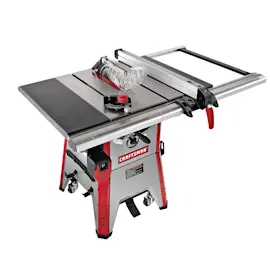
Common mistakes on the Craftsman 137218760 10" table saw are skipping guards and eye protection, making cuts freehand, using the fence and miter gauge incorrectly, and setting the blade height wrong. These errors increase kickback risk and blade-contact injuries; follow the 137218760 owner's manual safety and cutting steps.
Most common mistakes (and the safer habit)
- Not wearing PPE: Always wear safety glasses; add hearing protection and a dust mask when needed.
- Guards not installed or not working: Keep the blade guard in place and operating correctly before cutting.
- Cutting freehand: Use the rip fence for ripping and the miter gauge for crosscutting; neither cut is safe freehand.
- Using the rip fence and miter gauge together: For crosscuts, remove the rip fence and use the miter gauge in the groove.
- Blade set too high: Set blade height about 1/8 inch above the workpiece for ripping and crosscutting.
- Ripping warped or twisted stock: Do not rip wood that is warped, twisted, or lacks a straight edge against the fence.
- Not using push sticks for narrow rips: When your hand cannot safely fit between the blade and fence, use one or more push sticks; never make through-saw cuts narrower than 1/2 inch.
Quick pre-cut safety checklist (use every time)
Before turning the saw ON, we recommend confirming:
- Blade is tight on the arbor
- Bevel angle lock knob is tight
- Rip fence knob is tight and fence is parallel to the miter gauge grooves (when ripping)
- Blade guard is installed and working
- Work area is clean and well lit
Ripping vs. crosscutting: correct setup
| Cut type | Use this guide | Remove this first | Key setup detail |
|---|---|---|---|
| Ripping (with the grain) | Rip fence | Miter gauge | Feed forward only; keep hands out of blade path |
| Crosscutting (across the grain) | Miter gauge | Rip fence | Hold work firmly to gauge; keep work about 1 inch from blade before starting |
Why it matters
Most table saw injuries come from two preventable events: kickback (workpiece thrown back toward you) and blade contact. Proper guides (fence or miter gauge), correct blade height, straight stock, and push sticks reduce both risks.
If you need diagrams for safe setups, mounting, and electrical requirements (120V, 15A circuit protection), use the 137218760 owner's manual. For parts and model lookups, search by model number on Sears PartsDirect.
Last updated: February 2026
What size blade does the Craftsman 137218760 table saw use?
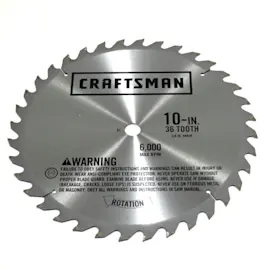
The Craftsman 137218760 10" table saw is designed to use a 10-inch blade. For the safest fit and best cut quality, match the blade’s arbor hole and the saw’s rated RPM to the specifications listed in the owner's manual.
Blade size and what to match
A “10-inch blade” describes the blade’s diameter, but you also need to match a few other specs so the blade mounts correctly and runs smoothly.
- Blade diameter: 10 inches
- Arbor hole size: Match the saw’s arbor (listed in the manual)
- Blade type: Rip, crosscut, combination, or plywood/finish blade
- Kerf thickness: Thin-kerf or full-kerf (choose based on your cut needs)
- Max RPM rating: Use a blade rated at or above the saw’s operating speed
Quick blade selection guide
Use this as a practical starting point when choosing a 10-inch blade for your Craftsman table saw.
| Cut you’re making | Typical tooth count (10") | What you’ll notice |
|---|---|---|
| Fast ripping (with the grain) | 24T to 30T | Faster feed, rougher edge |
| General purpose | 40T to 50T | Balanced speed and finish |
| Smooth crosscuts/plywood | 60T to 80T | Cleaner edge, slower feed |
Why it matters
Using the correct 10-inch blade helps the Craftsman 137218760 reach proper cutting depth, keeps the guard and splitter/riving components aligned, and reduces vibration that can cause burning, kickback risk, or poor accuracy.
Parts and documentation tips
- Confirm your exact model number is 137218760 before ordering accessories.
- Use the parts diagrams and parts list to identify the correct blade guard and safety components.
- If you need to search beyond the model parts list, use your model number on Sears PartsDirect.
Last updated: February 2026