Owner’s manual
 Error Codes


How many cubic feet is my Kenmore Elite refrigerator?
Your Kenmore Elite refrigerator model 79551372012 is typically listed at about 30.6 cubic feet of total capacity. For the exact capacity and how it is broken out between the fresh food and freezer sections, check the specifications section in the 79551372012 owner's manual.
We recommend verifying capacity using the model-specific documentation because capacity can vary slightly by configuration within a model family.
- Find the model tag inside the refrigerator compartment (usually on a side wall).
- Confirm the model number reads 79551372012.
- Check the specifications section in the manual for total cubic feet.
- If you are comparing to another refrigerator, compare total capacity (not shelf count).
- Keep in mind that bins, ice storage, and air channels reduce usable space.
Total cubic feet is a standardized measurement, but real-world storage depends on layout and accessories.
| What you are measuring | What it means | Why it can look smaller |
|---|---|---|
| Total capacity (cu. ft.) | Combined fresh food + freezer volume | Includes areas you cannot pack solid (airflow space) |
| Usable shelf space | What you can actually load | Reduced by shelves, bins, ice bucket, and ducts |
| Freezer “packing” ability | How much food fits well | Depends on drawer/basket layout and ice storage |
Knowing the cubic feet helps when you are matching a replacement refrigerator, planning kitchen fit, or estimating food storage. It also helps you follow best practices for airflow so the refrigerator cools evenly.
For airflow guidance and control settings, follow the “ensuring proper air circulation” and “adjusting control settings” sections in the 79551372012 owner's manual.
Last updated: January 2026
What is the average lifespan of a Kenmore Elite refrigerator?
A Kenmore Elite refrigerator like model 79551372012 typically lasts 10 to 15 years. With consistent maintenance (good airflow, clean seals, and stable temperatures), many units reach the upper end of that range before major repairs such as sealed-system or compressor work become more likely.
Most side-by-side refrigerators fall into a similar life range; the biggest difference is how hard the unit has to work day to day.
- 10 to 15 years is the normal service life for a modern refrigerator
- 8 to 10 years is common if the unit runs hot (dirty condenser area, warm room, frequent door openings)
- 15+ years is common when temperatures are stable and maintenance is consistent
- Major repairs tend to cluster later in life (cooling system, control board, fan motors)
Use the 79551372012 owner's manual for model-specific care and operating guidance.
- Keep vents inside the compartments clear so air can circulate
- Minimize long door openings; organize food so you can grab items quickly
- Keep door gaskets clean and sealing tightly
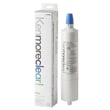
- Replace the water filter on schedule if you use the dispenser (see Kenmore refrigerator water filter 9990 5231JA2006E)
- Watch for early warning signs: warmer temps, unusual noises, frost buildup, or water leaks
Your refrigerator may run more than an older unit and still be operating normally. Many modern refrigerators run about 40% to 80% of the time at normal room temperatures, and more in warmer conditions.
| What you notice | Often normal | Often needs attention |
|---|---|---|
| Compressor runs a lot | After loading groceries, hot room, frequent door openings | Temps not holding, condenser area clogged, fan not running |
| Rattling/vibration | Unit not level, items touching cabinet | Persistent loud noise, fan hitting ice |
| Lights out | Power interruption | LED service needed (handled by a technician) |
Knowing the typical lifespan helps you decide when maintenance is worth it versus when a major repair may not be cost-effective, especially as the unit approaches the 10 to 15 year range.
Last updated: January 2026
What are the common problems with Kenmore Elite refrigerators?
Common problems on the Kenmore Elite 79551372012 side-by-side refrigerator include not cooling (often airflow or fan related), frost or ice buildup from frequent door openings or poor sealing, and “normal” operating noises during defrost. Use the 79551372012 owner's manual troubleshooting guide to match symptoms to the right fix.
- Not cooling or weak cooling: unit in defrost cycle, Demo Mode enabled, dirty condenser area, or a failed evaporator fan motor.
- Frost or ice crystals on frozen food: door not closing properly or doors opened often (warm, humid air causes frost).
- Too much noise: normal defrost and airflow sounds, vibration from leveling issues, or a fan noise.
- Lights not working: LED light failure (service item).
- Ice tastes bad or smells: old ice, food odors, or a filter that needs replacement.
- Confirm it is not in Demo Mode: on this model, open the refrigerator door and press Ultra Ice and Fridge Temp together for 5 seconds.
- Give it time after a power interruption: cooling can take time to stabilize after power returns.
- Check door closing and sealing: make sure bins and shelves are not preventing a full close.
- Listen for normal defrost sounds: sizzling on the defrost heater and water dripping into the drain pan can be normal.
- Reduce frost triggers: limit door openings and keep food from blocking air vents.
| Symptom | Common suspect part | Example part for this model |
|---|---|---|
| Warm fridge/freezer, fan noise, poor airflow | Evaporator fan motor | Refrigerator evaporator fan motor 4681JB1029S |
| Frost/icing from defrost failure | Defrost system component | Refrigerator defrost heater ADL74581702 |
| Bad-tasting ice or slow water flow | Water filter | Kenmore refrigerator water filter 9990 5231JA2006E |
Cooling complaints on a side-by-side refrigerator are often airflow related. Catching a door-seal issue, blocked vents, or a failing fan early helps protect food temperatures and reduces compressor run time.
Last updated: January 2026