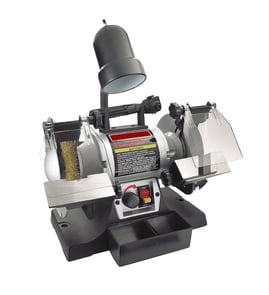

What is a Craftsman bench grinder?
A Craftsman bench grinder (including model 319190620) is a stationary power tool that spins abrasive wheels to grind, sharpen, shape, and clean up metal. We typically use it for sharpening hand tools, deburring cut edges, and removing rust or paint from small parts.
What you can do with a bench grinder
- Sharpen chisels, plane irons, mower blades, and drill bits (with the right technique)
- Grind and shape metal (bolts, brackets, tool edges)
- Deburr freshly cut metal to remove sharp edges
- Clean metal using a wire wheel or wire cup attachment (if your grinder supports it)
- Polish with a buffing wheel (light-duty finishing)
Key parts and features (what they do)
| Feature | What it does | Why it matters |
|---|---|---|
| Grinding wheels | Remove material and shape edges | Wheel grit controls speed vs. finish quality |
| Tool rests | Support the workpiece at a stable angle | Helps keep sharpening consistent and safer |
| Eye shields/spark guards | Deflect debris and sparks | Reduces risk of eye and face injury |
| Wheel guards | Contain fragments if a wheel fails | Critical for safe operation |
Basic safety and setup checks we recommend
- Unplug the grinder before adjusting tool rests, guards, or wheels.
- Verify the wheel is rated for the grinder’s RPM before installing it.
- Keep tool rests close to the wheel (a small gap) to prevent the workpiece from catching.
- Let the wheel reach full speed before grinding; use light pressure.
- Wear eye protection and avoid loose sleeves or gloves near rotating wheels.
Why it matters
A bench grinder removes material fast; the right wheel, guard setup, and technique help you get cleaner results (sharper edges, smoother deburring) while reducing vibration, overheating, and kickback.
For help identifying the exact model number on your grinder before ordering parts, use how to find your appliance model number (and what it means for parts).
Last updated: February 2026
What are the 4 important rules for a bench grinder?
Four important bench grinder rules for your Craftsman 319190620 are: wear proper eye and face protection, keep the work rest and guards correctly adjusted, grind only on the wheel’s face (not the side), and always start and stop safely (let it reach full speed; wait for a complete stop before handling the work).
The 4 rules (with what to do)
- Protect yourself: Wear safety glasses plus a face shield; tie back hair and avoid loose sleeves or gloves that can catch.
- Set the grinder up correctly: Keep guards in place and adjust the work rest close to the wheel (typically about 1/8 inch) so small parts cannot wedge.
- Use the wheel correctly: Grind on the front face of the wheel only; side pressure can crack many bench grinding wheels.
- Start and stop safely: Stand slightly to one side at startup, let the wheel reach full speed before grinding, and wait until the wheel fully stops before setting tools down near it.
Quick setup targets (typical)
These are common bench grinder safety targets used across many Craftsman-style grinders.
| Item to adjust | Typical target | Why it matters |
|---|---|---|
| Work rest gap | ~1/8 inch | Prevents the workpiece from being pulled into the wheel |
| Tongue guard (spark guard) gap | ~1/4 inch | Helps contain debris and reduces pinch points |
| Startup position | Off to the side | Reduces risk if a wheel fails at startup |
Why it matters
Most bench grinder injuries come from wheel breakage, flying grit, or a workpiece getting grabbed between the wheel and rest. Following these four rules reduces kickback, binding, and exposure to sparks and fragments.
Helpful DIY skill for safe troubleshooting
If your grinder vibrates, won’t start, or trips a breaker, electrical checks are often part of safe diagnosis. Use our guide: how to use a multimeter to test electrical parts video.
Last updated: February 2026
What is the weight of a grinder?
A Craftsman bench grinder like model 319190620 typically weighs about 15 to 35 lb depending on wheel size, motor housing, and base style. For the exact weight of your specific unit, match the model number on the tool to the listing details you use when ordering parts on Sears PartsDirect.
Typical bench grinder weight ranges
Most bench grinders fall into these practical ranges:
- 6-inch bench grinder: about 15 to 25 lb
- 8-inch bench grinder: about 25 to 40 lb
- Industrial/heavy-duty units: 40 lb and up
| Grinder type | Common wheel size | Typical weight |
|---|---|---|
| Light-duty bench grinder | 6 in. | 15 to 25 lb |
| Medium-duty bench grinder | 8 in. | 25 to 40 lb |
| Heavy-duty grinder/buffer | 8 to 10 in. | 40 lb+ |
What changes the weight the most
These features usually make one grinder heavier than another:
- Wheel diameter and thickness (larger wheels add mass)
- Motor size and frame material (more metal, more weight)
- Cast-iron base vs. stamped steel base
- Built-in work lights, guards, and tool rests
- Pedestal mounting hardware (if included with your setup)
Why it matters
Weight affects stability and vibration. A heavier bench grinder generally stays planted better during sharpening and grinding, which helps you get cleaner results and reduces the chance of the tool “walking” on the bench.
Quick handling and setup tips
- Set the grinder on a solid, level workbench.
- Bolt it down if you notice vibration.
- Keep wheel guards installed and properly adjusted.
- Replace wheels that are chipped, cracked, or out of round.
- If you are troubleshooting power issues, use a meter safely; see how to use a multimeter to test electrical parts video.
Last updated: February 2026
What does 5 8 11 arbor mean?
A 5/8-11 arbor means the grinder’s spindle (arbor) has a 5/8-inch diameter with 11 threads per inch. On many U.S. grinders, that thread size is a common standard for mounting compatible accessories, but you still need to match the accessory type and rated speed.
What the numbers mean
- 5/8: the outside diameter of the threaded arbor (in inches)
- 11: threads per inch (TPI)
- Right-hand thread is most common (tightens clockwise), but always confirm on your tool
- “Arbor” and “spindle” are often used interchangeably
How to use this when buying wheels or accessories
For your Craftsman 319190620 bench grinder, arbor size is only one fit requirement. Also check:
- Wheel type (bench grinding wheel vs. wire wheel vs. buffing wheel)
- Wheel diameter and thickness (must clear guards and tool rests)
- Maximum RPM rating on the wheel (must be at least the grinder’s no-load speed)
- Bushing/adapters included with the wheel (common on bench grinder wheels)
- Flanges and washers condition (bent or missing hardware causes wobble)
Quick compatibility checklist
| Item to match | What to look for | Why it matters |
|---|---|---|
| Arbor thread | 5/8-11 | Ensures the accessory can screw on correctly |
| RPM rating | Wheel RPM ≥ grinder RPM | Prevents wheel failure |
| Wheel style | Rated for grinding | Wrong style can load up or break |
| Hardware | Correct flanges, tight nut | Reduces vibration and runout |
Why it matters
If the arbor thread does not match, the wheel or attachment will not seat correctly and can loosen, wobble, or bind. Matching arbor size plus wheel rating and hardware fit helps your bench grinder run smoother and safer.
For help locating the correct replacement parts by model number, use how to find your appliance model number (and what it means for parts).
Last updated: February 2026
How to restore a bench grinder?
To restore your Craftsman bench grinder model 319190620, do a full clean, inspection, and tune-up first; then repair wiring and replace any worn rotating parts. A proper restoration reduces vibration, improves wheel tracking, and keeps the grinder safe to use.
Safety first
- Unplug the grinder before any work.
- Wear eye protection and a dust mask when removing rust, paint, or wheel debris.
- Never run without guards, tool rests, and eye shields installed.
- Replace any wheel that is cracked, chipped, or has been dropped.
- Fix brittle or cracked wire insulation before powering on.
Restoration checklist (practical order)
- Document and label: Take photos of spacers, flanges, guards, and wire routing.
- Disassemble and degrease: Remove guards, tool rests, wheels, and covers; clean thoroughly.
- Inspect bearings and shaft: Spin by hand; roughness, play, or noise means bearing service.
- Inspect switch and cord: Look for loose terminals, heat discoloration, or damaged insulation.
- Remove rust and refinish: Wire brush or sand; prime and paint if desired.
- Reassemble and align: Set tool rest close to the wheel and square to the face.
- Dress the wheels: Dress after mounting so the wheel runs flat and true.
Electrical checks (quick and important)
Use a multimeter to verify the grinder is safe to energize:
- Confirm cord continuity and no shorts to the metal frame
- Test the switch for consistent on/off continuity
- Repair damaged conductors and secure strain relief
Helpful DIY references:
Common “restore vs replace” calls
| Symptom | Likely cause | Best next step |
|---|---|---|
| Loud rumble | Worn bearings | Replace bearings before use |
| Heavy vibration | Wheel/flange issue or bearings | Replace wheel, inspect flanges, check bearings |
| Slow start, overheating | Electrical resistance or motor issue | Inspect cord, switch, and motor |
Why it matters
A bench grinder runs at high speed; worn bearings, damaged wheels, or compromised wiring create vibration and unsafe operation. Restoring the grinder correctly gives smoother grinding and safer starts.
Last updated: February 2026