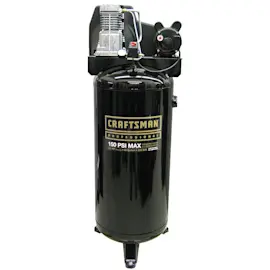
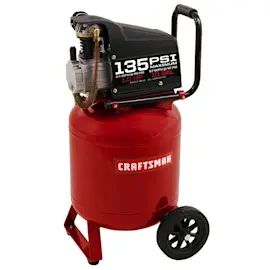
Owner’s manual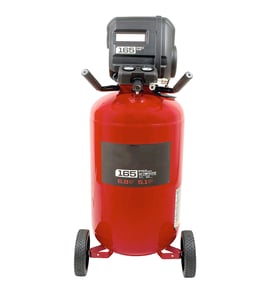

What is the most common cause of air compressor failure?
The most common cause of failure on a Craftsman air compressor like model 919165190 is poor maintenance that leads to overheating, air leaks, and premature wear. Keeping ventilation openings clear, draining the tank daily, and fixing leaks early prevents many no-start and low-pressure problems (see the 919165190 owner's manual).
These issues create the majority of breakdowns in homeowner-grade air compressors:
- Overheating from restricted airflow (blocked ventilation openings, unit too close to a wall)
- Moisture damage from not draining the tank daily (rust and tank thinning)
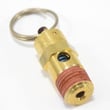
- Air leaks at fittings, the check valve, or the pressure switch release valve
- Restricted air intake filter causing low output and longer run times
- Pressure control problems (pressure switch not shutting off at cut-out)
Use this routine to reduce failures and extend compressor life:
- Operate in a clean, dry, well-ventilated area; keep at least 12 inches of clearance from walls/obstructions
- Do not restrict ventilation openings; overheating can damage internal components
- Drain the tank daily or after each use to reduce internal rust
- Stay in attendance while operating; do not run the compressor unattended
- Before service, unplug and bleed off all tank pressure
| What you notice | Most likely cause | What to check first |
|---|---|---|
| Won’t start | Pressure switch issue, motor/electrical issue, or hard start with pressure in tank | Power source, pressure switch operation, unloader behavior |
| Won’t build tank pressure | Air leak, check valve restriction, intake restriction | Leaks at fittings, check valve, intake filter |
| Safety valve pops | Excessive tank pressure, pressure switch cut-out too high | Shut off immediately; inspect pressure switch and controls |
| Tank won’t hold air | Leak at fittings or tank/welds | Soap test fittings; inspect tank condition |
Most “failures” start as small airflow restrictions, moisture buildup, or minor leaks. Those problems force longer run times, raise operating temperature, and stress pressure-control components, which turns a simple maintenance issue into a no-start or low-pressure breakdown.
For step-by-step troubleshooting and repair paths, use our DIY guides like air compressor won't start and air compressor won't build tank pressure. For parts lookup by model number, start with the parts list for 919165190, or search by model on Sears PartsDirect.
Last updated: February 2026
What does 4.0 scfm at 90 PSI mean?
“4.0 SCFM at 90 PSI” means the air compressor can deliver 4 standard cubic feet of air per minute while maintaining 90 PSI at the outlet; it is a performance rating you compare to your air tool’s SCFM requirement at the same pressure. For Craftsman model 919165190, the manual lists 6.2 SCFM at 90 PSIG.
Match the tool’s air demand to the compressor’s delivered air at the pressure you will run.
- Find your tool’s required SCFM at 90 PSI (or at 40 PSI for some tools)
- Compare that number to the compressor’s SCFM at the same PSI
- If the tool needs more SCFM than the compressor can supply, the compressor will run constantly and pressure will drop
- Set regulated pressure while air is flowing (trigger pulled) for the most accurate adjustment
- If you see a big pressure drop during use, reduce air usage or use a tool with lower SCFM demand
SCFM is airflow corrected to standard conditions so different compressors can be compared more fairly. That is why SCFM is more useful than a raw CFM number when you are shopping or comparing models.
Use these ratings as your baseline when deciding what the compressor can realistically support.
| Rating point | What it tells you | 919165190 value |
|---|---|---|
| SCFM @ 40 PSIG | Higher flow at lower pressure | 8.4 |
| SCFM @ 90 PSIG | Usable flow for many air tools | 6.2 |
| Cut-in pressure | When the motor restarts | 110 PSI |
| Cut-out pressure | When the motor stops | 135 PSI |
If your tool is rated, for example, 5 SCFM at 90 PSI, a compressor rated 4 SCFM at 90 PSI will struggle to keep up; you will notice slower tool performance and more frequent cycling. Using the correct SCFM-at-PSI match helps protect the motor, pressure switch, and pump.
- For performance issues that feel like “not enough air,” use air compressor won't build tank pressure.
For parts lookup by model number and diagrams, start with the model parts list and, if needed, search on Sears PartsDirect. For operating terms and ratings, we recommend the owner's manual.
Last updated: February 2026
Is a 150 PSI air compressor good for car detailing?
Yes. A 150 PSI max air compressor can work well for car detailing because you typically regulate tool pressure down (often around 90 PSI), and the extra headroom helps the tank recover. For your Craftsman 919165190, matching your tool’s CFM demand and staying within the recommended duty cycle matters most.
For detailing tools like blow guns and air nozzles, steady airflow is the difference between “works great” and “constantly waiting for recovery.” Focus on:
- CFM at your working pressure (commonly referenced at 90 PSI)
- Tank size (bigger tanks reduce cycling during long blow-outs)
- Regulator control so outlet pressure never exceeds the tool rating
- Moisture control (water in the line can spot paint and trim)
- Duty cycle: this compressor is intended for 50% duty cycle max (about 30 minutes pumping per hour) per the owner's manual
Use this as a practical starting point; then compare it to your tool’s label requirements.
| Detailing task | Typical air demand | What to prioritize |
|---|---|---|
| Blow gun, drying crevices | Low to moderate | Tank size, moisture control |
| Tornador-style cleaning gun | Moderate to high | Higher CFM at 90 PSI, recovery time |
| Light pneumatic tools (small ratchets) | Moderate | CFM and hose size |
| Continuous blowing for long periods | Moderate | Duty cycle, cooling breaks |
The manual’s start-up steps are built around safe pressure regulation and tool protection:
- Set the On/Auto/Off lever to OFF before adjusting
- Back the regulator down to zero before connecting tools
- Turn to AUTO and let tank pressure build
- Increase outlet pressure slowly with the regulator
- Keep outlet pressure at or below the tool’s max rating (never exceed it)
For more troubleshooting if performance feels weak, use our DIY guide: air compressor won't build tank pressure.
Detailing often uses long trigger times. If your tool demand pushes the compressor past its intended duty cycle, you will see more heat, more cycling, and more waiting. Staying within the 50% duty cycle guidance helps the compressor run more reliably and consistently.
For parts and diagrams for the Craftsman 919165190, start with the model parts list, or search by model on Sears PartsDirect.
Last updated: February 2026
What company makes Craftsman air compressors?
Craftsman is a brand name, so Craftsman air compressors are built by different original equipment manufacturers (OEMs) depending on the model and production era. For the Craftsman 919165190 air compressor, the maker is best identified by checking the data plate and the information in the 919165190 owner's manual.
Look for these identifiers on the unit label (usually on the tank or frame) and in the documentation:
- The full model number (for this unit: 919165190)
- Any manufacturing code, prefix, or type number on the data plate
- The motor nameplate brand and electrical ratings
- The pump or compressor head casting marks (letters or numbers)
- The parts list and exploded view references in the manual
Craftsman-branded compressors have been produced under contract by multiple OEMs over the years. That is why two Craftsman air compressors can look and service differently even if they share similar features like a pressure switch, regulator, check valve, and tank pressure gauge.
| What you have | What it usually indicates | Where to confirm |
|---|---|---|
| A 919.xxxxxx model number | A specific Craftsman production family | Data plate and manual |
| Older unit with legacy labeling | Earlier OEM production runs | Data plate |
| Newer retail-era unit | Different contracted OEM | Data plate |
Knowing the OEM helps you match the correct repair parts and service procedures for items like the pressure switch, check valve, regulator, and pump assembly. It also helps when you are comparing diagrams and troubleshooting steps for symptoms such as “won’t start” or “won’t build tank pressure.”
We recommend using the model number 919165190 when searching parts and diagrams; you can also search by model on Sears PartsDirect if you are looking beyond the parts list shown for this model page.
Last updated: February 2026
What are the 4 types of compressors?
The four common compressor types are reciprocating (piston), rotary screw, centrifugal, and axial. Your Craftsman air compressor model 919165190 is a portable, tool-powering style unit that falls under the positive-displacement family (most commonly reciprocating). For model-specific operation and maintenance details, use the 919165190 owner's manual.
- Reciprocating (piston): Uses a piston and cylinder to compress air in pulses; common for portable and shop compressors.
- Rotary screw: Uses two meshing rotors for continuous airflow; common in commercial and industrial shops.
- Centrifugal: Uses a high-speed impeller to add velocity and convert it to pressure; common for large facilities.
- Axial: Uses multiple rotating and stationary blade stages; used in very high-flow applications (often aerospace and large industrial systems).
| Category | Types included | How they build pressure | Typical use case |
|---|---|---|---|
| Positive displacement | Reciprocating, rotary screw | Traps air and reduces its volume | Tools, shops, general compressed air |
| Dynamic | Centrifugal, axial | Adds velocity to air then converts it to pressure | High-volume plant air, large systems |
Knowing the type helps you match duty cycle, maintenance, and troubleshooting to the design.
For example, the 919165190 manual calls out a 50% duty cycle guideline (maximum compressor pumping time of about 30 minutes per hour). Staying within that range helps prevent overheating and premature wear. See the 919165190 owner's manual.
- Place the unit in a clean, dry, well-ventilated area with about 12 inches of clearance from walls/obstructions.
- Drain condensation from the tank at the end of each use (drain valve at the base of the tank).
- Use the regulator correctly: pull the knob out, turn to set pressure, then push in to lock.
- If the motor trips or struggles, check for low voltage symptoms (dimming lights, blown fuses on start).
- For replacement parts by model number, start with the parts list for 919165190, or search by model on Sears PartsDirect.
Last updated: February 2026