 Installation guide
 Owner’s manual




How big of a washer do I need to wash a king size comforter?
For a king-size comforter, we recommend using a large-capacity washer around 4.5 cu. ft. or larger so the comforter can move freely for proper wash, rinse, and spin. If your GE GTWP2000F1WW is smaller than that, a laundromat-size machine is the safer choice to prevent poor cleaning and out-of-balance spinning.
Recommended washer capacity (quick guide)
- 4.5 to 5.0 cu. ft.: Best fit for most king comforters
- 3.8 to 4.4 cu. ft.: May fit some comforters, but often washes poorly and can go out of balance
- Under 3.8 cu. ft.: Typically too small for a king comforter
- No central agitator (or low-profile agitator): Usually handles bulky bedding better
- Front-load washers: Often clean bulky items more evenly because they tumble
How to decide if it will fit and wash correctly
Use these checks before you run a full cycle:
- Confirm the comforter’s care label says machine washable
- Load it loosely; it should not be packed tight against the tub
- Leave roughly a hand’s width of space at the top so water and detergent can circulate
- Choose bulky/bedding or deep fill (if your washer has it)
- Plan on an extra rinse if detergent residue is likely
What to do if the washer bangs or goes out of balance
A king comforter can shift into a heavy lump during spin. If that happens:
- Pause the cycle and redistribute the comforter evenly
- Run a lower spin setting if available
- Wash the comforter by itself (no towels or sheets)
- Make sure the washer is level and on firm flooring
Why it matters
Oversizing the load is one of the fastest ways to get poor cleaning, leftover detergent, and violent vibration during spin. Your installation requirements also matter: the GTWP2000F1WW should sit on firm flooring and be leveled to minimize vibration during the spin cycle (details are in the installation guide).
| Comforter size | Typical washer capacity that works well | Notes |
|---|---|---|
| Queen | 3.8 to 4.5 cu. ft. | Depends on fill (down vs. heavy polyfill) |
| King | 4.5+ cu. ft. | 5.0+ cu. ft. is ideal for thick comforters |
Last updated: February 2026
How do I reset the error code on my GE washer?
To reset (clear) an error code on your GE GTWP2000F1WW washer, we start with a power reset: unplug the washer for 10 minutes, then restore power and try a cycle. If the code returns, use the model’s diagnostic steps in the owner's manual to address the underlying problem before clearing it.
Quick reset steps (safe first try)
- Press the control knob/dial to OFF and make sure the washer is not running.
- Unplug the washer for 10 minutes.
- Plug it back into a properly grounded outlet.
- Select a normal cycle and press Start.
- If the code reappears, stop the cycle and troubleshoot the cause (drain, fill, lid switch, out-of-balance).
If the code keeps coming back
An error code is usually a symptom, not the failure itself. On this GE top-load platform, the most common causes are drain problems, fill problems, lid switch issues, or excessive vibration during spin.
| What you notice | Likely area to check | Common related part for this model |
|---|---|---|
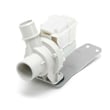
| Won’t drain, water left in tub | Drain path or pump | Washer drain pump WH23X10043 |
| Won’t fill or fills slowly | Water supply, screens, inlet valve | Washer water inlet valve WH13X10037 |
| Won’t spin with lid closed | Lid switch not sensing closed lid | Washer lid switch assembly WH12X10334 |
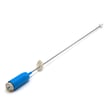
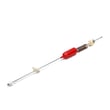
| Bangs or walks during spin | Leveling, suspension, load balance | Washer suspension rod, rear WH16X10159 |
Why it matters
Clearing the code without fixing the cause usually makes the code return and can lead to poor washing performance (no spin, no drain, or repeated out-of-balance stops). Correcting the root issue first saves time and prevents repeat breakdowns.
Helpful model-specific tips that affect error conditions
From the installation requirements for this washer:
- Install on firm flooring to minimize vibration during spin.
- Confirm household water pressure is typically 10 to 150 psi.
- Level the washer using the front leveling legs; then tilt the washer forward slightly to help set the rear legs (per the installation guide).
For code meanings and model-family troubleshooting, use our GE top load washer error codes reference alongside your manual.
Last updated: February 2026
What brand is best for front-load washers?
LG and Speed Queen are the two front-load washer brands we see customers choose most often when they prioritize strong cleaning and long-term durability; GE and Samsung are also solid options when you want more features at a wider range of price points. Your GE GTWP2000F1WW is a top-load washer, so we focus on keeping it installed correctly while you compare front-load brands.
What to compare when choosing a front-load washer brand
Use the same checklist across brands so the comparison stays fair:
- Reliability history and common repairs (pump, bearings, control board)
- Cleaning performance and rinse quality
- Spin speed and water extraction (affects dry time)
- Serviceability (ease of access to major components)
- Parts availability and typical part cost
- Warranty coverage details in your paperwork
Quick brand comparison (front-load washers)
| Brand | Typical strengths | Typical tradeoffs |
|---|---|---|
| LG | Strong cleaning, high spin, feature-rich | More electronics; control-related repairs are more common |
| Speed Queen | Durable, service-friendly designs | Higher purchase price; fewer advanced features |
| GE | Broad lineup, widely supported | Performance varies by series and price point |
| Samsung | Modern features and styling | Service experience varies by region |
GTWP2000F1WW installation specs that matter (top-load)
Even though you asked about front-load brands, correct setup prevents vibration, draining problems, and premature wear on your current washer. For the GE GTWP2000F1WW, the installation instructions specify:
- Install on firm flooring to minimize vibration during spin
- Water pressure: 10 psi minimum to 150 psi maximum
- Drain discharge height: not less than 30 inches, and no more than 8 feet above the base of the washer
- Standpipe: 1-1/2 inches minimum inside diameter and open to atmosphere
- Level the washer by adjusting the front leveling legs, then tilt forward 4 to 6 inches to set the rear legs
For the step-by-step procedure and clearance requirements, use the GTWP2000F1WW installation guide.
Why it matters
The “best” front-load brand is the one that matches your priorities (cleaning, noise, features, and repairability). Proper installation on any washer reduces out-of-balance loads, improves draining, and helps parts last longer.
Last updated: February 2026


