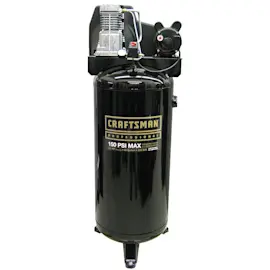
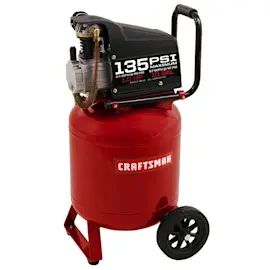
Owner’s manual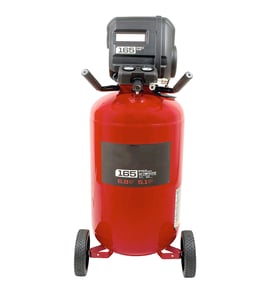

Is a 20 gallon air compressor big enough for air tools?
Yes, a 20-gallon compressor is big enough for many air tools used in short bursts; for continuous-use tools, airflow (SCFM) matters more than tank size. Your Craftsman 919165330 is actually a 33-gallon unit rated about 9.9 SCFM at 90 PSI, so it supports more tools than a typical 20-gallon compressor; see the 919165330 owner's manual for the full spec chart.
What matters more than gallons
Tank size mainly affects how long you can work before pressure drops; SCFM at the tool’s working PSI determines whether the compressor can keep up.
- Match the tool’s required SCFM to the compressor’s SCFM at the same PSI (often 90 PSI)
- Bigger tanks help with burst tools by reducing how often the pump cycles
- Continuous tools need higher SCFM so pressure does not sag while you work
- Long hoses, small hose diameter, and restrictive fittings reduce usable airflow
- Regulator setting and leaks can make a capable compressor feel underpowered
Quick guidance by tool type
| Tool type | Typical air demand | 20-gallon compressor | Craftsman 919165330 (33-gal, ~9.9 SCFM @ 90 PSI) |
|---|---|---|---|
| Brad/finish nailer | Low | Good fit | Excellent fit |
| Impact wrench (intermittent) | Medium | Works with pauses | Works better, fewer pauses |
| Blow gun, tire inflation | Low to medium | Good fit | Excellent fit |
| DA sander, die grinder | High (continuous) | Not a good fit | Borderline; depends on tool SCFM |
| Paint spraying (many setups) | Medium to high (continuous) | Often not a good fit | Often better, but confirm SCFM |
How we recommend choosing a compressor for your tools
- Find each tool’s SCFM requirement on the tool label or in its manual
- Compare it to compressor SCFM at the same PSI (40 PSI and 90 PSI are common ratings)
- For steady work, choose compressor SCFM that meets or exceeds the tool’s requirement
Why it matters
When SCFM is too low, tank pressure drops quickly, tool performance slows, and the motor runs more often, turning jobs into stop-and-go work.
If performance is poor even with adequate SCFM, use troubleshooting like air compressor won't build tank pressure. For parts and diagrams by model number, search on Sears PartsDirect.
Last updated: February 2026
Is it worth it to repair a compressor?
Yes, it’s worth repairing a Craftsman air compressor model 919165330 when the failure is in a replaceable component (pressure switch, check valve, regulator, gauges, or pump parts) and the air tank is in good condition. If the tank leaks or shows severe rust, replacement is the right choice.
Quick decision checklist
- Repair when the motor runs but the unit won’t reach normal shutoff pressure (often a leak, valve issue, or worn pump components).
- Repair when it won’t start and the issue points to the pressure switch, unloader, or electrical supply.
- Repair when air leaks are at fittings, the drain valve, the safety valve, or the regulator manifold.
- Replace when the tank won’t hold air or you see heavy corrosion, pitting, or damaged weld areas.
- Replace when the repair total is about half the cost of a comparable new compressor.
Typical repair vs. replace scenarios
| Symptom | Common cause | Typical path |
|---|---|---|
| Won’t start | Pressure switch, unloader, power issue | Repair first |
| Won’t build tank pressure | Check valve leak, pump valve wear, major air leak | Repair first |
| Cuts in and out too often | Leak, pressure switch setting issue | Repair first |
| Can’t regulate outlet pressure | Regulator or gauge problem | Repair |
| Tank leak or severe rust | Tank integrity issue | Replace |
Model-specific performance targets to compare against
For model 919165330, the owner's manual lists approximate pressure settings of 100 PSI cut-in and 130 PSI cut-out, plus airflow ratings of 14.2 SCFM @ 40 PSIG and 9.9 SCFM @ 90 PSIG. After any repair, those numbers are the benchmark for “back to normal.”
What we recommend before you decide
- Confirm the symptom: won’t start, won’t build pressure, leaks, or can’t adjust output.
- Do a leak check with soapy water on fittings, the drain valve, the safety valve, and the check valve area.
- Watch the gauge behavior: stalls well below cut-out, reaches cut-out then bleeds down, or short-cycles.
- Price the needed parts by model number 919165330; if you need to broaden your search, use Sears PartsDirect.
Helpful DIY troubleshooting
- Air compressor won't start
- Air compressor won't build tank pressure
- How to rebuild an air compressor pump
Why it matters: A solid tank plus correct cut-in and cut-out behavior usually means a repair restores safe, reliable performance; a compromised tank does not.
Last updated: February 2026
What is the average lifespan of an air compressor?
Most homeowner and light shop air compressors last 10 to 15 years with normal use and basic maintenance. For the Craftsman 919.165330 oil-free air compressor, lifespan depends most on run time, heat, moisture control, and fixing air leaks early; use the 919165330 owner's manual for model-specific care and safety guidance.
Typical lifespan ranges (what to expect)
Air compressor life varies by design and workload. Here are practical averages:
- DIY / homeowner portable units: 5 to 10 years
- Prosumer / small shop units: 10 to 15 years
- Industrial rotary screw systems: 15 to 20 years
- Tank life: often the limiting factor if moisture is not drained regularly
Quick comparison table
| Compressor type | Typical use | Typical lifespan |
|---|---|---|
| Oil-free piston (like many Craftsman units) | Intermittent, light to moderate | 10 to 15 years |
| Oil-lubricated piston | Moderate to heavy | 12 to 20 years |
| Rotary screw | Continuous duty | 15 to 20 years |
What shortens lifespan fastest
These issues cause early failure on many air compressors (motor, pressure switch, pump, or tank-related):
- Not draining the tank; moisture accelerates internal corrosion
- Running past duty cycle; overheating wears seals and valves
- Air leaks; longer run time increases heat and wear
- Restricted airflow around the unit; higher operating temperature
- Dirty intake filtration; debris damages the pump
- Incorrect power supply; low voltage can overheat the motor
Maintenance habits that add years
Use these habits to extend service life and keep performance steady:
- Drain the tank after each use (or daily in humid conditions)
- Keep the compressor in a clean, well-ventilated area
- Fix leaks promptly and recheck fittings periodically
- Let the unit cool between long cycles
- Inspect cords, plugs, and connections for heat damage
For step-by-step troubleshooting when the unit stops running, use air compressor won't start.
Why it matters
A compressor that runs longer to reach cut-out pressure (or cycles too often) builds extra heat and moisture. That combination shortens pump life and can also reduce tank life, so small maintenance steps protect the most expensive components.
You can look up diagrams and order replacement parts by model number through Sears PartsDirect.
Last updated: February 2026
What is the most common cause of air compressor failure?
The most common cause of air compressor failure is poor maintenance that leads to overheating and accelerated wear. On the Craftsman 919165330 oil-free air compressor, restricted airflow, dirty intake filtration, and running the unit beyond its duty cycle commonly trigger heat-related damage and pressure problems; see the 919165330 owner's manual for safety and operating limits.
What fails first most often (and why)
When maintenance is skipped, these areas usually show problems first:
- Intake and cooling airflow: blocked vents or dusty areas trap heat and shorten motor and pump life.
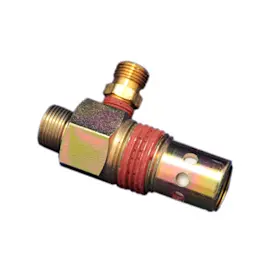
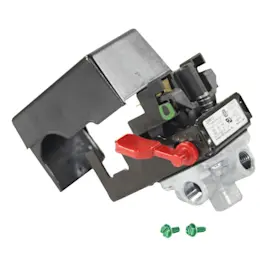
- Pressure control components: a drifting pressure switch or leaking check valve can cause hard starts and rapid cycling.
- Seals and fittings: small air leaks force longer run times, raising temperature and wear.
- Tank drain and moisture control: water left in the 33-gallon ASME tank promotes internal corrosion and contaminates air tools.
- Electrical supply issues: undersized circuits, weak connections, or incorrect voltage can overheat the motor.
Quick prevention checklist for model 919165330
Use this routine to reduce failures on this 240V, 15-amp unit:
- Keep the pump and motor area clean so the fan can move air.
- Drain the tank after use to remove moisture.
- Listen for leaks at the regulator, drain valve, and fittings; fix leaks promptly.
- Avoid repeated rapid restarts; let the compressor complete normal cut-in and cut-out cycles.
- Verify power matches the spec (240V single phase) and the branch circuit meets the 15-amp minimum.
Common symptoms and the most likely cause
| Symptom | Most likely cause | What to check first |
|---|---|---|
| Won’t start | Pressure switch, capacitor/motor issue, low voltage | Power supply, switch operation |
| Runs but won’t build pressure | Check valve, internal pump wear, major leak | Leak test, check valve |
| Cycles too often | Air leak, regulator issue | Fittings, hose, outlet connections |
| Gauge reads wrong | Faulty tank gauge | Gauge and connection |
Why it matters
Overheating and air leaks make the compressor run longer to reach its approximate 100 PSI cut-in and 130 PSI cut-out range, which increases stress on the motor and oil-free pump components. That extra run time is what turns small issues into major failures.
Helpful DIY troubleshooting
Ordering parts
When you are ready to replace a worn component (such as a pressure switch, check valve, gauge, or drain valve), use your model number 919165330 to search parts on Sears PartsDirect.
Last updated: February 2026