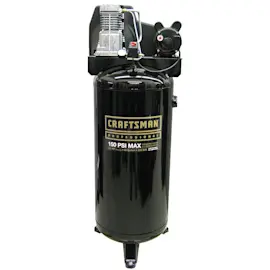
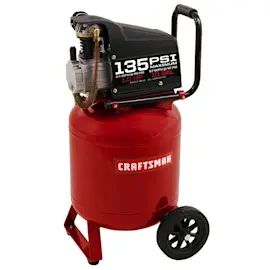
Owner’s manual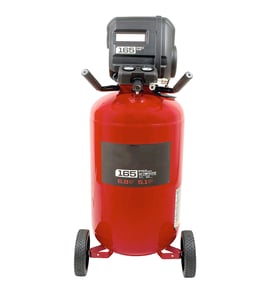

What is the most common cause of air compressor failure?
The most common cause of failure on a Craftsman air compressor like model 919165610 is poor maintenance that leads to overheating and overwork, especially from restricted airflow and small air leaks. Even minor leaks can make the compressor run harder and wear out parts faster (valves, seals, motor components).
What fails most often (and why)
These issues create the most repeat breakdowns on homeowner air compressors:
- Air leaks at fittings or valves: the pump runs longer to reach cut-out pressure, which accelerates wear.
- Restricted air intake filter or blocked airflow: reduced cooling airflow increases heat and trips overload protection.
- Low voltage or long extension cords: the motor struggles to start or reach speed, which overheats windings and trips breakers.
- Excessive run time (tool demand higher than compressor output): prolonged cycling overheats the pump and can damage valves.
- Vibration from poor mounting: excessive vibration can loosen fittings and stresses the tank and fasteners.
Quick checks we recommend first
Use these steps to prevent the most common “failure” symptoms (won’t start, won’t build pressure, runs constantly):
- Place the unit in a clean, dry, well-ventilated area and keep it at least 12 inches from walls/obstructions.
- Keep the air filter area clear so airflow is not restricted.
- Check fittings and connections with a soap solution; tighten leaks but do not overtighten.
- Avoid long, undersized extension cords; plug close to the power source.
- If the motor overload trips, let it cool fully before restarting.
Common symptoms and the most likely cause
| Symptom | Most likely cause | What to do next |
|---|---|---|
| Won’t start or trips overload | Overheating, low voltage | Improve ventilation, reduce cord length, let motor cool |
| Won’t build tank pressure | Air leak, valve issue, restricted intake | Soap-test leaks, check intake filter, inspect pump valves |
| Runs but tool pressure is low | Demand exceeds output, leaks | Reduce air use, fix leaks, verify regulator setting |
| Constant hiss at pressure switch area | Check valve or release valve issue | Inspect check valve and unloader circuit |
Why it matters
Heat and run time are what shorten compressor life. When airflow is restricted or leaks are present, the pump and motor run longer per cycle, which increases temperature and speeds up wear on valves, seals, and electrical components.
For model-specific setup, break-in, and leak-check procedures, follow the 919165610 owner's manual. For parts lookups and diagrams, search by model on Sears PartsDirect.
Last updated: February 2026
What company makes Craftsman air compressors?
Craftsman is a brand, so different companies have manufactured Craftsman air compressors over the years. For the Craftsman 919165610 air compressor, the most reliable way to identify the original manufacturer is to match the model and label information to the details in the 919165610 owner's manual.
How to identify who made your specific Craftsman compressor
Use these checks on the unit’s data label and paperwork; they work even when the brand name is Craftsman.
- Confirm the full model number is 919165610 (not a similar 919.xxxxxx model)
- Look for an OEM code, prefix, or manufacturing label on the tank or motor shroud
- Compare label wording to the manual’s model identification and safety pages
- Note whether it is oil-free vs. oil-lubricated, and single-stage vs. two-stage
- Record the serial number; it helps distinguish production runs
What we know for model 919165610
The documentation for this unit identifies it as a Craftsman permanently lubricated, 2-stage, twin valve, stationary air compressor (model 919165610). That tells you the configuration and service approach, even if the OEM name is not printed prominently on the outside of the unit.
Quick reference
| Item | What to look for | Why it helps |
|---|---|---|
| Model number | 919165610 | Ties the unit to the correct manual and parts list |
| Data label/OEM marking | Small print on tank or shroud | Often reveals the contracted manufacturer |
| Compressor type | 2-stage, stationary | Narrows down compatible service procedures |
Why it matters
Knowing the actual manufacturer helps you match the correct pressure switch, check valve, pump components, gauges, and fittings when troubleshooting or ordering replacement parts. For parts searches beyond the model page, use the model number on Sears PartsDirect.
Last updated: February 2026
Are air compressor parts interchangeable?
Most air compressor parts are not interchangeable, especially internal components (pump parts, valves, gaskets, motor components) that are engineered for a specific make and model like the Craftsman 919165610. Some external items (certain quick-connect fittings, hoses, and regulators) can be standardized, but you still must match thread type, size, and pressure rating.
What’s usually model-specific (not interchangeable)
These parts are commonly designed around the compressor’s pump design, pressure range, and mounting points:
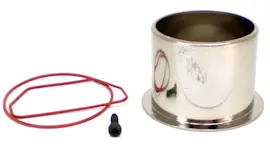
- Pump intake and exhaust valves
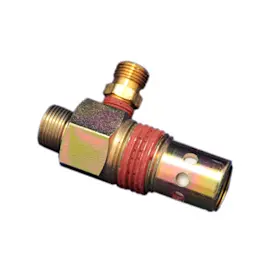
- Check valve and unloader-related components
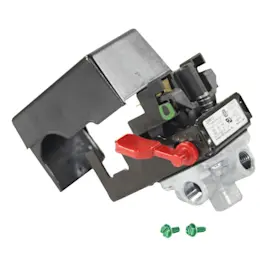
- Pressure switch mounting and pressure settings
- Tank-mounted gauges and manifold layouts
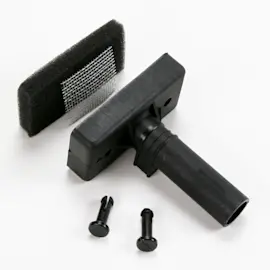
- Air filter housings and intake connections
- Motor start components (capacitor, overload) and wiring requirements
For model-specific diagrams, part names, and service procedures, use the 919165610 owner's manual.
What’s often interchangeable (with careful matching)
Some accessories are more universal, but only when the connection and ratings match:
- Air hose sizes (commonly 1/4 inch, 3/8 inch, or 1/2 inch I.D.)
- Quick connector sets (coupler and plug style must match)
- Tire air chuck accessories
- Inline filters and regulators
The manual lists common accessory types and hose I.D. sizes used with this compressor, which helps you choose compatible add-ons.
Quick compatibility checklist (before you buy)
Use this checklist to avoid leaks, poor performance, or unsafe setups:
- Connection standard: industrial, automotive, or other quick-connect style
- Thread type and size: confirm NPT size and whether it’s male or female
- Pressure rating: must meet or exceed your compressor’s cut-out pressure
- Flow requirement: tool SCFM demand must fit what the compressor can supply
- Mounting and port location: especially for switches, gauges, and manifolds
Common “looks the same” mix-ups
| Part or accessory | Why it may not interchange | What to match |
|---|---|---|
| Pressure switch | Different cut-in/cut-out range and port layout | Pressure range, port size, mounting style |
| Check valve | Different tube size and thread pitch | Port threads, tube connection size |
| Quick-connect coupler/plug | Different profiles will not seal together | Coupler/plug style and thread size |
| Hose | Wrong I.D. restricts airflow | I.D., length, pressure rating |
Why it matters
Interchanging the wrong part can cause constant air leaks, hard starting, low tank pressure, or tools that starve for airflow. The troubleshooting section also ties low air supply to leaks, restricted intake filters, and check valve issues, which are all areas where correct fit is critical.
If you need to locate the right replacement by model number, start with the parts list for Craftsman 919165610, or search by model on Sears PartsDirect.
Last updated: February 2026
Is it worth it to repair a compressor?
Yes; repairing your Craftsman air compressor model 919165610 is worth it when the failure is a single, common service issue (leak, pressure control, check valve, gauge) and the tank and pump are otherwise sound. Replacement makes more sense when the tank, motor, or pump has major damage or repeated failures.
Quick decision checklist
- Repair for one clear symptom (won’t start, won’t build pressure, air leak).
- Repair when the tank holds pressure and the unit cycles normally after the fix.
- Repair when the solution is basic maintenance (drain tank, clean/replace filter, tighten fittings).
- Replace when the tank won’t hold air after addressing fittings and valves.
- Replace when the motor or pump is seized, knocking, or repeatedly overheats.
- Replace when multiple problems persist after basic service.
Cost vs. value comparison
| Problem you see | Best first move | Why |
|---|---|---|
| Air leaks at fittings/lines | Repair | Usually sealing or fitting work |
| Won’t start or won’t restart | Repair first | Often pressure switch or check valve related |
| Won’t build tank pressure | Repair first | Commonly valve or gasket issues |
| Tank won’t hold air | Replace | Tank integrity drives safety and reliability |
Safety rules we follow before servicing
- Unplug the compressor; bleed off all tank pressure.
- Let the pump head and outlet tube cool before touching.
- Keep guards and covers in place during operation.
- Use a properly grounded outlet with correct fuse protection.
For model-specific procedures and maintenance intervals, use the 919165610 owner's manual.
DIY guides that often make repair worthwhile
- Air compressor won't start
- Air compressor won't build tank pressure
- Air compressor air leaks
- How to replace an air compressor check valve
Why it matters
A targeted repair restores normal cut-in and cut-out cycling at a predictable cost; replacing avoids sinking money into a failing tank or worn-out pump.
If you decide to repair, start with the model 919165610 parts list; you can also search by model number on Sears PartsDirect.
Last updated: February 2026