Owner’s manual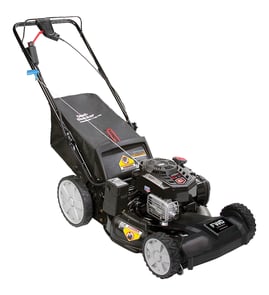



What is the difference between a lawn mower and a mulching mower?
A standard lawn mower cuts grass and typically sends clippings out the side or into a bag, while a mulching mower (or a mower set up for mulching) recuts clippings into smaller pieces and returns them to the lawn. On the MTD 11A-549R729, mulching is done by operating with the mulching plug installed instead of the grass catcher.
How mulching works on the MTD 11A-549R729
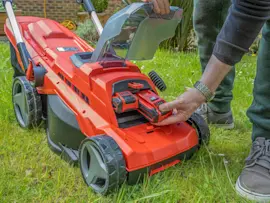
Our mower can be used as a mulching mower or a rear bagger. For mulching, we remove the grass catcher and the side-discharge chute, then operate with the mulching plug so clippings recirculate back into the turf (instead of being collected). See the 11A-549R729 owner's manual for the exact setup steps and safety notes.
- Mulching returns finely cut clippings to the lawn.
- Bagging collects clippings for disposal elsewhere.
- For a uniform cut, keep all cutting height adjustment levers at the same relative position.
- For best results, avoid cutting wet grass.
- If grass is very tall or thick, take a narrower cut.
When to mulch vs bag (quick guide)
| Situation | Better choice | Why |
|---|---|---|
| Regular weekly mowing | Mulch | Clippings break down quickly and feed the lawn |
| Wet grass | Bag or side discharge | Mulching wet clippings can clump and clog |
| Grass over about 4 inches tall | Side discharge first, then mulch | Mulching is not recommended when grass is overgrown |
| You need a clean finish (events, heavy leaf drop) | Bag | Removes debris and clippings from the lawn |
Why it matters
Choosing mulching vs bagging affects cut quality, cleanup time, and lawn health. Mulching can reduce yard waste and help return nutrients, but bagging or side discharge is often the better choice when conditions are wet or the grass is overgrown.
Last updated: January 2026
Why do landscapers use stand up mowers?
Landscapers often choose stand-up mowers because they finish properties faster with less fatigue: standing improves visibility and tight-turn maneuverability, and it is quicker to step off and on around obstacles. For safety practices that also apply to walk-behind equipment like the MTD 11A-549R729, follow the guidance in the 11A-549R729 owner's manual.
Key advantages for professional crews
- Faster on and off: easier to hop off to move hoses, toys, branches, or open gates.
- Better visibility: standing position helps spot sprinklers, edging, and uneven ground sooner.
- Tighter maneuvering: compact footprint helps around trees, beds, and narrow access points.
- Less turf scuffing: many stand-on designs reduce turning damage compared to heavier sit-down units.
- Crew efficiency: quicker transitions between mowing, trimming, and cleanup.
Safety and operating habits that matter (stand-on or walk-behind)
Even though your MTD 11A-549R729 is a walk-behind mower, the same jobsite risks drive equipment choices and procedures.
- Keep bystanders, helpers, children, and pets well away while mowing (the manual calls out a 75-foot safety zone).
- Inspect the area first and remove debris that could be thrown by the blade.
- Avoid wet grass and steep slopes; the manual warns against mowing slopes over 15 degrees.
- Stay in the operator zone and never bypass safety controls.
Quick comparison: stand-on vs walk-behind
| Feature | Stand-up mower | Walk-behind mower (like MTD 11A-549R729) |
|---|---|---|
| Best use | Larger properties, frequent obstacles | Smaller to mid-size lawns, tighter budgets |
| Operator position | Standing platform | Behind handles |
| Typical productivity | Higher for pros | Moderate, depends on pace |
| Storage/transport | Often compact for trailers | Usually easiest to store |
Why it matters
For pros, time on site is profit. Stand-up mowers can reduce wasted motion (dismounting, repositioning, visibility checks) while still supporting safe mowing practices like debris control, bystander distance, and slope limits.
Last updated: January 2026
What is the average total cost of the mowers?
For an MTD walk-behind gas mower like model 11A-549R729, the average total cost to buy a comparable new mower is typically $250 to $600, with higher prices for self-propelled and premium features. For exact model details that affect value, use the 11A-549R729 operator's manual.
Typical price ranges (what most shoppers see)
Pricing varies most by drive type, deck size, and whether the mower includes bagging and mulching capability.
- Push (non-propelled) gas mower: $200 to $350
- Self-propelled gas mower: $350 to $650
- Commercial or heavy-duty walk-behind: $700+
- Used mower (running, average condition): $75 to $250
- Used mower (needs work): $0 to $100
| Mower type | Typical cost | Best for |
|---|---|---|
| Push gas | $200 to $350 | Small, flat lawns |
| Self-propelled gas | $350 to $650 | Medium lawns, slopes |
| Used gas | $75 to $250 | Budget buyers comfortable with maintenance |
Costs beyond the mower (ownership costs)
These are the most common add-on costs that change the “total cost” over a season.
- Fuel and oil for routine operation
- Blade sharpening or replacement (dull blades cut poorly and stress the engine)
- Air filter and spark plug during tune-ups
- Occasional wheel, cable, or handle hardware replacement
Why it matters
A mower that is maintained (sharp blade, tight fasteners, clean deck) cuts cleaner and lasts longer, which lowers your total cost over time. The manual also emphasizes safe servicing practices like stopping the engine and disconnecting the spark plug wire before working near the blade.
Last updated: January 2026
How much does a 72 inch mower weigh?
Most 72-inch mowers (meaning a 72-inch cutting deck, usually on commercial zero-turn machines) weigh about 1,200 to 1,800 lb. Your MTD 11A-549R729 is a walk-behind mower with a much smaller deck, so its weight is far lower; confirm the exact spec in the 11A-549R729 owner's manual.
Typical weight ranges by mower style
A “72-inch mower” almost always refers to a large-deck riding mower; weight varies mainly by frame size, engine, fuel capacity, and deck construction.
- Commercial zero-turn (72-inch deck): ~1,200 to 1,800 lb
- Stand-on (large deck): ~700 to 1,200 lb
- Residential zero-turn (42 to 54 inch decks): ~500 to 900 lb
- Walk-behind push/self-propelled: ~60 to 110 lb
Quick comparison table
| Mower type | Typical deck size | Typical weight |
|---|---|---|
| Walk-behind (like MTD 11A-549R729) | smaller walk-behind deck | 60 to 110 lb |
| Residential zero-turn | 42 to 54 in. | 500 to 900 lb |
| Commercial zero-turn | 60 to 72 in. | 1,200 to 1,800 lb |
How to confirm the correct weight (especially for transport)
Use the spec listed for your exact model, then decide whether you need operating weight or shipping weight.
- Check the specifications section in the 11A-549R729 owner's manual.
- If you are planning to lift or load it, weigh the mower with common add-ons installed (grass bag, handle hardware).
- For the most accurate scale reading, drain fuel and oil first and keep the mower upright.
- If you are replacing deck hardware during service, match fasteners to the parts list (example: lawn mower height adjuster lever 94832).
Why it matters
Weight determines ramp angle, tie-down needs, trailer capacity, and how stable the mower feels on slopes. Staying within the operating limits in the manual helps prevent loss of control and damage.
Last updated: January 2026