Owner’s manual
 Error Codes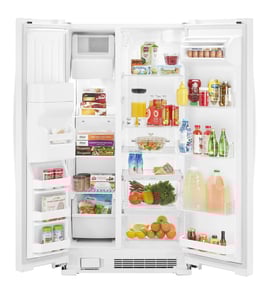



What is the disadvantage of a side-by-side fridge?
A common disadvantage of a side-by-side refrigerator like the Whirlpool GSF26C4EXB00 is reduced usable width in each compartment; wide platters, pizza boxes, and large bins can be harder to fit, and you may bend more to reach fresh-food items stored lower in the refrigerator section.
Common downsides you may notice
- Narrow shelves can limit wide items (party trays, sheet cakes, large leftovers).
- More bending for produce and deli drawers because they sit low.
- Freezer organization can feel “stacked” because items are tall and narrow.
- Door storage can crowd the main shelves when the doors are packed.
- Ice maker and dispenser components can take up door space.
Side-by-side vs. other styles (quick comparison)
| Feature | Side-by-side | French door | Top freezer |
|---|---|---|---|
| Fits wide items | Fair | Best | Good |
| Frozen-food access | Easy (eye level) | Good (drawer) | Fair |
| Fresh-food access | Fair | Best | Fair |
| Door storage impact | Higher | Medium | Lower |
What you can do to reduce the drawbacks
- Keep frequently used fresh items at eye level; reserve lower bins for bulk produce.
- Use shallow bins to prevent “lost” items on deep shelves.
- Avoid overpacking the doors; it can make the interior feel tighter.
- If water taste or flow is an issue, replace the refrigerator water filter EDR1RXD1 on schedule.
- If odors build up faster in a tightly packed fridge, replace the refrigerator air filter W10311524 and keep uncovered foods sealed.
Why it matters
Most complaints about side-by-side fridges come down to space geometry, not cooling performance. Once you organize around narrower shelf width and keep airflow paths clear, day-to-day usability improves and temperature consistency is easier to maintain.
For model-specific features and storage guidance, check the owner's manual.
Last updated: February 2026
What is the biggest problem in a Whirlpool refrigerator?
The most common “big” problem we see in Whirlpool refrigerators like model GSF26C4EXB00 is a cooling failure caused by airflow or defrost issues (frosted evaporator, weak evaporator fan, or a defrost component problem). Water and ice maker issues are also frequent and can look like a cooling problem.
Most common trouble areas (and what you’ll notice)
- Dirty condenser coils: warm fresh food section, longer run times, poor overall cooling.
- Evaporator fan not moving air (fan blade or motor issue): freezer may stay cold while the refrigerator warms.
- Defrost system failure (heater or defrost bi-metal): heavy frost on the freezer back wall, reduced airflow.
- Temperature sensing problems (thermistor): temperatures swing, food freezes in the refrigerator section.
- Water supply problems (inlet valve or filter restriction): slow water dispense, small/hollow ice, no ice.
Quick checks we recommend first
- Set temperatures to normal targets: 0°F freezer and 37°F refrigerator.
- Clean condenser coils and confirm the condenser fan area is clear.
- Listen for the evaporator fan when the freezer door switch is held in.
- Look for frost buildup behind the freezer rear panel.
- If water or ice is weak, replace the filter and purge air from the dispenser.
Parts that commonly solve these symptoms on GSF26C4EXB00
| Symptom | Likely system | Example part on this model page |
|---|---|---|
| Frosted freezer back panel, warm fridge | Defrost | Refrigerator heater WPW10495967 or refrigerator defrost bi-metal WPW10225581 |
| Warm fridge, freezer OK | Airflow | Evaporator motor 4389144 or refrigerator evaporator fan blade WP2169142 |
| No ice or slow water | Water supply | Refrigerator water inlet valve WPW10238100 or refrigerator water filter EDR1RXD1 |
Why it matters
Cooling complaints often come from airflow (fans, frost blockage) rather than the sealed system. Fixing the root cause early helps prevent food spoilage and reduces compressor run time.
For model-specific operating details and control settings, use the owner's manual.
Last updated: February 2026
How can I tell how many cubic feet my Whirlpool refrigerator is?
To estimate the cubic feet of your Whirlpool GSF26C4EXB00 side-by-side refrigerator, we measure the usable interior space (or use the cabinet dimensions as a rough estimate), calculate cubic inches (width × height × depth), then divide by 1,728 to convert to cubic feet. For exact capacity, check the owner's manual.
Quick steps to calculate cubic feet
- Empty the compartment you are measuring (fresh food, freezer, or both).
- Measure interior width, height, and depth in inches (interior gives the best estimate of usable space).
- Multiply:
width × height × depthto get cubic inches. - Divide by 1,728 to get cubic feet.
- Repeat for the freezer and refrigerator sections, then add them together.
Example calculation
If a compartment measures 24 in × 70 in × 24 in:
- Cubic inches:
24 × 70 × 24 = 40,320 - Cubic feet:
40,320 ÷ 1,728 ≈ 23.3 cu ft
Interior vs. exterior measurements (what to use)
| Measurement type | Best for | What it tells you |
|---|---|---|
| Interior (recommended) | Usable storage estimate | Closest to real food space |
| Exterior cabinet | Fit and clearance planning | Not a reliable capacity number |
| Listed capacity in manual | Exact spec for the model | The official cubic feet rating |
Why it matters
Cubic feet helps us match the right refrigerator size to your household needs and compare models fairly. It also helps when planning shelf/bin organization and understanding why a side-by-side may feel narrower even at similar total capacity.
Last updated: February 2026
What is the most dependable side-by-side refrigerator?
The most dependable side-by-side refrigerator is the one with a strong reliability track record and easy-to-service parts support; in real homes, Whirlpool, KitchenAid, and Frigidaire models are commonly chosen for that reason. For your Whirlpool GSF26C4EXB00, staying on top of filter changes and door sealing helps it run reliably for years.
What “dependable” means (what we look for)
- Consistent temperatures in both compartments
- Fewer ice maker and water dispenser issues over time
- Strong door gasket seal (prevents warm air leaks and frost)
- Readily available wear parts (filters, valves, fan parts)
- Straightforward diagnostics and repair access
Practical picks: how to choose a dependable model
Dependability varies by model series and how it is maintained, so we recommend comparing these factors before you buy:
| What to compare | Why it matters | What to check |
|---|---|---|
| Water system design | Reduces dispenser and ice maker failures | Filter type, valve access, leak history |
| Cooling airflow | Prevents warm spots and freezer burn | Evaporator fan performance, vent blockage |
| Door sealing | Cuts frost and run time | Gasket condition, door alignment |
| Controls and sensors | Improves temperature stability | Thermistor and control board history |
How to keep a side-by-side dependable (especially Whirlpool)
Even a great refrigerator becomes “unreliable” when airflow, filtration, or sealing is neglected. For Whirlpool side-by-sides like GSF26C4EXB00, these steps prevent many common complaints:
- Replace the water filter on schedule; a restricted filter can reduce water flow and stress the inlet valve.
- Change the air filter to reduce odors and keep airflow fresh.
- Keep door gaskets clean and fully sealing; warm air leaks cause frost and temperature swings.
- Avoid overpacking; blocked vents reduce cooling performance.
- If you see error codes or repeated temperature issues, use the diagnostic guidance in the owner's manual.
Parts that commonly support reliability on this model
- Refrigerator water filter EDR1RXD1 (water flow, taste, and dispenser performance)
- Refrigerator air filter W10311524 (odor control and fresh-air circulation)
- Refrigerator water inlet valve WPW10238100 (water supply to dispenser and ice maker)
Why it matters
A “dependable” side-by-side is usually the one that maintains stable temperatures with minimal frost and steady water and ice performance. Routine maintenance (filters, seals, airflow) prevents the most frequent service calls and extends compressor life.
Last updated: February 2026