Installation guide

How do I find the model number on my 61000?
Your Broan range hood’s model number is printed on the rating label attached to the hood. On model 61000, the label is typically inside the hood where you can see it after removing the grease filter or opening the lower panel; match the full number exactly when ordering parts.
Where to look on a Broan range hood
Check these common label locations first:
- Inside the hood, behind or above the grease filter
- On the inside wall of the hood canopy (left or right side)
- Near the blower or wiring compartment cover
- On the top of the hood body (visible after loosening the hood from the cabinet)
- On the back of the hood (visible from inside the cabinet above)
How to confirm you have the right number
Use the full model number exactly as printed (including any dashes or extra digits). If you see multiple identifiers, use this quick guide:
| What you see on the label | What to use for parts lookup | Example |
|---|---|---|
| Model or Model No. | Use this | 61000 |
| Serial or S/N | Do not use for parts lookup | (varies) |
| Part numbers | Use only when replacing that specific part | (varies) |
Why it matters
The model number controls which diagrams and manufacturer-approved parts fit your hood. Using the exact model number helps you avoid ordering the wrong items, especially for electrical parts like a circuit board or transformer.
Helpful tip while you’re checking
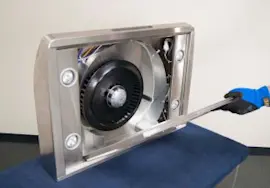
Before you start removing covers, shut off power to the range hood at the breaker. Then follow the access steps shown in the installation guide.
Last updated: March 2026
What are the most common issues with 61000?
For the Broan 61000 range hood, the most common problems are a noisy or weak fan, a fan that will not run, and control or power issues that make the hood act intermittent. Most fixes involve cleaning airflow paths or replacing a failed electrical or blower component.
Common problems we see on Broan 61000
- Fan runs but airflow is weak (grease buildup, blocked duct, dirty filters)
- Exhaust fan is noisy or rattles (loose mounting, worn blower wheel)
- Fan does not run at any speed (failed capacitor, control, or motor circuit)
- Hood turns on by itself or behaves erratically (control board or control logic issue)
- Lights and fan both do not work (power supply, transformer, or control issue)
Quick checks before replacing parts
- Turn off power at the breaker; confirm the hood has a solid power feed.
- Clean the grease filter and confirm the damper and ducting are not blocked.
- Check for vibration: tighten mounting screws and confirm the hood cover is secure.
- If the fan hums but will not start, the run capacitor is a prime suspect.
Parts that commonly solve these symptoms
| Symptom | Likely area | Example part for this model |
|---|---|---|
| Hums, slow start, or no start | Motor start circuit | Capacitor SB06106285 |
| Loud vibration or scraping | Blower assembly | Fan wheel SB03295076 |
| Random operation, dead buttons | Electronic control | Circuit board SB08080101 |
Why it matters
A weak or noisy range hood does not just affect comfort; it reduces smoke and grease capture, which can leave residue on cabinets and shorten the life of the blower and controls.
Helpful guidance
- For step-by-step mounting, venting, and electrical requirements specific to the Broan 61000, use the installation guide.
- If you want symptom-based troubleshooting, follow range hood fan doesn't work or range hood exhaust fan is noisy.
Last updated: March 2026
What is the average lifespan of 61000?
A Broan 61000 range hood typically lasts 15 years with normal cooking use and basic maintenance. Keeping the filters clean, the vent path clear, and the blower balanced helps the motor and controls reach that full service life; see the installation guide for care and setup details.
What affects lifespan the most
- Grease buildup on filters and inside the hood (raises heat and load on the motor)
- Restricted ducting (backdraft damper stuck, crushed duct, heavy lint and grease)
- Fan imbalance from debris on the blower wheel
- Heat and moisture exposure from frequent high-heat cooking without adequate ventilation
- Electrical stress (power surges, loose connections)
Maintenance schedule we recommend
| Task | Typical frequency | Why it helps |
|---|---|---|
| Clean or replace hood filters | Every 1 to 3 months | Protects the motor and improves airflow |
| Wipe interior surfaces | Monthly | Prevents grease from reaching wiring and controls |
| Check vent flap and duct for blockage | Every 6 to 12 months | Reduces strain and noise |
| Inspect blower for buildup and wobble | Every 6 to 12 months | Prevents vibration and premature bearing wear |
Parts that commonly drive “end of life” symptoms
If the hood is noisy, weak, or intermittent, these model-relevant parts are often involved:
- Fan wheel SB03295076 (imbalance, rubbing, reduced airflow)
- Capacitor SB06106285 (motor hums, hard starting)
- Circuit board SB08080101 (erratic speeds, dead controls)
Why it matters
A range hood that is near the end of its lifespan usually shows up as poor smoke capture, higher noise, and inconsistent fan speeds. Addressing airflow restrictions and worn electrical components early often restores performance and prevents motor overheating.
Last updated: March 2026