Owner’s manual
 Error Codes



How to remove bottom grille on GE refrigerator?
On the GE CWE23SP4MBW2 bottom-mount refrigerator, the bottom grille (base grille) typically comes off by releasing its retaining tabs or removing a small number of screws, then pulling the grille straight out from the front. Use gentle, even pressure so the plastic clips do not crack.
- Unplug the refrigerator (or switch off power at the breaker) for safety.
- Look along the top edge and corners of the grille for screws; remove them if present.
- If there are no screws, grip the grille near both ends and pull outward to release the clips.
- If it feels stuck, press in on the clip areas while pulling the grille forward.
- Set the grille aside on a towel to prevent scratches.
- Vacuum dust from the front kick area and airflow openings.
- Confirm the grille is not warped; warping can cause rattles.
- Make sure the grille is not blocking airflow at the toe-kick.
- If you moved the refrigerator, re-level it so doors close properly.
- Line up the grille tabs with the slots first.
- Push evenly from left to right until you feel the clips seat.
- Reinstall any screws snugly (do not overtighten).
| What you see | What it usually means | What to do |
|---|---|---|
| Screws at corners/top edge | Screw-mounted grille | Remove screws, then pull grille forward |
| No screws, firm resistance | Clip-mounted grille | Pull straight out evenly to release clips |
| Grille won’t sit flush | Tabs not aligned or grille warped | Re-seat tabs, check for damage |
The bottom grille helps protect components and supports proper airflow. Keeping it secure and clean helps the refrigerator cool efficiently and reduces noise.
For model-specific diagrams and access notes, use the CWE23SP4MBW2 owner’s manual.
Last updated: January 2026
Is a top mount or bottom mount fridge better?
A bottom-mount refrigerator like the GE CWE23SP4MBW2 is better when you want fresh-food items at eye level and more organization in the refrigerator section; a top-mount is better when you prioritize the lowest upfront cost and simpler access to the freezer. The best choice depends on how your household uses the fridge daily.
| Feature | Top mount (freezer on top) | Bottom mount (freezer on bottom) |
|---|---|---|
| Fresh-food access | Requires more bending | Easier access at eye level |
| Freezer access | Easiest access | More bending (unless pull-out drawers fit your routine) |
| Organization | Typically simpler shelving | Often more bins, drawers, and zones |
| Typical price | Usually lower | Usually higher |
| Best for | Budget, freezer-heavy use | Fresh-food-heavy use, meal prep, organization |
- Choose bottom mount if you open the fresh-food doors frequently and want less bending for everyday items.
- Choose top mount if you use the freezer most often and want it at chest height.
- Measure your space and door swing clearance; built-in style models can be heavier and more sensitive to leveling.
- Plan for maintenance access (pulling the unit out safely, protecting floors, avoiding pinching the power cord or water line).
- If you have kids, consider which section you want them reaching most easily.
Your choice affects daily ergonomics, food visibility (waste reduction), and how well the refrigerator fits your cooking habits. For built-in style GE models like CWE-series units, proper installation and anti-tip protection are also part of safe long-term use.
For safe setup and handling details (including anti-tip guidance and moving the refrigerator for cleaning), follow the CWE23SP4MBW2 owner's manual.
Last updated: January 2026
What is the most common problem with GE profile refrigerators?
The most common service complaint we see on GE Profile-style bottom-mount refrigerators like model CWE23SP4MBW2 is cooling trouble (warm fresh food section, warm freezer, or temperature swings). Many “not cooling” symptoms trace back to airflow, defrost, or temperature-sensing issues rather than the sealed system.
- Fresh food section warm but freezer seems OK
- Freezer warm and ice cream soft
- Frost buildup on the freezer back wall (defrost issue)
- Loud fan noise, rattling, or intermittent buzzing
- Slow ice production or weak water dispenser flow
- Confirm settings: Set fresh food to about 37°F and freezer to about 0°F (typical targets).
- Check door sealing and loading: Overpacked shelves can block vents and cause warm spots.
- Listen for the evaporator fan: If airflow is weak or the fan is noisy, cooling performance drops.
- Look for frost patterns: Heavy frost often points to a defrost problem.
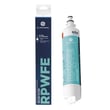
- Water and ice issues: If flow is weak, replace the filter every 6 months or sooner if flow drops (your manual calls out a 6-month or 170-gallon interval).
| Symptom | Common area | Example part to check |
|---|---|---|
| Temperature swings or “too warm” | Sensing/control | Refrigerator temperature sensor WR55X10025 |
| Frost buildup, warm temps | Defrost system | Refrigerator defrost bi-metal thermostat WR50X10108 |
| Weak water flow, slow ice | Water filtration | GE refrigerator water filter RPWFE |
Cooling problems can spoil food quickly and can also make the ice maker and dispenser seem “broken” when the real issue is airflow, defrosting, or temperature feedback to the control.
Use the CWE23SP4MBW2 owner’s manual to match your exact control panel behavior, filter location, and maintenance intervals to your refrigerator.
Last updated: January 2026