Installation guide
 Owner’s manual
 Error Codes





How do you do a hard reset on a GE washer?
For the GE GTWN4250D1WS washer, a “hard reset” is typically a simple control reset: unplug the washer (or switch the breaker off) for about 2 minutes, restore power, then press START to reinitialize the controls. See the GTWN4250D1WS user manual for model-specific control behavior.
- Press STOP/PAUSE (if the washer is responding).
- Unplug the washer (or turn the circuit breaker off).
- Wait 2 minutes.
- Restore power.
- Select a cycle and press START.
These checks are common for this GE top-load platform:
- Confirm the outlet has power (try a lamp or small appliance).
- Make sure both water faucets are fully open.
- Close the lid fully; the washer will not agitate or spin with the lid open.
- If the washer was paused for a long time, reselect the cycle and press START.
- If the lid safety circuit is failing, inspect/replace the washer lid switch assembly WH12X10334.
A power reset clears many temporary electronic “glitches,” but it does not fix a mechanical failure.
| Situation | Reset likely helps? | What to check next |
|---|---|---|
| Control seems frozen or unresponsive | Yes | Power cycle, then press START |
| Washer will not spin with lid closed | Sometimes | Lid switch/magnet, load balance |
| Washer will not fill | Sometimes | Faucet supply, inlet screens, valve |
| Washer stops mid-cycle repeatedly | Sometimes | Error condition, lid switch, drain issues |
Resetting the controls is a fast first step that can restore normal operation after a power flicker or a paused cycle, and it helps you avoid replacing parts unnecessarily.
Last updated: January 2026
What are common problems with GE washers?
Common problems we see on GE washers like model GTWN4250D1WS include leaking, not draining or spinning, excessive vibration or noise, and poor cleaning or odors. Many issues start with simple causes (load size, detergent, hoses) but can also point to a worn or failed component.
- Leaks: loose fill hoses, worn hose washers, cracked drain hose, or a failing tub seal
- Won’t drain / water left in tub: kinked drain hose, clogged pump, or a drain pump failure
- Won’t spin / stops with lid open: lid not fully closed, lid switch or lid magnet issue
- Loud banging or shaking: unbalanced load, washer not level, suspension wear
- Water temperature or fill problems: closed faucets, clogged inlet screens, or a failing inlet valve
For cycle and operating basics specific to this washer, use the GTWN4250D1WS owner’s manual.
- Reset the controls: unplug for 2 minutes, plug back in, then press START.
- Confirm installation basics: standpipe height must be at least 30 inches; washer should sit on firm, level flooring.
- Reduce suds: use HE detergent and measure carefully (oversudsing can mimic drain problems).
- Inspect hoses: check for drips at connections and look for rubbing or cracks.
- Try a drain and spin: redistribute the load first if the tub is off-balance.
| Symptom | Part to check | What it does |
|---|---|---|
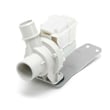
| Won’t drain / humming during drain | Washer drain pump WH23X10043 | Pumps water out of the tub during drain and spin |
| Won’t start or won’t spin with lid closed | Washer lid switch assembly WH12X10334 | Confirms the lid is closed for safe agitation/spin |
| Slow fill or no fill | Washer water inlet valve WH13X10053 | Opens to let hot/cold water into the washer |
Catching the root cause early helps prevent secondary damage, such as water damage from leaks or drive system strain from repeated out-of-balance spinning.
Last updated: January 2026
What is the life expectancy of a GE washing machine?
GE does not publish a specific life-expectancy number for the GE GTWN4250D1WS washer in the product documentation we use for this model. In real-world use, lifespan varies widely based on installation, load habits, detergent use, and how quickly you address leaks, draining issues, or vibration; see the GTWN4250D1WS owner’s manual for care and troubleshooting guidance.
From the GTWN4250D1WS documentation, we can point you to factors that directly affect longevity:
- Proper loading and using HE detergent to reduce oversudsing and residue
- Leaving the lid open after washing to help moisture evaporate
- Turning off water faucets when not in use to reduce leak risk
- Replacing fill hoses periodically (the manual recommends every 5 years)
- Correct drain setup (standpipe height requirements) to prevent drain problems
- Overloading or tightly packing the basket
- Chronic out-of-balance loads and frequent heavy spins
- Too much detergent (especially non-HE detergent)
- Ignoring small leaks or slow draining
- Poor installation setup (drain height, leveling, water supply issues)
If the washer is otherwise in good condition, these common symptoms are often repairable on GTWN4250D1WS:
| Symptom | What to check first | Common related part for this model |
|---|---|---|
| Won’t drain or leaves clothes wet | Drain hose height/kinks; run Drain & Spin | Washer drain pump WH23X10043 |
| Won’t start or stops when lid is opened | Lid closes fully; lid safety function | Washer lid switch assembly WH12X10334 |
| Slow fill or no fill | Hot/cold valves fully open; inlet screens | Washer water inlet valve WH13X10053 |
Because GE does not state a fixed lifespan for GTWN4250D1WS, the best way to maximize service life is preventing the failures that typically end a washer’s useful life: leaks, chronic vibration, and repeated drain or fill problems.
Last updated: January 2026