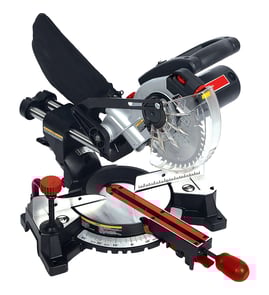

What is the 31.6 on a miter saw?
On the Craftsman 137212090 compound miter saw, 31.6° is a common miter detent (preset stop) used for cutting crown molding laid flat on the saw table. It is typically paired with a 33.9° bevel to produce tight inside or outside corner joints for common crown spring angles.
What the 31.6° setting is used for
When you cut crown molding “flat” (instead of nested against the fence), you set both angles on the saw:
- Miter: rotates the table left or right (often 31.6°)
- Bevel: tilts the blade (often 33.9°)
- Detent/stop: helps you hit the exact miter angle quickly and repeatably
- Goal: accurate corner joints without holding crown at an awkward wall/ceiling position
Typical crown molding angle pairs (flat on the table)
These are the most common reference pairs you will see on many compound miter saws:
| Crown spring angle | Typical miter setting | Typical bevel setting |
|---|---|---|
| 38° | 31.6° | 33.9° |
| 45° | 35.3° | 30.0° |
How to use it correctly (quick checklist)
- Confirm your crown’s spring angle (38° and 45° are most common).
- Set the bevel first, then set the miter to the detent.
- Make a test cut on scrap and check the corner fit before cutting finish pieces.
- Keep the molding flat and fully supported; use extensions or a stable stand.
- Use a sharp blade and steady feed to reduce tear-out on profiles.
Why it matters
Crown molding corners are unforgiving; being even 1° off can open gaps. The 31.6° detent is there to make repeatable, accurate setup faster, especially when you are cutting multiple inside and outside corners.
For general DIY safety and setup habits before making precision cuts, we recommend reviewing are diy appliance repairs safe.
Last updated: February 2026
Where can I buy Craftsman replacement parts?
You can buy replacement parts for your Craftsman compound miter saw model 137212090 by using the model-specific parts list and diagrams on Sears PartsDirect; matching the exact model number helps ensure the part fits your saw and works safely.
Best way to get the right part for model 137212090
Use the model number 137212090 to shop by diagram so you can identify the exact component name and location before ordering.
- Confirm the model tag reads 137212090 (not a similar Craftsman number)
- Use the parts diagrams to pinpoint the exact assembly (guard, fence, table, motor area)
- Compare the part description to what you see on the saw (left vs. right, upper vs. lower)
- Order the replacement part through Sears PartsDirect
What information to gather before ordering
Having these details ready reduces wrong-part orders and downtime.
| What to check | Why it matters |
|---|---|
| Model number: 137212090 | Ensures the diagram and parts list match your exact saw |
| Serial number (if present) | Helps confirm production variation when applicable |
| Symptom (won’t start, won’t lock, won’t cut square) | Points you to the most likely assemblies |
| Photos of the broken area | Helps you match shapes, holes, and mounting points |
Why it matters
Compound miter saw parts are often model-specific (especially guards, fences, detents, and switch components). Ordering by the exact model number helps you avoid fit issues that can affect cut accuracy and safe operation.
Helpful tip for finding the model number
If the label is dirty or worn, clean the housing and check common spots like the rear of the saw, the motor housing, or the base casting. For more guidance, use how to find your appliance model number (and what it means for parts).
Last updated: February 2026
What brand makes the best mitre saw?
There is no single “best” miter saw brand for everyone; the best choice depends on how you use it (trim work vs. framing), how often you cut, and what accuracy features you need. For a Craftsman compound miter saw like model 137212090, focus on cut accuracy, fence and bevel adjustments, and long-term parts support.
What to compare when choosing a miter saw brand
- Cut accuracy and repeatability: solid detents, minimal play in the pivot, and a stable base.
- Fence and table flatness: helps keep crown molding and baseboard cuts consistent.
- Bevel and miter range: common needs are 0 to 45 degrees (sometimes 50+ degrees) with positive stops.
- Slide mechanism quality (if sliding): smooth travel with minimal deflection.
- Dust collection design: matters for indoor trim work.
- Serviceability: availability of wear items like brushes (if brushed), switches, guards, and bearings.
Quick brand fit guide (typical use cases)
| If you mainly do... | Prioritize | Brands often chosen by pros/DIYers |
|---|---|---|
| Finish trim, cabinetry | tight tolerances, smooth bevel/miter locks | Bosch, Makita, DeWalt |
| General DIY, remodeling | value, easy calibration, common parts | Craftsman, Ridgid, DeWalt |
| Jobsite framing | durability, speed, rugged fences | DeWalt, Makita, Bosch |
Why it matters
A miter saw is only as “good” as its ability to hold calibration. Even a powerful motor will disappoint if the miter detents drift, the fence is out of square, or the bevel lock slips. Comparing brands through the lens of alignment, adjustability, and parts availability leads to better results than chasing a single top-rated name.
Helpful next step for owners
If you are evaluating whether to keep repairing your Craftsman 137212090 or replace it, start by checking for common wear issues (switch, wiring, and electrical testing) using how to use a multimeter to test electrical parts video.
Last updated: February 2026
Which mitre saw is the most accurate?
The most accurate miter saw is the one that’s rigid, properly aligned, and stays in calibration; in practice, premium saws (and a well-tuned saw like your Craftsman 137212090) can cut extremely accurately when the fence, bevel, and miter detents are set correctly and the blade is right for the job.
What “most accurate” really means
Accuracy is usually a mix of repeatability and cut quality:
- Repeatable angles: miter and bevel settings return to the same angle every time.
- Square cuts: the blade is 90° to the table and fence when set to 0°.
- Low deflection: the head, rails (if sliding), and pivot points do not flex.
- Clean kerf: the blade does not wander, burn, or tear out.
- Stable work support: the saw is mounted flat and the work is clamped.
How to get maximum accuracy from a compound miter saw
These steps matter more than brand name for day-to-day precision:
- Use a sharp, high-tooth-count crosscut blade (and match blade diameter to your saw).
- Verify the fence is straight and both fence halves are coplanar.
- Set and confirm 0° miter and 0° bevel with a reliable square.
- Check miter detents (0°, 15°, 22.5°, 31.6°, 45°) for true angle.
- Clamp the workpiece; do not “hand-hold” long stock.
- Let the blade reach full speed; feed smoothly to reduce drift.
Quick comparison: what typically separates “ultra-accurate” saws
| Feature | What it improves | What to look for |
|---|---|---|
| Heavier, stiffer base | Repeatability | Less twist, better fence alignment |
| Better detent plate | Angle accuracy | Positive stops that do not shift |
| Tighter pivots/rails | Reduced play | Minimal side-to-side head movement |
| Better blade + arbor fit | Cut quality | Less runout, cleaner crosscuts |
Why it matters
If you’re building cabinets, trim, or furniture, a saw that holds calibration saves time and material. Most “accuracy complaints” come from setup (out-of-square fence/bevel), a dull blade, or stock not being supported and clamped.
Helpful related DIY reading
For general repair and diagnostic techniques that also apply to power tools (checking switches, cords, and connections), use how to use a multimeter to test electrical parts video.
Last updated: February 2026
How thick of wood can you cut with a 12-inch miter saw?
A 12-inch miter saw typically crosscuts about 3-1/2 to 4-1/2 inches thick at 90 degrees; thickness capacity drops on 45-degree miters and bevels. Your Craftsman 137212090 is a compound miter saw model, so use its actual cut-height measurement to set a safe limit.
Typical thickness capacity for a 12-inch miter saw
Use these as practical planning numbers for most 12-inch saws (sliding models often handle wider boards, not dramatically thicker stock):
- 90-degree crosscut (max cut height): ~3-1/2 to 4-1/2 in.
- 45-degree miter: commonly ~2-1/2 to 3-1/2 in.
- Bevel cuts: usually less than 90-degree capacity
- 4x4 material: commonly doable at 90 degrees (actual 4x4 is about 3-1/2 in.)
- 6x6 material: not a one-pass cut on a miter saw; use a different cutting method
How to measure max cut thickness on Craftsman 137212090
This gives you the real, repeatable limit for your specific saw and blade.
- Unplug the saw and set 0-degree miter and 0-degree bevel
- Lower the head fully and measure from the table to the lowest tooth
- Confirm the board can sit flat on the table and tight to the fence
- Check that the lower blade guard clears the workpiece through the full stroke
- Re-check after changing blade diameter, adding a zero-clearance insert, or using an auxiliary fence
Quick reference table
| Cut setup | What changes | Result |
|---|---|---|
| 90-degree crosscut | Maximum clearance | Thickest single-pass cut |
| 45-degree miter | Blade meets stock at an angle | Less thickness capacity |
| Bevel cut | Head tilts, guard and fence clearance change | Often less than 90 degrees |
Why it matters
Staying within true cut height prevents binding, kickback, and motor strain. Measuring your Craftsman 137212090’s clearance is the most accurate way to decide whether a board is safe to cut in one pass.
For help confirming the exact model number on the saw before looking up parts, use how to find your appliance model number (and what it means for parts).
Last updated: February 2026