Owner’s manual
 Error Codes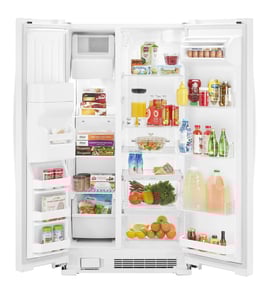


How do I find the size of my Kenmore refrigerator?
For your Kenmore 25351232101 side-by-side refrigerator, “size” usually means either the outside dimensions (to confirm fit in your kitchen) or the storage capacity in cubic feet (to compare models). We use the 25351232101 owner's manual for model-specific guidance, then measure and calculate based on what you need.
Measure the outside dimensions (fit size)
Use a tape measure and record in inches:
- Height: floor to top of hinge cover (or top of cabinet if no cover)
- Width: left to right at the widest point (often the doors)
- Depth: front of doors to back of cabinet (measure with and without handles if needed)
- Door swing clearance: space needed for doors to open fully
- Ventilation clearance: space behind and above for airflow
Quick fit checklist
- Measure the opening (cabinet space) first
- Measure the refrigerator second
- Plan for leveling and a little clearance so doors do not rub
Calculate storage capacity (cubic feet)
If you want an estimated cubic-foot size, we calculate the interior volume (not the outside cabinet size).
- Measure the usable interior of the fresh food section (and freezer if you want total):
- Height (in)
- Width (in)
- Depth (in)
- Multiply to get cubic inches.
- Divide by 1,728 (12 × 12 × 12) to convert to cubic feet.
Example calculation
| What you measure | Formula | Result |
|---|---|---|
| Interior (inches) | H × W × D | cubic inches |
| Convert to cubic feet | cubic inches ÷ 1,728 | cubic feet |
Why it matters
- Outside dimensions prevent delivery and installation problems.
- Cubic feet helps you compare capacity, but it varies based on shelves, bins, and ice maker space.
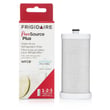
If you are also trying to match a replacement filter for this model, the genuine Kenmore refrigerator water filter WFCB is a common related part for the dispenser system.
Last updated: February 2026
What are the most common problems with Kenmore refrigerators?
The most common problems we see on Kenmore refrigerators like model 25351232101 are cooling issues (often airflow or defrost related), water leaks, ice maker or dispenser troubles, and unusual noises. Many fixes start with basic maintenance and then move to checking key parts listed in the 25351232101 owner's manual.
Most common symptoms and what usually causes them
- Not cooling or weak cooling: dirty condenser coils, failed condenser fan motor, failed evaporator fan, or frost buildup from a defrost problem
- Freezer cold but fresh food warm: restricted airflow (blocked vents), evaporator fan issue, or defrost ice blocking the evaporator
- Water leaking or puddles: clogged defrost drain, cracked water line, or a leaking water tank
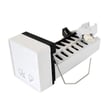
- Ice maker not making ice: low water flow (clogged filter), frozen fill tube, or ice maker component failure
- Ice dispenser jams: cubes clumping from infrequent use; the manual advises removing the bin and shaking to loosen cubes (do not use sharp tools)
- Noisy operation: fan blade rubbing ice, worn fan motor, or vibration from the unit not sitting level
Quick checks we recommend before replacing parts
- Set temperatures to typical targets: 0°F freezer and 37°F fresh food.
- Confirm doors seal tightly and close on their own.
- Make sure vents are not blocked by food packages.
- Clean condenser coils and verify the condenser fan runs when the compressor is running.
- If ice or water output is slow, replace the water filter and flush the system.
Parts that commonly solve these problems (when symptoms match)
| Symptom | Common part to check | Example part on this model page |
|---|---|---|
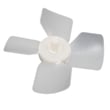
| Warm temps, poor airflow | Evaporator fan blade or fan area icing | Refrigerator evaporator fan blade 5308000010 |
| Frost buildup, warm fridge | Defrost system components | Refrigerator defrost bi-metal thermostat 5303918214 and defrost heater 5303918215 |
| Slow water, bad taste/odor | Water filter | Genuine Kenmore refrigerator water filter WFCB |
Why it matters
Cooling, ice maker, and leak complaints usually trace back to airflow and water flow. Keeping coils clean, maintaining good door sealing, and replacing filters on schedule helps prevent compressor overwork, ice clumping, and recurring puddles.
Last updated: February 2026
What causes a side-by-side refrigerator to stop cooling?
On a Kenmore 25351232101 side-by-side refrigerator, “not cooling” is usually caused by a control set to OFF or too warm, a normal defrost cycle, loss of power at the outlet/breaker, dirty condenser coils, or doors not sealing fully. Use the checks in the owner's manual to pinpoint the cause.
Quick checks we recommend first
- Confirm the unit has power; the plug is fully seated and the breaker is not tripped.
- Make sure the freezer temperature control is not set to OFF (OFF stops the compressor but does not cut power to lights).
- Wait 30 minutes and recheck; an automatic defrost cycle can temporarily stop cooling.
- Verify doors close completely; avoid overloading shelves so containers do not hold the door open.
- Clean the condenser area; a dirty condenser makes the refrigerator run longer and cool poorly.
Most common causes and what you will notice
| What’s happening | Likely cause | What to do next |
|---|---|---|
| No cooling and compressor never runs | Control set to OFF, unplugged cord, tripped breaker/fuse, power outage | Restore power and set controls correctly; allow 8 to 12 hours to cool fully |
| Cooling seems to stop briefly, then returns | Normal defrost cycle (about 30 minutes) | Let the cycle finish; avoid frequent door openings |
| Refrigerator runs a lot but temps stay warm | Dirty condenser, doors opened often, door slightly open, gasket leaking | Clean condenser; reduce door openings; check door seal |
When a door seal problem is the real culprit
A poor seal lets warm air in, which forces longer run times and can prevent stable temperatures.
- Inspect for gaps, rips, or hardened areas on the gasket
- Clean the gasket and mating surface with mild soap and water
- Check that the cabinet is level so doors self-close
- If the gasket is worn or cracked, replace it with the correct part for your model (for example, refrigerator gasket 241786015)
Why it matters
A refrigerator that is warm because of control settings, power issues, dirty condenser coils, or a leaking door seal often looks like a “cooling failure,” but these are the fastest fixes and help prevent food spoilage and compressor overwork.
Last updated: February 2026
Where is the model number on a Kenmore side by side refrigerator?
On the Kenmore side-by-side refrigerator model 25351232101, the model number is printed on the serial plate located inside the fresh food (refrigerator) compartment. Open the refrigerator door and look along the interior walls for the label; it lists both the model and serial information.
Where to look inside the refrigerator compartment
Check these common serial plate locations first:
- Upper side wall near the front opening
- Side wall behind the top shelf area
- Near the crisper drawer area on a side wall
- Along the ceiling area inside the fresh food section
For the exact label location and how it is referenced in the documentation, use the owner's manual.
What you should see on the label
The serial plate typically includes:
- Model number (for example, 25351232101)
- Serial number
- Electrical ratings (voltage and amperage)
- Basic manufacturing information
Quick ID guide
| Item | What it tells you | Why you need it |
|---|---|---|
| Model number | The exact design and parts fit | Ensures you order the correct Kenmore parts |
| Serial number | Production details for your unit | Helps match revisions and production runs |
Cleaning and reading the serial plate (best practice)
We recommend:
- Wiping the label gently with soap and water only
- Avoiding abrasive pads or strong cleaners that can remove printing
- Taking a clear photo of the label before ordering parts or starting a repair
Why it matters
The model number is the key to getting the right refrigerator water filter, ice maker parts, door seals, and control components for your exact Kenmore configuration. Using the correct model number prevents mismatched parts and repeat repairs.
Last updated: February 2026