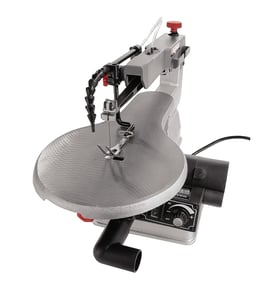

How thick of wood can a scroll saw cut through?
For the Craftsman scroll saw model 31517260, the practical cutting thickness depends on the blade and the wood. Most scroll-saw projects cut cleanly in 3/4 inch to 1-1/2 inches; thicker stock is possible with the right blade, slower feed, and simpler curves.
- 3/4 inch to 1-1/2 inches: best balance of control, detail, and cut quality
- Up to about 2 inches: achievable for many scroll saws in softer woods with a coarse blade and slow feed
- Hardwoods (oak, maple): stay closer to 3/4 inch to 1-1/4 inches for smoother cuts and less blade drift
- Tight inside curves: use thinner stock so the blade can turn without twisting
- Plywood: cuts well, but thick sheets can burn or wander if the blade is dull
| Factor | What you’ll notice when it’s too thick | What to change |
|---|---|---|
| Blade tooth pattern (fine vs. coarse) | Burning, slow cutting | Use a coarser blade for thicker wood |
| Feed rate (push pressure) | Blade bends, cut drifts | Feed slower; let the blade cut |
| Wood hardness | Stalling, rough edges | Reduce thickness or use a more aggressive blade |
| Blade tension | Vibration, wandering | Increase tension and recheck blade setup |
- Choose a blade sized for thickness; coarse teeth clear sawdust better.
- Keep the work flat on the table; don’t twist the wood to force turns.
- If you smell burning, slow the feed and switch to a sharper blade.
- For thick stock, make gentler curves or rough-cut first, then refine.
Staying in a realistic thickness range improves accuracy, reduces blade breakage, and helps prevent overheating and scorch marks, especially on detailed scrollwork.
For help confirming you’re ordering parts and accessories for the correct Craftsman model, use how to find your appliance model number (and what it means for parts).
Last updated: February 2026
Should I get pinless or pinned scroll saw blades?
For a Craftsman scroll saw like model 31517260, we recommend pinless (plain-end) blades for most projects because they fit more blade holders, allow tighter turns, and make inside cuts through small starter holes. Choose pinned blades mainly for quick, thicker cuts when your saw is set up for them.
| Feature | Pinless (plain-end) blades | Pinned blades |
|---|---|---|
| Best for | Fretwork, lettering, puzzles, fine curves | Faster rough cutting, thicker stock |
| Inside cuts | Excellent (small pilot holes) | Limited (needs larger holes) |
| Blade variety | Widest selection (skip-tooth, reverse-tooth, spiral) | Fewer options |
| Setup | Uses blade clamps/adapters | Uses pin slots; quick to mount |
- Pick pinless for detailed patterns, tight radiuses, and clean control in thin to medium wood.
- Pick pinned if you are doing simple cuts, want faster blade changes, and your saw’s arms accept pinned blades without adapters.
- For inside cuts, pinless is the practical choice because you can thread the blade through a smaller drilled hole.
- If you cut plywood or want a cleaner bottom edge, try a reverse-tooth pinless blade.
- If you want to cut in any direction without turning the work, a spiral pinless blade can help (it trades some edge smoothness for flexibility).
Because blade mounting varies by scroll saw design, we use these checks to match blades correctly:
- Look at the upper and lower blade holders: do they clamp a plain blade, or do they have pin slots?
- Measure the maximum blade length your holders accept (most scroll saw blades are standardized, but holders can differ).
- Confirm you have the right blade clamps or adapters installed if you plan to run pinless blades.
- Verify your tensioning method works smoothly; pinless blades rely heavily on proper tension.
Using the right blade type improves cut accuracy, reduces blade breakage, and makes pattern work easier. For most owners, pinless blades unlock the widest range of scroll saw blade styles and project types.
For help locating the exact model tag before ordering accessories, use how to find your appliance model number (and what it means for parts).
Last updated: February 2026
Should scroll saw teeth point up or down?
For a Craftsman scroll saw like model 31517260, the blade teeth should point down (toward the table) so the saw cuts on the downstroke. This gives you better control, cleaner cuts, and helps prevent the blade from grabbing and snapping.
- Teeth point down: correct for most scroll saw cutting
- Teeth point up: usually causes rough cutting, lifting, and frequent blade breakage
- If you lightly drag a fingertip along the blade, it should feel smooth going up and catchy going down (use care)
A scroll saw is designed so the blade’s cutting action happens primarily on the downstroke. With teeth facing down, the workpiece stays pressed to the table, which improves accuracy and reduces vibration.
- The wood stays flatter on the table
- The cut line is easier to follow
- Less splintering on the top surface (with the right blade and feed rate)
- Fewer sudden “jumps” or grabs
- The workpiece lifts or chatters on the table
- The blade wanders and won’t track your line
- Cuts burn or stall because you compensate with too much pressure
- Blades break near the clamps from extra stress
- The saw feels like it is “pulling” the wood upward
- Unplug the saw before adjusting the blade
- Install the blade with teeth down and forward (toward you on most saws)
- Tension the blade until it gives a clear, high “ping” when plucked (not a dull thud)
- Square the table to the blade for straight, accurate cuts
| Blade type/use | Teeth direction | Typical goal |
|---|---|---|
| Standard scroll saw blades | Down | Control and clean downstroke cutting |
| Specialty “reverse tooth” blades | Mostly down (small section up near bottom) | Reduce tear-out on the bottom surface |
Correct tooth direction reduces blade breakage, improves cut quality, and makes your Craftsman scroll saw safer and easier to control, especially on tight curves and delicate fretwork.
For safe electrical checks if the saw won’t run after adjustments, use our guide: how to use a multimeter to test electrical parts video.
Last updated: February 2026
What are some common scroll saw mistakes?
Common mistakes on a Craftsman scroll saw like model 31517260 are incorrect blade tension, forcing the cut, using the wrong blade for the wood thickness, and poor work support. Fixing these basics improves cut accuracy, reduces blade breakage, and makes the saw safer to use.
- Overtightening or undertightening the blade: Tension the blade so it feels firm and cuts without wandering; recheck after the first few minutes of running.
- Pushing the wood too fast: Use a steady, light feed rate; let the blade do the cutting.
- Using the wrong blade type/size: Match blade size to material thickness and detail level (fine blades for tight turns, coarser blades for thicker stock).
- Cutting with a dull or damaged blade: Replace blades early; dull blades cause burning, drift, and rough edges.
- Not keeping the work flat on the table: Keep consistent downward pressure so the wood does not lift and chatter.
- Skipping dust control and visibility: Clear sawdust often so you can follow the line accurately.
- Poor safety habits: Keep fingers out of the cut path, avoid loose sleeves, and use eye protection.
| Symptom | Most likely cause | Best first fix |
|---|---|---|
| Blade breaks often | Too much feed pressure, tight turns, wrong blade | Slow feed; use a finer blade for tight curves |
| Cut drifts or bevels | Blade tension off, dull blade, pushing sideways | Retension; install a fresh blade; feed straight |
| Wood “jumps” or chatters | Work not held flat, blade tension low | Hold stock flat; increase tension slightly |
| Burning/scorching | Dull blade, feeding too slowly | Replace blade; keep a steady feed |
- Bolt or clamp the saw to a solid bench to reduce vibration.
- Start with flat, stable stock; warped wood increases chatter and drift.
- Drill clean entry holes for inside cuts; do not force the blade through.
- Make relief cuts on tight inside corners to avoid twisting the blade.
Most “scroll saw problems” are really blade control problems. Correct tension, the right blade, and a gentle feed rate protect the blade, improve accuracy, and reduce the chance of the workpiece grabbing or lifting.
For tool and electrical checks that apply to many shop tools, we use guides like how to use a multimeter to test electrical parts video.
Last updated: February 2026