 Owner’s manual
 Error Codes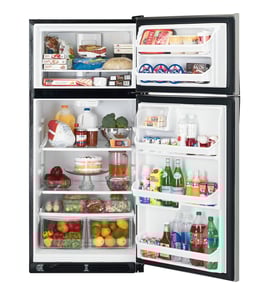




How to read GE refrigerator model number?
For your GE top-mount refrigerator model GTH18EBT2RWW, the model number identifies the product design and features, while the serial number is what you use to determine the manufacturing date. You’ll find both on the rating label inside the fresh food compartment (upper left side). See the GTH18EBT2RWW owner’s manual.
On GE top-freezer/top-mount units like GTH18EBT2RWW, the label is typically located:
- Inside the refrigerator (fresh food section)
- On the upper left side wall
- Behind items on the top shelf area (clear the area to see it)
- Printed as Model # and Serial # on the same sticker
Use the model number to match parts and documentation for your exact refrigerator.
- Confirms the exact GE product platform (top-mount/top-freezer style)
- Helps match correct shelves, gaskets, motors, and electrical parts
- Narrows down color/finish and configuration differences
Use the serial number to determine the manufacture date.
- The first character commonly indicates the month
- Another character in the serial typically indicates the year
- This is the number service techs use to date the unit
| Number on label | Primary use | When you need it |
|---|---|---|
| Model number (GTH18EBT2RWW) | Parts lookup and manuals | Ordering parts, identifying features |
| Serial number | Manufacturing date | Dating the refrigerator, service history |
Reading the label correctly prevents wrong-part orders and speeds up troubleshooting. For example, if you’re replacing a common wear item like a door seal, matching the model first helps you choose the correct gasket such as the refrigerator door gasket (white) WR24X10236 when your unit uses that specific version.
Last updated: February 2026
What is the most common problem with a GE refrigerator?
The most common problem we see with GE refrigerators like model GTH18EBT2RWW is a cooling complaint (refrigerator not cold enough or freezer warming up). In most cases, the root cause is restricted airflow, dirty condenser coils, a failing fan motor, or a door gasket that is leaking air.
- Make sure air vents inside the fresh food and freezer sections are not blocked by food packages.
- Set temperatures correctly and give the unit 24 hours to stabilize after changes (see the GTH18EBT2RWW owner’s manual).
- Clean condenser coils and the area around the condenser fan (dust buildup is a top cause of poor cooling).
- Confirm the doors close fully and the gaskets seal all the way around.
- Listen for the evaporator fan in the freezer; if it is silent or noisy, airflow to the refrigerator section drops.
If basic cleaning and airflow checks do not help, these parts are frequent suspects on top-mount designs:
| Symptom | Most likely area | Example part for this model |
|---|---|---|
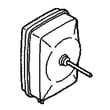
| Fridge warm, freezer cold | Evaporator airflow issue | Refrigerator evaporator fan motor WR60X31522 |
| Frost buildup, warming over time | Defrost system issue | Refrigerator defrost heater WR51X10038 |
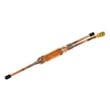
| Runs but struggles to start | Start components | Combo device WR07X10131 |
| Warm temps, moisture, long run times | Door seal leak | Refrigerator door gasket (white) WR24X10236 |
Cooling problems are usually airflow or sealing related; fixing those early helps protect food, reduces run time, and prevents heavier wear on the compressor and start components.
Last updated: February 2026
Is the GTH18EBT2RWW garage ready?
The GE GTH18EBT2RWW top-mount refrigerator is not marketed as a “garage ready” model; for reliable cooling and ice production, we recommend installing it in a temperature-controlled space and following the ambient temperature and installation guidance in the GTH18EBT2RWW owner’s manual.
A garage-ready refrigerator is designed to run correctly in wider ambient temperature swings than a standard top-freezer. In a garage that gets very cold or very hot, a non-garage-ready unit can have temperature control issues.
- Freezer warms up or fresh food gets too cold
- Compressor run time becomes erratic
- Icemaker output drops (or stops) because the freezer does not stay cold enough
- Food spoils faster during heat waves
- Condensation increases around doors and gaskets
Before replacing parts, we recommend these practical steps:
- Confirm the unit is on a dedicated, properly grounded outlet (no extension cord).
- Set temperatures and allow 24 hours for the refrigerator to stabilize after changes.
- Minimize door openings during extreme outdoor temperatures.
- Check door seal condition; air leaks make garage performance worse.
- If you have an icemaker, remember a new install can take 12 to 24 hours to start making ice.
If you are seeing warm temperatures, noise, or weak airflow, these model-matched parts are commonly involved:
| Symptom | What to inspect | Model-matched part example |
|---|---|---|
| Warm fridge, freezer OK | Airflow from freezer to fresh food | Evaporator fan motor |
| Frost buildup, warming | Defrost system | Defrost heater |
| Moisture, poor sealing | Door seal | Door gasket |
Helpful part pages for this model:
- Refrigerator evaporator fan motor WR60X31522
- Refrigerator defrost heater WR51X10038
- Refrigerator door gasket (white) WR24X10236
Garages often fall outside the operating range assumed by standard temperature controls. Keeping the GE GTH18EBT2RWW in a stable indoor environment helps protect food temperatures, reduces compressor stress, and improves overall efficiency.
Last updated: February 2026





