Owner’s manual
 Error Codes



How to remove bottom grille on GE refrigerator?
On the GE GFE24JMKAFES bottom-mount refrigerator, we remove the bottom (base) grille by taking out the two Phillips-head screws, then pulling the grille away from the cabinet. Reinstall by positioning the grille and reinstalling the same two screws per the GFE24JMKAFES owner's manual.
- Unplug the refrigerator if you will be working near wiring or moving the unit.
- Locate the base grille at the very bottom front of the refrigerator.
- Remove the two Phillips-head screws securing the grille.
- Pull the grille straight out and away from the refrigerator.
- Set the grille and screws aside so they do not get lost.
| Situation | Why the grille comes off |
|---|---|
| Leveling the refrigerator | Access to the leveling legs and front frame |
| Moving through a doorway | Extra clearance after removing doors/drawer (if needed) |
| Cleaning under the unit | Better access for vacuuming and wiping |
- Line up the grille tabs and edges with the openings along the bottom front.
- Hold the grille in place and start both screws by hand to avoid cross-threading.
- Tighten the two Phillips screws until snug; do not overtighten.
- If the grille looks uneven, re-seat it and retighten.
The base grille helps protect components at the bottom front of the refrigerator and keeps airflow and appearance correct. It also provides access to the leveling legs, which stabilize the refrigerator and help the doors seal properly.
Last updated: January 2026
What is the most common problem with GE refrigerators ice maker?
On the GE GFE24JMKAFES bottom-mount refrigerator, the most common ice maker issue is restricted water supply, usually from a clogged water filter or low household water pressure. When water flow is weak, the ice maker may make small, hollow, slow-forming, or no ice.
- Replace the refrigerator water filter if it is older than 6 months; a clogged filter reduces flow to the ice maker.
- Confirm the shutoff valve to the refrigerator is fully open.
- Check for kinked or pinched water tubing behind the refrigerator.
- If your home has low water pressure, expect slower ice production and possible cycling behavior.
- If the water supply is shut off, set the ice maker power switch to 0 (off).
| Symptom | Most likely cause | What to do |
|---|---|---|
| No ice at all | Water supply off, filter clogged, ice maker switched off | Verify valve is open, replace filter, turn ice maker on |
| Small or hollow cubes | Restricted flow (filter, low pressure, RO setup) | Replace filter; address pressure; use bypass plug if required |
| Cubes clumping in bin | Ice not used often | Break up cubes and discard old ice |
| Ice maker light off | Freezer door open | Close door; light returns when door is closed |
If your water supply uses reverse osmosis and the refrigerator also has a water filter, using both filters together can cause hollow ice cubes. In that setup, use the refrigerator filter bypass plug as described in the GFE24JMKAFES owner's manual.
If replacing the filter and confirming water supply does not restore normal ice production, the next common water-supply suspect is the inlet valve that feeds the ice maker.
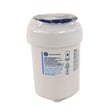
- Start with the filter: GE refrigerator water filter MWFP
- If water flow is still weak: refrigerator water inlet valve WR57X25054
The ice maker depends on steady water flow and correct fill timing. When flow is restricted, the ice maker cannot fill the mold properly, which leads to slow production, undersized cubes, and poor ice quality.
Last updated: January 2026
How do I find the model number on my GFE24JMKAFES?
On your GE GFE24JMKAFES bottom-mount refrigerator, the model number is printed on the rating label inside the fresh food (refrigerator) compartment. Look on the right side wall near the top; the label lists both the model and serial numbers.
- Open the refrigerator (upper) door
- Check the right interior side wall
- Look near the top front area of the compartment
- Find the label that shows Model # and Serial #
- Write both numbers down before ordering parts or scheduling service
Having the exact model and serial number helps us match the correct diagrams and parts for your specific build.
| Label item | What it tells you | When you need it |
|---|---|---|
| Model number | Exact refrigerator model (example: GFE24JMKAFES) | Ordering parts, looking up manuals |
| Serial number | Production-specific identifier | Service history, warranty paperwork |
GE often makes small design changes within a model series. Using the exact model number from the label prevents ordering a similar-looking part that does not fit, such as a water filter, door gasket, or control board.
For the same location details shown by GE, see the owner's manual.
Last updated: March 2026