Installation guide
 Owner’s manual
 Error Codes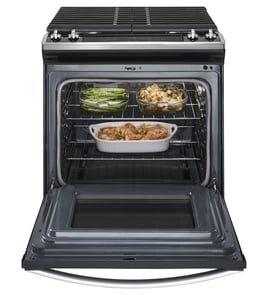

How to reset error code on Whirlpool stove?
On the Whirlpool WFG371LVQ2 gas range, you can clear many error codes by pressing Cancel/Off to stop the cycle, then doing a power reset (turn the breaker off for about 1 minute, then back on) to reboot the oven control. If the code returns, the range needs troubleshooting for the specific failure.
Quick reset steps (safe order)
- Press Cancel/Off once to clear the display and stop heating.
- Wait 30 seconds.
- If the code stays on: turn OFF the range circuit breaker for about 1 minute.
- Turn the breaker ON and set the clock if needed.
- Start a short Bake test to see if the code returns.
If the error code comes back
A repeating code usually points to a part or wiring issue, not a one-time glitch. On this model, common checks include:
- Overheating or wrong temperature: test/inspect the range oven temperature sensor WPW10181986.
- Ignition problems (no heat, delayed ignition): inspect the igniter and burner area; the range oven igniter WP8054129 is a common fix when the igniter is weak.
- Control-related faults: check harness connections at the control and sensor; replace the control if diagnostics confirm it.
- Door lock related codes (if equipped): inspect the latch and switch; the range oven door lock assembly WPW10107820 is the service part.
What to check first (before replacing parts)
- Confirm the range has steady power (breaker not tripping).
- Make sure all control knobs are in Off.
- Verify the gas shutoff valve is open and the range is connected correctly.
- Look for loose, burned, or pinched wires at the sensor, igniter, and control.
Common symptoms and likely direction
| What you notice | What it usually points to | What to do next |
|---|---|---|
| Code clears after reset and doesn’t return | Control glitch | Keep using; monitor |
| Oven temperature is way off | Sensor circuit issue | Check/replace sensor |
| Oven won’t heat, igniter doesn’t glow or is slow | Weak igniter | Check/replace igniter |
| Code returns immediately at power-up | Control or wiring fault | Inspect harness; test components |
Why it matters
Resetting clears temporary control-board glitches, but a repeating error code helps prevent unsafe heating or ignition problems. Fixing the root cause protects the oven control, improves baking accuracy, and restores reliable burner ignition.
For model-specific operating and troubleshooting guidance, use the WFG371LVQ2 owner’s manual.
Last updated: January 2026
What does f2 mean on a Whirlpool gas stove?
On a Whirlpool gas range like model WFG371LVQ2, the F2 error code points to an oven temperature problem, most often caused by the oven temperature sensor circuit (sensor, wiring, or the electronic oven control). A power reset is the first quick step to see if the code returns.
What to do first (safe, quick checks)
- Turn the range off at the circuit breaker for 1 minute, then restore power.
- Watch the display for about 1 minute; if F2 comes back, continue troubleshooting.
- If the oven was actively heating when F2 appeared, let the range cool completely before checking anything.
- If you smell gas, do not use the range; shut off the gas supply and have it checked.
Common causes of an F2 code
| Likely cause | What you may notice | Typical fix |
|---|---|---|
| Failed oven temperature sensor | Oven overheats, underheats, or trips F2 during preheat | Replace the sensor |
| Loose or damaged sensor wiring/connector | F2 appears intermittently, especially when the oven heats up | Reseat connector, repair wiring |
| Electronic oven control issue | F2 persists even after sensor and wiring check | Control diagnosis and replacement |
For this model, the sensor is the range oven temperature sensor WPW10181986.
How we recommend troubleshooting (in order)
- Reset power (breaker off 1 minute) and retest.
- Inspect the sensor harness connection at the back of the control area and at the sensor; look for heat damage, corrosion, or a loose plug.
- Test the sensor with a multimeter (power off); a sensor that reads far out of the normal range at room temperature is a strong failure sign.
- If wiring and sensor test good, the electronic oven control board becomes the next suspect.
If you need diagrams, wiring routing, or access instructions for WFG371LVQ2, use the WFG371LVQ2 owner's manual.
Why it matters
An F2 condition can mean the oven is not regulating temperature correctly. That can lead to poor baking results and, in some cases, overheating that can damage wiring, the igniter, or the control.
Last updated: January 2026
What is the lifespan of a 2 burner gas stove?
Most 2-burner gas stoves typically last about 13 to 15 years with normal home use and basic maintenance. For a Whirlpool range like WFG371LVQ2, keeping burners clean, using correct flame settings, and fixing ignition or heating issues early helps you reach (or beat) that lifespan; see the WFG371LVQ2 owner's manual for care and operating guidance.
What affects lifespan the most
- Burner cleanliness and flame quality: clogged ports and spillovers cause poor ignition and uneven heating.
- Ignition system wear: frequent clicking, delayed lighting, or weak sparking shortens usable life if ignored.
- Oven temperature accuracy: baking issues often trace back to sensing or control problems.
- Gas supply and regulator setup: correct installation and stable gas pressure support reliable operation.
- Heat and moisture exposure: heavy boilovers and harsh cleaners can damage finishes and components.
Maintenance that extends life (practical checklist)
- Clean burner caps and ports regularly; the manual notes a good flame is blue, not yellow.
- Avoid running burners with empty cookware.
- Wipe up spillovers quickly so debris does not enter burner ports.
- If the oven bakes unevenly or temperatures drift, test and replace the range oven temperature sensor WPW10181986 when needed.
- If ignition becomes slow or inconsistent, inspect the igniter and wiring; the range oven igniter WP8054129 is a common fix for weak ignition symptoms.
Quick “repair vs replace” guide
| What you’re seeing | Most likely next step | Typical outcome |
|---|---|---|
| Burners click but light slowly | Clean burner ports, check spark and wiring | Often a low-cost fix |
| Oven temperature swings | Check sensor and calibration | Restores baking performance |
| Strong gas smell or valve issues | Stop using and have it serviced | Safety-critical repair |
| Multiple major failures in a short time | Compare repair total to replacement | Replacement may make sense |
Why it matters
A gas stove that is maintained and repaired early usually costs less to own over time because it heats more efficiently, lights more reliably, and avoids secondary damage (like overheating controls or sooting from poor combustion).
Last updated: January 2026