Owner’s manual
 Error Codes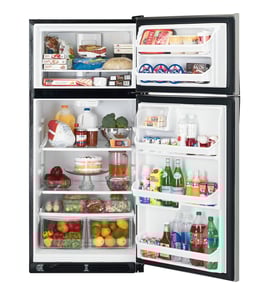





What are the disadvantages of a top mount fridge?
A top-mount (top-freezer) refrigerator like the GE GTS17DTNERWW is simple and reliable, but the main disadvantages are less convenient fresh-food access (more bending), fewer premium organization features, and fewer built-in dispenser options compared with many bottom-freezer designs. See the GTS17DTNERWW owner's manual for model-specific features and setup.
Common disadvantages you may notice
- Fresh-food items sit lower: you bend more to reach produce drawers and lower shelves.
- Freezer is easiest to access: great for frozen-food-heavy households, less ideal if you use the refrigerator section most.
- Fewer convenience features on many models: less common to have external water/ice dispensers.
- Organization can feel tighter: door bins and shelf layouts are often simpler than higher-end styles.
- More temperature swings with frequent door openings: opening the top freezer can affect overall airflow in some kitchens.
Quick comparison: top-mount vs bottom-freezer
| Feature | Top-mount (top-freezer) | Bottom-freezer |
|---|---|---|
| Fresh-food access | Lower, more bending | Eye-level, easier access |
| Freezer access | Very convenient | Requires bending |
| Typical features | Simpler, fewer extras | Often more premium options |
| Cost to own/repair | Often lower | Often higher |
What matters for day-to-day use
If you are deciding whether a top-mount is right for your kitchen, focus on how you shop and cook:
- If you use fresh foods constantly, bottom-freezer layouts reduce bending.
- If you rely on frozen foods, top-mount layouts keep the freezer at a comfortable height.
- If you want water/ice features, confirm whether your exact configuration supports an ice maker or water line options in the manual.
Why it matters
Choosing the right layout helps you avoid daily frustration (bending, cramped storage, awkward reach) and can reduce door-open time, which helps the refrigerator maintain stable temperatures and run efficiently.
Last updated: February 2026
What is the most common problem with GE profile refrigerators?
The most common GE Profile refrigerator problems are ice maker issues and temperature (cooling) problems. Even though your model GTS17DTNERWW is a GE top-mount refrigerator (not a Profile unit), the same failure patterns show up most often: airflow problems, defrost-related frost buildup, and water supply issues to the ice maker.
Most common symptoms customers report
- Ice maker not making ice or slow ice production
- Fresh food section warm but freezer cold (airflow restriction)
- Frost buildup on the freezer back wall (defrost problem)
- Clicking, humming, or fan noise changes (fan or airflow issue)
- Water leaking or no water to ice maker (water supply or valve issue)
What to check first on model GTS17DTNERWW
Start with the quick checks below; they solve a large share of “not cooling” and “no ice” complaints without parts.
- Confirm doors seal tightly; clean gaskets with warm soapy water and dry folds completely (the manual notes gasket care helps them last longer)
- Make sure vents inside the refrigerator and freezer are not blocked by food packages
- If you have an ice maker, verify the shutoff arm or switch is in the ON position
- Verify household water pressure is in range for ice maker operation (typical guidance is 20 to 120 psi without a filter and 40 to 120 psi with a filter)
- Listen for the evaporator fan in the freezer; if it is not running, cooling will suffer
Parts that commonly fix these problems
If the basic checks point to a failed component, these are common repairs for this GE platform:
| Problem area | What you may notice | Example part for GTS17DTNERWW |
|---|---|---|
| Evaporator airflow | Warm fridge, freezer OK, weak airflow | GE refrigerator evaporator fan motor WR60X31522 |
| Ice maker water fill | No ice, hollow cubes, no fill sound | Refrigerator water inlet valve WR57X32213 |
| Door not sensing closed | Lights stay on, fan behavior odd, warm temps | Refrigerator door switch WR23X31507 |
| Frost buildup (defrost) | Frost wall, warming over days | Refrigerator defrost heater assembly WR55X31113 |
Why it matters
Ice maker and cooling complaints usually trace back to airflow, defrost performance, or water supply. Fixing the root cause protects food temperatures, prevents repeat icing, and reduces compressor run time.
Helpful DIY guidance
- Use GE refrigerator error codes if your unit displays a fault code.
- Use the GTS17DTNERWW owner’s manual for model-specific operating features, temperature settings, and care steps.
Last updated: February 2026
How do I find the model number on my GTS17DTNERWW?
For your GE GTS17DTNERWW top-mount refrigerator, the model and serial numbers are printed on a label inside the fresh food (refrigerator) compartment. Look on the left side, near the middle of the compartment, and write the numbers down for parts and service.
Where to look (fast checklist)
- Open the refrigerator door (not the freezer door)
- Check the left interior wall
- Look near the middle height of the compartment
- Find a label that lists Model # and Serial #
- Record both numbers exactly as shown (letters and numbers)
What the label looks like
Most GE top-freezer models use a simple ID label with fields like these:
| Field on label | What it’s used for |
|---|---|
| Model # | Matching the correct diagrams and replacement parts |
| Serial # | Identifying production details for service and warranty paperwork |
Why it matters
Using the exact model number helps us match the correct GE parts for your refrigerator, including items like a door gasket, evaporator fan motor, or water inlet valve. Even small model-number differences can change which parts fit.
Helpful tip for ordering parts
When you search or order, use the full model number exactly as printed on the label (for example, GTS17DTNERWW). For diagrams and additional identification notes, check the GTS17DTNERWW owner's manual.
Last updated: March 2026