Owner’s manual

What size blade is a craftsman 137218740 table saw?
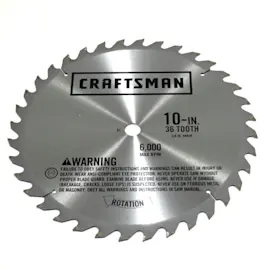
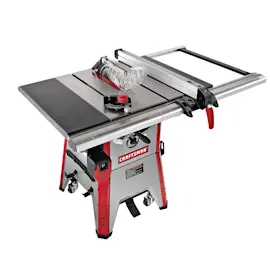
The Craftsman model 137218740 is a 10-inch table saw, and it uses a 10-inch blade. This blade size is part of the saw’s published specifications and matches the standard blade diameter for this 2.5 HP (maximum developed) table saw.
The blade diameter is listed in the specifications section of the owner's manual. When you’re buying a replacement blade, match the diameter (10 inches) first, then confirm the blade’s arbor hole size and tooth style for your type of cuts.
- Use a 10-inch diameter blade
- Match the arbor hole size to your saw’s arbor
- Choose tooth count for the job (rip vs. crosscut vs. combination)
- Verify the blade is rated for at least 5,000 RPM
- Use a blade type intended for table saws (not miter saw only blades)
These model-specific specs help you pick the right blade and set expectations for cutting capacity.
| Spec (Craftsman 137218740) | What it means for you |
|---|---|
| Blade diameter: 10 inches | Standard blade size for this saw |
| No-load speed: 5,000 RPM | Blade must be RPM-rated for safe operation |
| Max depth of cut at 90°: 3 inches | Typical max thickness for straight cuts |
| Max depth of cut at 45°: 2-1/2 inches | Reduced capacity when bevel cutting |
| Max dado width: 1/2 inch | Limits dado stack width (if used) |
Using the correct 10-inch blade helps the blade guard and cutting geometry work as designed, and it keeps your depth-of-cut and safety features aligned with the saw’s specifications.
Last updated: February 2026
Are craftsman table saws any good?
Yes. Craftsman table saws are a solid choice for many DIYers and hobbyists because they typically deliver good cutting power and practical features at a reasonable price. For the Craftsman 137218740 10-inch table saw, the 137218740 owner's manual shows a 10-inch blade, 5000 RPM (no-load), and a 3-inch max depth of cut at 90°, which fits common home-shop needs.
These model-specific specs help set expectations for performance and capacity:
- Blade size: 10 inches
- No-load speed: 5000 RPM
- Max cut depth at 90°: 3 inches
- Max cut depth at 45°: 2-1/2 inches
- Max dado width: 1/2 inch (max dado diameter 6 inches)
| Feature | Craftsman 137218740 spec | What it means in the shop |
|---|---|---|
| Max depth at 90° | 3 in. | Handles typical 2x lumber in one pass |
| Max depth at 45° | 2-1/2 in. | Good capacity for bevel cuts |
| Dado capability | Up to 1/2 in. | Supports basic joinery (within limits) |
| Power requirement | 120V, 15A circuit | Standard household circuit setup |
Most “mixed reviews” come down to accuracy and repeatability, not whether the saw can cut.
- Fence alignment and rigidity affect rip accuracy
- Miter gauge fit affects crosscut consistency
- Table flatness and stand stability affect vibration and cut quality
- Blade choice often matters more than the motor for clean cuts
- Setup and calibration (square blade, parallel fence) determines real-world results
A table saw is only “good” when it is set up safely and used with the right controls.
- Use the blade guard, spreader, and anti-kickback pawls for through-cuts when possible
- Use a push stick for narrow ripping
- Never cut “freehand”; use the rip fence or miter gauge
- Stand out of the blade path to reduce kickback risk
- Use proper power: 120V, 15A branch circuit with correct protection
If you mainly do home projects, trim, shelving, and occasional ripping, a Craftsman saw like the 137218740 can be a dependable workhorse when tuned correctly. If you need production-level precision, the fence and miter system are usually the first areas to upgrade or refine.
Last updated: February 2026
Are all table saw arbor nuts the same size?
No. Table saw arbor nuts are not all the same size because arbor shaft diameter and thread direction can vary by saw model. On the Craftsman 137218740 10-inch table saw, the arbor nut is tightened clockwise (toward the rear of the table), and you should match the nut to the arbor threads shown in the owner's manual.
Even among 10-inch table saws, these details commonly vary:
- Arbor shaft diameter (many 10-inch saws use a 5/8-inch arbor for the blade bore, but the nut threads still vary)
- Thread pitch (fine vs. coarse)
- Thread direction (right-hand vs. left-hand)
- Nut wrench size (the hex size you put a wrench on)
- Flange and washer stack-up (some setups use different flange thicknesses)
The manual’s blade-install steps confirm how the arbor nut is handled on this model:
- You remove the arbor nut and flange to install the blade.
- You hold the arbor flats with an open-end wrench to keep the arbor from turning.
- You tighten the arbor nut by turning it clockwise (toward the rear of the saw table).
| Check | What to look for | Why it matters |
|---|---|---|
| Thread engagement | Nut spins on by hand several turns | Prevents cross-threading |
| Bottoming out | Nut clamps blade and flange firmly | Avoids blade wobble |
| Wrench fit | Wrench fully seats on nut flats | Prevents rounding |
| Arbor flats | Flats are not rounded or damaged | Lets you hold arbor securely |
Using the wrong arbor nut (wrong thread, pitch, or direction) can strip the arbor threads or fail to clamp the blade and flange tightly. That can lead to blade runout, vibration, and unsafe cutting conditions.
Last updated: February 2026
Can you use an 8 inch blade on a 10 inch table saw?
Yes; you can use an 8-inch standard saw blade on the Craftsman 137218740 as long as it matches the arbor size and is rated for the saw’s RPM, but you will lose cutting depth and you must confirm the blade guard and splitter/spreader still function correctly (see the 137218740 owner's manual).
The manual lists this saw as a 10-inch blade table saw with these key limits:
- Rated blade size: 10-inch blade
- Maximum depth of cut: 3 inches at 90°, 2-1/2 inches at 45°
- Maximum dado width: 1/2 inch
- Dado diameter limit: do not use a dado with a diameter larger than 6 inches
- Dado type limit: do not use adjustable (wobble) dadoes
| Item | 10-inch blade (normal setup) | 8-inch blade (smaller) |
|---|---|---|
| Max cut depth | Full capacity | Reduced capacity |
| Guard/splitter alignment | Designed to match | Must be checked carefully |
| Typical use | General ripping and crosscutting | Thin stock, specialty cuts |
| Dado guidance for this saw | Up to 1/2-inch width | Dado sets are limited to 6-inch diameter |
We use these checks any time a blade is changed:
- Unplug the saw before changing blades
- Confirm the blade is tight on the arbor and the flanges seat flat
- Spin the blade by hand to verify it clears the throat plate
- Verify the blade guard, splitter/spreader, and anti-kickback pawls operate freely
- Raise the blade to the needed height (a common target is about 1/8 inch above the workpiece)
Blade diameter changes the saw’s cutting geometry; if the guard and splitter/spreader do not line up, kickback risk goes up. Staying within the manual’s blade and dado limits keeps the Craftsman 137218740 operating as designed.
Last updated: February 2026