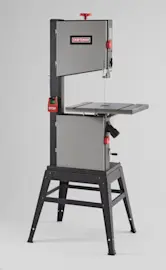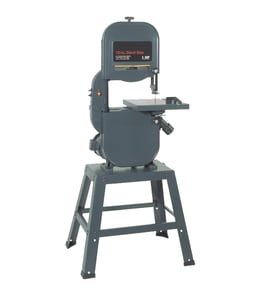
How to change blade on Craftsman 113226682 table saw?
To change the blade on your Craftsman 113226682 table saw, unplug the saw, remove the throat plate, lock the arbor, then loosen the arbor nut (typically left-hand thread) and swap the blade with the teeth facing the correct direction before tightening everything back down.
- Unplug the saw (do not rely on the switch).
- Raise the blade to its highest position for easier access.
- Remove the rip fence and miter gauge so nothing interferes.
- Wear cut-resistant gloves or hold the blade with a folded rag.
- Use the correct wrenches; avoid adjustable wrenches that can slip.
- Remove the throat plate (the insert around the blade) and set it aside.
- Remove the blade guard and splitter/riving setup if it blocks access.
- Lock the arbor (or hold the inner flange) and loosen the arbor nut.
- Slide off the outer washer/flange, then remove the old blade.
- Install the new blade with teeth pointing down toward the front of the table (so the blade cuts on the downstroke at the front).
- Reinstall the outer washer/flange and arbor nut.
- Tighten the nut firmly while holding the arbor; do not over-tighten.
- Reinstall the guard, throat plate, and lower the blade.
Many table saws use a reverse-thread arbor nut so it self-tightens during operation.
| What you see | What it usually means | What to do |
|---|---|---|
| Nut loosens the “wrong way” | Left-hand thread | Turn clockwise to loosen |
| Nut loosens normally | Right-hand thread | Turn counterclockwise to loosen |
A correctly installed blade (proper direction, washers seated flat, nut tightened) reduces vibration, improves cut quality, and helps prevent kickback.
If you are also troubleshooting power, switches, or wiring while you are in the saw cabinet, use how to use a multimeter to test electrical parts video.
Last updated: February 2026
What are the parts of a saw?
A saw is made up of a cutting system (blade or chain), a drive system (motor and gearing), and control and safety parts (switches, guards, handles). For your Craftsman model 113226682, the exact names vary by saw style, but these core parts are consistent.
- Blade or chain: does the cutting (teeth remove material)
- Arbor or sprocket: holds/drives the blade or chain
- Motor: powers the cut (corded electric, battery, or gas)
- Switch/trigger and lock-off: turns the saw on and helps prevent accidental starts
- Guard: covers the blade when not cutting (common on circular and miter saws)
- Base/shoe or table: supports the saw against the workpiece
- Handle(s)/grip: control and stability
| Saw type | Key parts you will see | What they do |
|---|---|---|
| Circular saw | Shoe, lower blade guard, depth lever, bevel lever | Controls cut depth and angle; protects blade |
| Table saw | Table top, fence, miter gauge, riving knife, blade guard | Guides stock; reduces kickback risk |
| Miter saw | Miter detent plate, bevel pivot, clamp, guard | Accurate crosscuts and angles |
| Reciprocating saw | Blade clamp, shoe, trigger | Fast demolition-style cutting |
Knowing the part names helps you diagnose problems faster (for example, a slipping cut can point to the drive system, while rough cuts often point to the blade/teeth). It also helps you match the right replacement part to your Craftsman 113226682.
- Use how to find your appliance model number (and what it means for parts) to confirm you are shopping the correct Craftsman model before ordering.
Last updated: February 2026
What size arbor is on a Craftsman table saw?
For Craftsman table saw model 113226682, the arbor is the shaft the blade mounts on. Most 10-inch Craftsman-style table saws use a 5/8-inch arbor, and you can confirm your exact arbor size in a few minutes by safely removing the blade and measuring the shaft.
- Unplug the saw and remove the switch key (if equipped).
- Remove the throat plate and blade guard/splitter assembly.
- Hold the arbor steady and remove the arbor nut and outer washer/flange.
- Slide the blade off and measure the arbor shaft diameter with a caliper.
- Check the blade’s center hole size stamped on the blade (often 5/8 in.).
Even with the correct arbor size, blade fit and safe operation depend on a few specs.
- Blade diameter (commonly 10 in. on many Craftsman table saws)
- Arbor hole size (commonly 5/8 in.)
- Kerf thickness (must clear the riving knife/splitter if used)
- Maximum RPM rating (must meet or exceed the saw’s no-load speed)
| Saw/blade type | Typical blade size | Common arbor hole |
|---|---|---|
| Full-size table saw blades | 10 in. | 5/8 in. |
| Compact/specialty blades | 7-1/4 in. to 8-1/4 in. | 5/8 in. or smaller |
| Some older/industrial setups | 10 in. | 1/2 in. or 3/4 in. |
A blade with the wrong arbor hole can mount off-center, causing vibration, poor cut quality, and unsafe operation. Measuring the arbor on your 113226682 ensures the blade seats flat against the inner flange.
For help identifying the correct replacement parts by model number, use how to find your appliance model number (and what it means for parts).
Last updated: February 2026
What size motor is on a 10 inch Craftsman table saw?
For the Craftsman power saw model 113226682, the exact motor size depends on the specific motor installed on your saw (original or replacement). Most 10-inch Craftsman table saws in this class use a 120V, 15-amp motor, which is the most common “size” rating you will see for portable and homeowner saws.
Motor size is commonly described in one of these ways:
- Amps (A): common on 120V saws; 15A is typical
- Horsepower (HP): more common on belt-drive or 240V cabinet saws
- Voltage (V): usually 120V for homeowner saws, sometimes 240V for larger shop saws
- Speed (RPM): often listed as no-load blade speed, not cutting speed
Use the saw’s motor nameplate (rating label) to confirm what you have installed.
- Unplug the saw before inspecting
- Look for a label on the motor housing or switch box
- Record amps, voltage, and any HP listing
- If the label is missing, check for a stamped model tag on the motor frame
- Match what you find when searching parts by model number on Sears PartsDirect
| Saw type (common) | Typical electrical rating | Typical motor description |
|---|---|---|
| 10-inch portable/jobsite | 120V, 15A | Direct-drive universal motor |
| 10-inch contractor (belt-drive) | 120V or 240V | Induction motor, often listed in HP |
| Cabinet saw | 240V | Induction motor, higher HP |
Knowing the correct motor rating helps you choose the right circuit, extension cord gauge, and replacement electrical parts (switch, cord, capacitor if equipped). It also prevents nuisance breaker trips and low-power cutting.
Last updated: February 2026