Owner’s manual
 Error Codes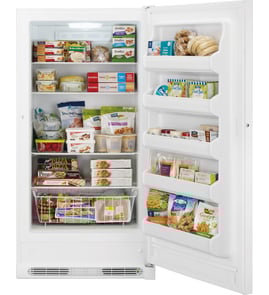


How many watts does my upright freezer use?
Most Kenmore upright freezers like model 253280528012 typically draw about 100 to 250 watts while the compressor is running; actual usage cycles on and off based on room temperature, door openings, and frost buildup. For model-specific electrical ratings, check the data plate and the 253280528012 owner's manual.
What to expect for real-world energy use
Watts change throughout the day because the compressor and fans do not run continuously.
- Start-up surge: brief higher draw when the compressor starts
- Running load: steadier draw while actively cooling
- Off cycle: very low draw when the compressor is off
- Hot rooms: longer run times (the cabinet can feel warm as it rejects heat)
- Frost or poor airflow: longer run times and higher total kWh
Quick estimate: watts to kWh (what you pay for)
Use this to translate “watts” into monthly energy.
| If it averages | That equals | About per 30 days |
|---|---|---|
| 100 W | 0.1 kWh per hour | 72 kWh |
| 150 W | 0.15 kWh per hour | 108 kWh |
| 250 W | 0.25 kWh per hour | 180 kWh |
How to measure your freezer’s actual wattage
For the most accurate number, we recommend measuring.
- Plug the freezer into a plug-in power meter (Kill A Watt style)
- Let it run 24 to 72 hours for a realistic average
- Record kWh used, not just instantaneous watts
- Compare readings after cleaning and improving airflow
Why it matters
Knowing typical watt draw helps, but run time drives your bill. Good airflow around the cabinet and a good door seal reduce compressor run time and help keep food at safe temperatures.
If you suspect a sealing problem
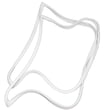
A torn or loose gasket can increase run time; the correct replacement for this model is the freezer door gasket 5304507199.
Last updated: January 2026
How do I find the cubic feet of my Kenmore freezer?
To find the cubic feet of your Kenmore upright freezer model 253280528012, measure the usable inside space (height, width, depth in inches), multiply those numbers, then divide by 1,728 to convert cubic inches to cubic feet. Use the 253280528012 owner's manual to confirm where to measure inside the cabinet.
Steps to calculate cubic feet
- Unplug the freezer and remove baskets/shelves if they block accurate measuring.
- Measure the inside height (top interior to floor).
- Measure the inside width (left interior wall to right interior wall).
- Measure the inside depth (back wall to the inside front edge, not the door thickness).
- Multiply: height × width × depth (in inches).
- Divide by 1,728 to get cubic feet.
Quick formula and example
Formula:
- Cubic feet = (H × W × D) ÷ 1,728
| What you measure | Use this unit | Example value |
|---|---|---|
| Inside height (H) | inches | 60 |
| Inside width (W) | inches | 24 |
| Inside depth (D) | inches | 20 |
| Result | cubic feet | (60×24×20)÷1,728 = 16.7 |
Measuring tips that improve accuracy
- Measure the largest open rectangle of usable space; ignore small molded bumps and corner radiuses.
- If the back wall has an interior panel, measure to the panel surface (not behind it).
- Take each measurement twice; use the larger number if the walls are slightly bowed.
Why it matters
Cubic feet helps you plan food storage and freezing loads. As a rule, we recommend freezing about 3 pounds of fresh food per cubic foot at one time so the freezer can pull temperatures down efficiently (guidance in the manual).
Last updated: January 2026
How do I reset my Kenmore freezer?
To reset your Kenmore upright freezer model 253280528012, unplug the power cord from the wall outlet for about 5 minutes, then plug it back in. This power-cycle clears many control glitches and restarts normal cooling; check the alarm after power is restored using the steps in the 253280528012 owner's manual.
Reset steps (safe, quick checklist)
- Move the temperature control away from OFF so the compressor can run.
- Unplug the freezer by gripping the plug (do not pull the cord).
- Wait 5 minutes (this lets the control and compressor protection reset).
- Plug the freezer directly into a grounded wall outlet (no extension cord).
- If the alarm sounds or the Hi TEMP light is on, press ALARM RESET.
- Allow time for temperatures to stabilize; most upright freezers need several hours to pull back down.
What you should see after a reset
| What happens | What it usually means | What to do |
|---|---|---|
| Hi TEMP light on and buzzer sounds right after plugging in | Normal startup condition | Press ALARM RESET and let it cool |
| Display shows an “E” | Service-needed error condition | Arrange service; keep door closed to hold temp |
| Unit runs but does not cool well | Airflow, door seal, or defrost issue | Check door seal and frost buildup |
Why it matters
A reset is the fastest way to recover from a brief power interruption or a control hiccup without changing settings. It also helps you confirm whether the issue is a temporary electronics state or an ongoing cooling problem.
If it still will not cool after resetting
- Confirm the outlet has power and the plug is fully seated.
- Make sure the door is sealing; a worn gasket can cause warm air leaks.
- Listen for the evaporator fan; if it is not running, cooling will be weak.
- Check for heavy frost on the back wall (defrost system problem).
- If you suspect a door seal problem, consider the freezer door gasket 5304507199.
Last updated: January 2026
Why is my Kenmore bottom freezer frosting up?
Frost buildup in a Kenmore freezer is almost always caused by warm, moist air getting inside or by conditions that increase moisture, such as frequent door openings or high humidity. On model 253280528012, the most important first checks are door sealing and how long the door stays open; both directly drive frost formation.
Quick checks that fix most frosting
- Make sure the door closes fully every time and is not being held open by food packages or baskets.
- Reduce long door-open times; organize items so you can grab what you need quickly.
- Wipe containers dry and wrap foods tightly before loading; moisture on packaging becomes frost.
- Do not line shelves with foil, wax paper, or paper towels; liners restrict airflow and can worsen frost.
- Confirm the freezer is level; a tilted cabinet can prevent the door from sealing correctly.
For model-specific operating and care steps (including leveling and defrosting guidance), use the 253280528012 owner’s manual.
Door seal and alignment: what to look for
A poor seal is the most common reason a freezer “frosts up.” If the gasket is torn, hardened, or pulling away from the door, warm air leaks in and frost builds quickly.
| What you notice | Likely cause | What we recommend |
|---|---|---|
| Frost mainly near the door opening | Door not sealing | Inspect gasket contact all the way around; re-level the cabinet |
| Frost after lots of use | Door opened often/too long | Consolidate trips; label and organize food |
| Moisture on outside of cabinet near door | Warm moist air meeting cold air | Focus on door seating and gasket condition |
If the gasket is damaged, the correct replacement for this model is the freezer door gasket 5304507199.
When it is more than a door issue
If the door is sealing well but frost rapidly coats the inside back wall, the defrost system can be involved (heater, thermostat, control). A common repair in this area is replacing the defrost heater, such as the defrost heat 5304496284 used on this model.
Why it matters
Excess frost reduces airflow and efficiency, makes temperatures less stable, and can lead to longer run times and harder door closing.
Last updated: January 2026