Installation guide
 Owner’s manual


How to hard reset Amana washing machine?
For the Amana NTW4700YQ1 washer, a “hard reset” is a power reset: unplug the washer (or switch off the breaker) for about 5 minutes, then restore power and start a cycle. This clears many control glitches and restores normal operation.
Hard reset steps (power reset)
- Press START/PAUSE to stop the cycle.
- Unplug the washer from the outlet (or turn OFF the circuit breaker).
- Wait 5 minutes.
- Plug the washer back in (or turn the breaker ON).
- Close the lid and run a cycle to confirm the controls respond normally.
If it still acts up: what to check next
A reset will not fix a mechanical or fill/drain problem. These quick checks solve many “won’t start,” “won’t fill,” or “won’t spin” complaints:
- Lid fully closed: the washer must sense the lid closed to run.
- Pause is normal: the washer can pause during certain phases; avoid interrupting the cycle.
- Load balance: redistribute items in loose heaps around the basket wall.
- Suds control: too much detergent can cause suds that slow or stop draining and spinning.
- Drain hose setup: make sure the drain hose is installed correctly and not pushed too far into the standpipe.
When a reset points to a part issue
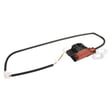
If the washer powers up but will not lock the lid, start, or complete a spin, a failed lid lock is a common cause on top-load models. For this model, the replacement is the washer lid lock assembly W10404050.
| Symptom after reset | Most likely area to inspect | Common related part |
|---|---|---|
| Won’t start, lid won’t lock | Lid lock system | Lid lock assembly |
| Won’t drain, clothes still wet | Drain path or pump | Drain pump assembly |
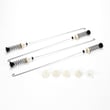
| Shakes or bangs in spin | Leveling or suspension | Suspension rod kit |
Why it matters
Resetting clears temporary electronic faults, but checking lid closure, load balance, detergent amount, and drain hose installation prevents repeat shutdowns and protects the drive system from strain.
For cycle behavior, pausing, and loading guidance specific to the NTW4700YQ1, follow the NTW4700YQ1 owner's manual.
Last updated: February 2026
What is the capacity of the Amana NTW4700YQ1?
The Amana NTW4700YQ1 top-load washer has a 3.4 cu. ft. capacity. That tub size handles most everyday laundry loads well when items are loaded loosely and evenly. For model-specific loading and cycle guidance, use the NTW4700YQ1 owner's manual.
What 3.4 cu. ft. means for real-world loads
A 3.4 cu. ft. washer is a mid-size top-load capacity designed for regular household laundry, including towels and jeans; bulky items need extra space to move.
- Load items in loose heaps, not tightly packed
- Keep the load evenly distributed around the basket wall
- Choose the right water level and cycle for the fabric type
- Avoid adding extra items mid-cycle; it can throw off balance
- Use the correct detergent amount to prevent residue and poor rinsing
Quick load-size guide
Use this as a practical starting point; adjust for fabric thickness and soil level.
| Load size | Typical examples | Basket fill guidance |
|---|---|---|
| Small | a few shirts, light items | under 1/3 full |
| Medium | mixed daily laundry | about 1/2 full |
| Large | towels, jeans, heavier items | about 3/4 full (loose) |
| Bulky | comforter, large blanket | wash alone if it moves freely |
Why it matters
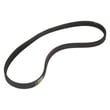
Using the right load size improves cleaning and reduces out-of-balance spinning. Chronic overloading increases stress on the drive system and can contribute to wear on parts like the suspension W10780048 and the washer drive belt WPW10006384.
Last updated: February 2026
How do I find the model number on my NTW4700YQ1?
Your Amana washer’s complete model number and serial number are printed on the model and serial number label attached to the washer. We use that exact model number (NTW4700YQ1) to match the correct parts, diagrams, and troubleshooting info in the owner's manual.
Where to look on the washer
Check these common label locations on top-load washers like the Amana NTW4700YQ1:
- Under the lid, around the tub opening (top rim)
- On the underside of the lid
- Along the lid opening on the cabinet frame
- On the back of the washer cabinet
- Inside the control console area (less common)
What to write down (and why)
Record both numbers exactly as shown on the label:
- Model number (example: NTW4700YQ1)
- Serial number
- Purchase date (helpful for service history and records)
Why it matters
Even small model-number differences can change which parts fit (for example, a lid lock, drain pump, or water inlet valve). Using the complete model number helps us ensure the replacement part matches your washer’s configuration.
Quick check: model vs. serial
| Item | What it tells you | Used for |
|---|---|---|
| Model number | The washer’s design/version | Correct parts and diagrams |
| Serial number | The specific unit’s production ID | Service records and manufacturing details |
Last updated: March 2026