Owner’s manual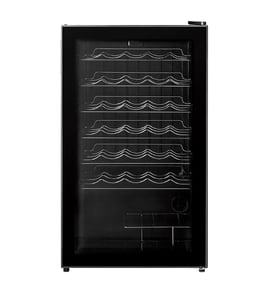



Does GE make wine coolers?
Yes. GE makes wine coolers and beverage centers, including the GE GVS04BQNCSS beverage center (wine and beverage cooler) covered by our parts list and the GVS04BQNCSS owner's manual.
GE identifies this unit as a Wine Center/Beverage and Wine Center in the manual, and it falls under wine and beverage cooler parts for model GVS04BQNCSS.
Common GE wine cooler styles you will see:
- Wine-only wine center (single temperature zone)
- Beverage and wine center (mixed storage)
- Freestanding undercounter-style cabinet
- Glass door models with interior lighting
We recommend matching the model number before ordering shelves, a door gasket, or electrical parts.
- Open the door and look on the left side inside the cabinet
- Write down the model and serial number
- Match the model exactly (example: GVS04BQNCSS)
- Use the manual to confirm control features and setup
If you are maintaining or repairing a GE wine cooler, these are common replacement categories.
| Symptom or need | Common part type | Example for GVS04BQNCSS |
|---|---|---|
| Door not sealing, sweating | Door gasket | Door gasket WR24X20031 |
| Unit not level, door swings | Leveling leg | Haier leveling leg WR01X29750 |
| No interior light | Lamp socket | Lamp socket WR02X31546 |
GE makes several similar-looking wine centers and beverage centers; the exact model number ensures you get the correct door, shelf, control board, or compressor parts and the right setup instructions for temperature control and leveling.
Last updated: February 2026
How do I find the right GE part number?
For your GE GVS04BQNCSS beverage center, the right part number starts with the exact model number from the ID tag inside the unit (left side). Once you match the model, use the parts diagram and description to confirm the correct part ID and compatibility before ordering.
- Locate the model and serial tag inside the beverage center on the left side (door open).
- Write down the model number exactly as shown: GVS04BQNCSS.
- Use the exploded-view diagrams and parts list in the GVS04BQNCSS owner's manual to identify the part name and location.
- Match the part by part name + part ID (not just a similar-looking photo).
- If multiple versions exist, compare your unit’s features (controls, door style, shelving) to the diagram callouts.
- Double-check you are ordering for a beverage center (not a full-size refrigerator or wine-only model).
- Mixing up model families: GVS04 and GWS04 are different products; always use the full model number.
- Ordering by description only: “Compressor” can refer to different assemblies; confirm the exact ID.
- Confusing part number vs. part ID: On Sears PartsDirect, the part ID is what ties to the correct listing for your model.
| What you need | Example part name (as listed) | Example part ID |
|---|---|---|
| Door seal | Door gasket | WR24X20031 |
| Cooling airflow | Fan set | WR02X20027 |
| Power connection | Power cord | WR55X31431 |
| User interface | Display panel | WR09X24393 |
If your symptom points to a specific component, starting with a known match like the door gasket WR24X20031 helps ensure you are looking at the correct section of the parts list.
Using the exact model number and the correct GE part ID prevents fit issues, wiring mismatches, and repeat repairs. It also helps you avoid ordering a part that looks right but is built for a different production run.
Last updated: February 2026
Why is my GE wine fridge not cooling?
If your GE GVS04BQNCSS beverage center is not cooling, the most common causes are warm air leaking past the door seal, poor airflow from dirty condenser coils, or a failed cooling system component (fan, control, or compressor). Use the GVS04BQNCSS owner's manual troubleshooting tips to narrow it down safely.
- Confirm the unit has power and the controls are set to a colder temperature.
- Keep door openings brief; frequent openings quickly raise cabinet temperature.
- Make sure the door closes fully and the gasket seals all the way around.
- Verify the cabinet is level with a slight tilt to the back for better door closure.
- Allow time after changes; beverage centers often need several hours to stabilize.
A beverage center cools by moving heat out of the cabinet. If airflow is restricted, temperatures stall.
| What you notice | Likely issue | What to do |
|---|---|---|
| Runs a lot, barely cools | Dirty condenser area | Clean dust from coils and vents; keep clearance around the unit |
| Warm spots, weak circulation | Fan not moving air | Listen for fan operation; inspect the fan set WR02X20027 |
| Cabinet cools unevenly | Blocked internal airflow | Reposition bottles and cans so vents are not covered |
A small air leak can keep a wine fridge stuck around the mid-50s.
- Inspect the gasket for gaps, tears, or hardened sections.
- Clean the gasket and mating surface with mild detergent and warm water.
- If the door “springs” open, adjust the front legs so the unit tilts back about 1/8 inch.
- If the gasket is damaged, replace the door gasket WR24X20031.
If the compressor runs but the cabinet never gets cold, or you hear unusual clicking and the unit will not start cooling, the issue can be in the start components, control board, or sealed system.
- Check for repeated clicking near the compressor area.
- Inspect wiring connections for damage.
- If cooling components test bad, common replacements include the pcb control WR55X24392 or a compressor such as compressor WR87X32530 (model-specific diagnosis required).
Running warm can spoil wine and force the compressor to run longer, which increases wear and energy use. Fixing airflow and door sealing issues early often restores normal temperatures without major repairs.
Last updated: February 2026