Owner’s manual
 Error Codes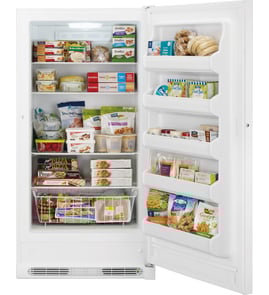


How can I tell how many cubic feet my freezer is?
To estimate the cubic feet of your Frigidaire LFFH17F3QWA upright freezer, we measure the usable inside space (width x depth x height), convert inches to feet, then multiply. For exact published capacity, check the LFFH17F3QWA owner's manual.
- Empty enough space to measure the main compartment (ignore door bins if you want “main cavity” capacity).
- Measure the inside:
- Width (left to right)
- Depth (front to back)
- Height (bottom to top)
- Use one of these formulas:
- Feet method:
- Convert each measurement to feet (inches ÷ 12)
- Cubic feet = width(ft) x depth(ft) x height(ft)
- Inches method (most common):
- Cubic feet = (width(in) x depth(in) x height(in)) ÷ 1,728
If the inside measures 36 in x 24 in x 24 in:
- Cubic feet = (36 x 24 x 24) ÷ 1,728 = 12.0 cu ft
- Measure inside the liner, not the outside cabinet.
- If shelves or baskets reduce usable space, measure the largest open rectangle you can actually load.
- For upright freezers, depth can vary because of the back wall and air channels; take the depth at the most usable point.
Capacity helps you plan how much food you can freeze at once. In the LFFH17F3QWA guide, Frigidaire recommends freezing about 3 pounds of fresh food per cubic foot at one time, which helps the freezer pull temperature down properly.
| What you have | What to do | Result |
|---|---|---|
| Inside measurements in inches | Multiply W x D x H, then ÷ 1,728 | Cubic feet estimate |
| Inside measurements in feet | Multiply W x D x H | Cubic feet estimate |
| Need the official spec | Use the manual’s specifications section | Published capacity |
Last updated: January 2026
Where to find model number on upright freezer?
On the Frigidaire LFFH17F3QWA upright freezer, the model number is printed on a rating label inside the cabinet; it’s commonly on an interior side wall or near the top (ceiling area). If you don’t see it inside, check the back of the unit or behind the lower kick plate.
- Inside the freezer compartment on a side wall
- Inside near the top (ceiling area) of the cabinet
- Along the door opening (door jamb area)
- On the back exterior panel
- Behind the lower kick plate or base panel
- Open the door and scan the upper interior walls first.
- Look for a white or silver sticker with MODEL and SERIAL.
- If not found, pull the freezer slightly forward and check the back panel.
- If your unit has a base panel, remove it and look for the label behind it.
| What you’ll see | Why it helps |
|---|---|
| Model number (example: LFFH17F3QWA) | Matches parts and diagrams to your exact freezer |
| Serial number | Helps identify production run and compatible revisions |
| Electrical ratings (V/Hz/A) | Useful for diagnosing power and compressor issues |
We use the exact model number to match the correct Frigidaire parts (like a door gasket, defrost timer, or evaporator fan motor) and to ensure repair instructions and wiring details line up with your freezer’s configuration. For model-specific identification details, use the LFFH17F3QWA owner's manual.
Last updated: January 2026
Are Frigidaire upright freezers good?
Yes. Frigidaire upright freezers like model LFFH17F3QWA are a solid choice for convenient, organized frozen-food storage; they are designed for stable temperatures, adjustable storage features on many models, and straightforward temperature control. For best results, follow the setup and loading guidance in the LFFH17F3QWA owner's manual.
A good upright freezer typically delivers consistent freezing, easy access to food, and efficient operation with minimal frost issues.
Common strengths customers value:
- Easy organization with shelves, baskets, and door bins
- Quick access (no stacking like a chest freezer)
- Simple temperature adjustments (turn toward COLDEST and allow time to stabilize)
- Better day-to-day convenience for bulk storage
- Less time spent searching with labeled, organized sections
The biggest difference between “good” and “great” performance is setup, loading, and airflow.
Key best practices from the manual:
- Allow 4 hours for the freezer to cool down before loading unfrozen food
- Freeze only about 3 lb of fresh food per cubic foot at one time
- Distribute packages evenly so cold air can circulate
- Do not line shelves or baskets with foil, wax paper, or paper towels (it restricts airflow)
- Keep door openings short; remove what you need and close the door promptly
| Feature | Upright freezer (like LFFH17F3QWA) | Chest freezer |
|---|---|---|
| Access | Fast, eye-level | Slower, stacked items |
| Organization | Shelves and bins | Baskets, more digging |
| Footprint | Taller, smaller floor space | Wider, more floor space |
| Frost management | Many are frost-free; some need periodic defrosting | Often manual defrost |
A freezer can be “good” on day one but struggle if it is overloaded, blocked for airflow, or loaded with too much unfrozen food at once. Following the cool-down and loading limits helps protect food quality and reduces compressor run time.
Last updated: January 2026
Why is my Frigidaire upright freezer not freezing?
If your Frigidaire LFFH17F3QWA upright freezer is running but not freezing, the most common causes are poor airflow (dirty condenser area or blocked vents), a warm air leak at the door gasket, or a cooling/defrost problem. Start with temperature settings and basic airflow checks before replacing parts.
- Confirm the temperature control is set colder; then wait several hours for temperatures to stabilize (avoid rapid knob changes). See the LFFH17F3QWA owner's manual.
- Allow proper cool-down time after startup; this model needs about 4 hours to cool down before loading unfrozen food.
- Make sure shelves and baskets are not lined with foil or paper; liners block cold air circulation.
- Reduce door openings and confirm the door closes fully every time.
- Check the room location; keep the freezer away from heat sources and direct sunlight.
| Symptom you notice | Likely area to check | What to do next |
|---|---|---|
| Runs a lot, temps stay warm | Airflow or door seal | Clean airflow paths; inspect gasket for gaps |
| Frost builds up heavily inside | Defrost system | Inspect defrost heater and timer; defrost safely |
| Warm cabinet, little or no airflow inside | Evaporator fan system | Check fan operation; inspect blade and motor |
| Clicks, hums, then stops | Start components | Test relay/capacitor; consider replacement |
If you find a specific failure, these model-matched parts are common solutions:
- Defrost system: white-westinghouse freezer defrost heater 5304496284 and freezer defrost timer 5304518034
- Air movement: freezer evaporator fan motor 297309000 and blade 5308000010
- Sealing: freezer door gasket 5304505529
- Compressor start: freezer start relay 297259515
A freezer that is not freezing can spoil food quickly and can also overwork the compressor. Fixing airflow restrictions, door leaks, or a defrost failure restores normal temperatures and helps prevent repeat icing and long run times.
Last updated: January 2026