Owner’s manual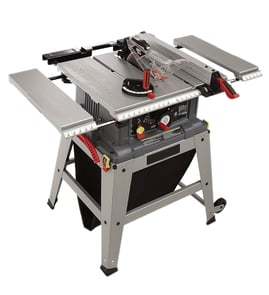

What not to do with a table saw?
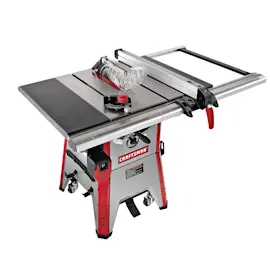
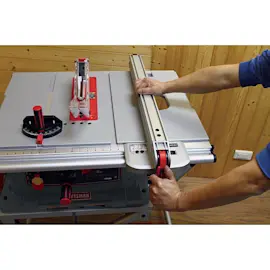
Do not use your Craftsman 351228050 table saw freehand or in a way that puts your hands, body, or the workpiece in line with the blade; most serious table saw injuries come from kickback, binding, or reaching too close during a cut. Use the safety setup and cutting methods shown in the 351228050 owner's manual.
Do not do these things
- Do not cut freehand; always guide the work with the rip fence or a miter gauge.
- Do not use the rip fence as a length stop for crosscuts; it can trap the board and cause kickback.
- Do not reach over or behind the blade to clear offcuts; wait for the blade to stop.
- Do not cut bowed, twisted, or unstable stock without a plan to keep it flat and controlled.
- Do not stand directly in line with the blade; stand slightly to one side.
- Do not wear gloves, loose sleeves, jewelry, or anything that can catch.
Safer habits that prevent kickback and binding
- Keep the blade guard and riving knife (or splitter) installed whenever the cut allows.
- Use a push stick or push block for narrow rips.
- Keep the fence parallel to the blade and lock it firmly before cutting.
- Support long boards with outfeed support so the work does not tip or pinch.
- Let the blade reach full speed before feeding; feed smoothly without forcing.
Quick guide: rip cuts vs. crosscuts
| Cut type | Correct guide | What to avoid | Main risk |
|---|---|---|---|
| Rip (with the grain) | Rip fence | Freehand ripping | Binding, kickback |
| Crosscut (across grain) | Miter gauge or sled | Crosscutting against the fence | Trapping, kickback |
Why it matters
A table saw’s high blade speed can grab a workpiece instantly; when wood binds between the blade and fence, kickback can launch the board toward the operator and pull hands toward the blade. Good guarding, correct guiding, and proper stance reduce that risk.
Last updated: January 2026
How thick of wood can you cut with a 10-inch table saw?
A 10-inch table saw typically cuts about 3 to 3-1/8 inches thick at 90° (and less at a bevel). For your Craftsman 351228050 left-tilting arbor saw, the exact maximum depth of cut depends on blade diameter, blade height setting, and tilt angle; confirm the published spec in the 351228050 owner's manual.
Typical depth of cut (what to expect)
Most 10-inch table saws fall into these common ranges:
- At 90° (straight cut): ~3" to 3-1/8" (some designs approach ~3-1/2")
- At 45° bevel: commonly ~2" to 2-1/4"
- With a thin-kerf vs. full-kerf blade: depth is usually similar; cut quality and motor load change more than depth
- With a dado stack: depth varies by setup and throat plate; always follow the manual’s limits
| Cut setup | Typical max thickness you can cut in one pass | Notes |
|---|---|---|
| 90° rip/crosscut | 3" to 3-1/8" | Most common spec for 10" saws |
| 45° bevel | ~2" to 2-1/4" | Bevel reduces depth significantly |
| 4x4 post (actual 3-1/2" x 3-1/2") | Often requires 2 passes | Turn the work or flip it safely if needed |
What changes the maximum thickness on a 10-inch saw
These factors determine real-world cutting capacity:
- Blade height above the table (maximum elevation)
- Bevel angle (tilting the blade reduces depth)
- Blade geometry (tooth height and plate design)
- Arbor flange and washer stack-up (affects usable blade position)
- Workpiece flatness and fence alignment (binding can limit practical capacity)
How to check your saw’s true capacity
Use this quick method after installing the correct blade:
- Unplug the saw.
- Raise the blade to its maximum height.
- Measure from the tabletop to the highest tooth tip.
- Repeat at 45° if you need bevel capacity.
- Compare your measurement to the spec in the 351228050 owner's manual.
Why it matters
Knowing the maximum depth of cut helps you choose the right approach (single pass vs. multiple passes), the right blade, and safer setups for thick stock like 4x4 material.
Last updated: January 2026
What size breaker for 240v table saw?
Breaker size for a 240V table saw is based on the saw motor’s nameplate amps and the wire size, not the tool type alone. For Craftsman model 351228050, confirm the required voltage and full-load amps on the rating label or in the 351228050 owner's manual before choosing a 2-pole breaker.
How we size the breaker (safe, standard approach)
Use the motor nameplate full-load amps (FLA) and follow electrical code practices for motor circuits.
- Verify the saw is actually wired for 240V (many saws can be 120V or 240V depending on wiring).
- Use a 2-pole breaker for 240V so both hot legs trip together.
- Size the breaker to the circuit wire gauge (the wire limits the breaker size).
- Use a dedicated circuit for the saw to reduce nuisance trips.
- If the breaker trips at startup, check for mechanical drag or electrical issues before upsizing.
Typical breaker and wire pairings for 240V shop tools
These are common home-shop ranges; always follow the saw’s nameplate and local code.
| Motor nameplate amps (FLA) | Typical 240V breaker | Typical copper wire size |
|---|---|---|
| 12A to 16A | 20A, 2-pole | 12 AWG |
| 17A to 24A | 30A, 2-pole | 10 AWG |
If the breaker trips, check these first
- Dull blade, binding stock, or misaligned fence causing overload
- Undersized extension cord or long cord run causing voltage drop
- Loose connections at the plug, receptacle, or breaker
- Weak start components (if equipped) or failing motor bearings
- Another high-draw tool (dust collector, heater) sharing the circuit
Why it matters
Correct breaker and wire sizing protects the branch-circuit wiring and helps the motor start and run without overheating or nuisance trips.
Last updated: January 2026
What is the difference between a cabinet table saw and a contractor table saw?
A cabinet table saw uses a fully enclosed base and heavier internal components for maximum stability, accuracy, and dust control; a contractor table saw uses a more open stand design to reduce weight and cost. For your Craftsman model 351228050, use the base and motor layout shown in the 351228050 owner's manual to identify which style it matches.
Quick comparison
| Feature | Cabinet table saw | Contractor table saw |
|---|---|---|
| Base | Fully enclosed cabinet | Open stand or partial enclosure |
| Trunnions | Cabinet-mounted, heavier | Often table-mounted, lighter |
| Motor placement | Inside cabinet | Often external or rear-hung |
| Stability | Highest | Moderate |
| Dust collection | Typically better | Typically needs upgrades |
What changes in real-world use
- Accuracy under load: Cabinet saw mass and trunnion design hold alignment longer.
- Vibration control: Heavier bases reduce vibration, improving cut quality.
- Fence performance: Cabinet saw packages more often include heavier-duty fence systems.
- Electrical needs: Cabinet saws commonly use higher-amperage circuits; contractor saws often run on standard household circuits.
- Mobility: Contractor saws are easier to move; cabinet saws are intended to stay put.
How to tell which type you have
Check these items on your Craftsman 351228050 and match them to the diagrams and specs in the 351228050 owner's manual:
- Base style: enclosed cabinet panels versus an open stand.
- Motor location: fully inside the base versus mounted externally.
- Dust port path: cabinet bases usually route dust more directly to a port.
- Overall mass: cabinet designs feel noticeably heavier and more planted.
Why it matters
The cabinet vs contractor design affects stability, dust collection, power requirements, and how often you need to re-check alignment (blade-to-miter-slot, fence parallelism, and bevel stops). Picking the right style for your workload improves safety and repeatable cuts.
Last updated: January 2026