Owner’s manual
 Error Codes



What is the most common problem with Samsung refrigerators?
For Samsung refrigerators like model RF263TEAESG, the most common customer-reported problems are ice maker issues (no ice, clumping, freezing up, leaks) and cooling complaints (warm fresh food section, frost buildup, noisy fans). These symptoms usually trace back to airflow, defrost, or ice-room components.
What you typically see first
- Ice maker stops producing or makes small/hollow cubes
- Ice clumps in the bin or the ice room frosts over
- Water leaking in or under the refrigerator
- Fresh food section warms while freezer seems OK
- Fan noise, clicking, or intermittent cooling
Common causes and the parts that often relate
On RF263TEAESG, these issues commonly involve the ice path, sensors, and airflow management. Checking the basics first prevents unnecessary part replacement; we use the RF263TEAESG owner's manual to confirm control settings and any model-specific checks.
| Symptom | Most likely area | Example part for this model (when applicable) |
|---|---|---|
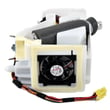
| No ice or clumping | Ice container or auger drive | Refrigerator auger motor assembly DA97-12540G; refrigerator ice container assembly DA97-12604D |
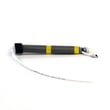
| Ice room frosting, fill issues | Fill tube/heater | Samsung refrigerator ice maker fill tube and heater DA97-00209Z |
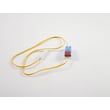
| Temps swing, odd cooling behavior | Temperature sensing | Refrigerator temperature sensor DA32-10104N |
| Warm fridge, noisy rear area | Condenser airflow | Refrigerator condenser fan motor assembly DA97-15765C |
Quick checks we recommend before replacing parts
- Confirm the temperature setpoints and that Cooling Off mode is not enabled.
- Make sure doors close fully and bins are not preventing a tight seal.
- Clear blocked vents; avoid packing food tightly against air returns.
- If ice is the issue, dump old ice, reseat the bin, and verify water supply flow.
- Clean condenser area and confirm the condenser fan runs when the compressor is running.
Why it matters
Ice maker and cooling problems can cascade: restricted airflow and frost buildup reduce heat transfer, which forces longer run times and leads to temperature swings that affect food quality.
Last updated: February 2026
How do you get the bottom shelf out of a Samsung refrigerator?
To remove the bottom shelf in your Samsung RF263TEAESG refrigerator, we lift the front edge, slide the shelf forward to the stop, then angle the glass and frame sideways to clear the liner notches before pulling it out.
Quick steps (safe removal)
- Remove food items and bins that block the shelf path.
- Lift the front of the shelf slightly to unseat it from the rear supports.
- Slide the shelf forward until it stops.
- Tilt the shelf up on one side, then rotate it sideways to clear the cabinet notch.
- Pull the shelf straight out while keeping it supported with both hands.
- Set the shelf on a flat surface to avoid twisting the glass.
What to do if it feels stuck
Most “stuck shelf” issues are caused by the shelf catching on a liner notch, a door bin, or a slightly skewed shelf frame.
- Open both fresh food doors fully so the shelf can rotate.
- Check that the shelf is centered on the left and right supports.
- Lift a little higher at the front, then try the sideways angle again.
- If the shelf has a spill lip, keep the lip facing up while rotating.
- If the shelf is binding, stop and reposition; forcing it can crack the glass.
Shelf removal at a glance
| Shelf position | Usual release action | Common hang-up point |
|---|---|---|
| Bottom fresh food shelf | Lift front, slide forward, rotate sideways | Liner notch near the front corners |
| Middle/upper shelf | Lift front, slide forward | Door bins or rear support tabs |
Why it matters
Removing the shelf the right way prevents chipped liner notches, bent shelf supports, and broken glass. It also makes it easier to clean spills and reinstall the shelf so it sits level and doesn’t rattle.
For shelf layout and support locations specific to this model, use the RF263TEAESG owner's manual.
Last updated: February 2026
What's the average lifespan of a Samsung fridge?
Most Samsung refrigerators, including the Samsung RF263TEAESG bottom-mount style, last 10 to 15 years on average. We see lifespan depend most on compressor health, airflow (clean condenser area), and how well the doors seal; consistent maintenance helps you reach the upper end of that range.
Typical lifespan and what affects it
A refrigerator’s life is usually limited by a few high-wear systems.
- Compressor and sealed system: the biggest driver of overall lifespan
- Condenser airflow: dust buildup makes the unit run hotter and longer
- Door gaskets and hinges: poor sealing causes temperature swings and heavy run time
- Ice maker and water system: clogs, freezing, and leaks add stress and service calls
- Temperature control components: sensors and fans keep cooling stable
What “normal” looks like by age
Use this as a practical expectation guide.
| Age of fridge | What we commonly see | What to do |
|---|---|---|
| 0 to 5 years | Mostly routine upkeep | Keep temps steady; replace filters on schedule |
| 6 to 10 years | More ice and airflow issues | Clean condenser area; check door seal |
| 11 to 15 years | Higher chance of major repair | Compare repair cost vs. replacement |
| 16+ years | End-of-life is common | Plan for replacement if cooling becomes unstable |
Maintenance that extends life (high impact)
These steps reduce run time and prevent overheating.
- Keep the condenser area clean and unobstructed
- Make sure doors close fully; avoid overloading door bins
- Set stable temps (avoid frequent changes)
- Keep vents inside the refrigerator and freezer unblocked
- Address ice maker slow production early using why your Samsung fridge stopped making ice and how to fix it
Why it matters
When a fridge runs longer to hold temperature (from dirty condenser airflow, warm air leaks, or ice buildup), the compressor and fans cycle harder. That extra run time is the main reason a 10 to 15 year appliance can end up closer to 10 than 15.
For model-specific care and operating guidance, follow the RF263TEAESG owner's manual.
Last updated: February 2026
Can I replace fridge parts myself?
Yes. On the Samsung RF263TEAESG bottom-mount refrigerator, we can safely replace many non-sealed-system parts ourselves (bins, shelves, switches, some ice maker components) using basic tools; unplug the refrigerator first and follow the steps in the RF263TEAESG owner's manual.
Good DIY replacements vs. pro-only repairs
Many repairs are straightforward, but anything involving refrigerant lines or complex electrical diagnostics should be handled by a service technician.
| Repair type | Typical DIY? | Why |
|---|---|---|
| Shelves, bins, drawer parts | Yes | No wiring or sealed system work |
| Door switch, sensors | Often | Light wiring and simple access |
| Ice maker components | Often | Mechanical parts, water line checks |
| Compressor, sealed system | No | Specialized tools and refrigerant handling |
DIY checklist before you start
- Unplug the refrigerator (or switch off the breaker) before removing panels or wiring.
- Confirm the full model number: RF263TEAESG.
- Take photos of wire connectors and screw locations as you disassemble.
- Use a towel to catch water when working near the dispenser or ice maker.
- Restore power only after all covers and connectors are reinstalled.
Parts on this model that are commonly DIY-friendly
These are examples of parts we often see customers replace successfully on RF263TEAESG:
- Refrigerator door switch DA34-00066B (lights and door-open sensing)
- Refrigerator temperature sensor DA32-10104N (temperature feedback to controls)
- Samsung refrigerator ice maker fill tube and heater DA97-00209Z (helps prevent fill tube freezing)
- Refrigerator ice maker module DA59-00294B (ice maker drive and cycling)
Why it matters
Choosing the right DIY repair saves time and avoids repeat failures. For example, an ice issue might be a frozen fill tube, a failed module, or a temperature/airflow problem; matching symptoms to the correct part prevents unnecessary returns.
For ice-production troubleshooting steps, use why your Samsung fridge stopped making ice and how to fix it.
Last updated: February 2026