Installation guide
 Owner’s manual
 Error Codes





Is a gas stove 110 or 220?
For the GE JGS760SEL1SS gas range, we plug the range into a 120-volt grounded outlet (typical household 110 to 120V). You do not need a 220 to 240V circuit for normal operation because gas provides the heat; the electricity powers items like ignition, controls, lights, and fans.
What the 120V power runs on this range
Even though it is a gas range, several components still need household power:
- Spark ignition (you will hear clicking when a burner is set to LITE)
- Oven control and display
- Oven light and related wiring
- Convection and cooling fans (if equipped)
- Safety circuits and sensors
For model-specific electrical and grounding requirements, follow the installation guide.
When 220 to 240V applies (and when it does not)
A 220 to 240V circuit is typically used for electric ranges because the heating elements draw much more current. For a gas range like the GE JGS760SEL1SS, 120V is the standard.
| Range type | Typical supply | What uses the power |
|---|---|---|
| Gas range (JGS760SEL1SS) | 120V grounded outlet | Ignition, controls, lights, fans |
| Electric range | 220 to 240V circuit | Heating elements plus controls |
Quick checks if the range has no power
If the display is blank or burners will not spark:
- Confirm the cord is fully seated in a working 120V grounded outlet
- Check the home breaker or fuse for the range outlet circuit
- Avoid using an extension cord (plug directly into the outlet)
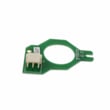
- If power is present but ignition is weak or inconsistent, inspect ignition-related parts such as the range spark module WB13X26360
Why it matters
Using the correct voltage and a properly grounded outlet helps the igniters, control board, and safety features work correctly; it also reduces nuisance ignition problems and prevents damage to electrical components.
Last updated: February 2026
What is the average life of a GE stove?
A GE stove (including the GE gas range model JGS760SEL1SS) typically lasts 13 to 15 years with normal household use and basic maintenance like keeping burners clean and addressing ignition or temperature issues early. Use the care and cleaning guidance in the owner's manual to help maximize lifespan.
What affects how long a GE gas range lasts
Several everyday factors have the biggest impact on service life:
- Cleaning habits: grease buildup around burners and vents can cause poor ignition and overheating.
- Cooking frequency: heavy daily use shortens the life of igniters, valves, and control components.
- Power quality: surges and outages can stress electronic boards and ignition systems.
- Ventilation and heat management: blocked vents can increase internal temperatures.
- Timely part replacement: replacing a weak igniter or failing sensor early prevents bigger failures.
Common wear items on model JGS760SEL1SS
These parts often fail before the range itself is “worn out.” If symptoms match, replacing the worn part can extend the range’s life.
| Symptom | Likely wear area | Example part for this model |
|---|---|---|
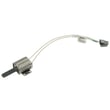
| Oven won’t heat or heats slowly | Ignition system | Range oven burner igniter WB13X40206 |
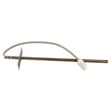
| Oven temperature is inaccurate | Temperature sensing | Range oven temperature sensor WB24X25557 |
| Burners click but don’t light consistently | Spark/ignition control | Range spark module WB13X26360 |
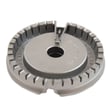
| Burner flame is weak or uneven | Burner cap/valve/orifice area | Range surface burner cap WB28K10222 |
Why it matters
Knowing the typical 13 to 15 year lifespan helps you decide whether to repair or replace. If your JGS760SEL1SS is under about 10 years old, fixing a single failed part (like an igniter or sensor) is often the most practical way to restore safe, reliable cooking.
Last updated: February 2026
Can I still use a gas stove without electricity?
Yes, you can usually use the cooktop burners on your GE JGS760SEL1SS gas range during a power outage by lighting the burner with a match or long lighter after you turn the knob to LITE. The oven and many control features typically will not operate without electricity; check your owner's manual for your model’s exact behavior.
What will and won’t work without power
In most homes, a gas range still needs electricity for ignition and oven controls. Here’s what to expect:
- Cooktop burners: Often usable with manual lighting (match or long lighter)
- Oven bake/broil: Commonly not usable because the control system and safety circuits need power
- Clock/timer and display: Not usable until power returns
- Convection fan and cooling fan: Not usable until power returns
- Control lock (LOC): If the control is locked, you must unlock it to use normal functions
Safe way to light a surface burner manually
Use this method only for the surface burners, and only if you do not smell gas.
- Turn the burner knob to OFF first
- Hold a lit match or long-reach lighter near the burner head
- Slowly turn the knob to LITE until the burner ignites
- Adjust the flame to the desired setting
- If it does not light within a few seconds, turn the knob OFF, wait, and try again
If the range is acting “dead” after power returns
Your manual notes that a power outage or surge can require a reset.
| Symptom | What we do | Why it helps |
|---|---|---|
| Display shows an error again after reset | Disconnect power briefly, then restore power | Clears a temporary control fault |
| Oven was running when power went out | Press Cancel/Off, reset the clock, then reselect cooking mode | Restores normal operation |
| “LOC ON” shows | Turn off control lock | Enables normal use |
Why it matters
Manual lighting can keep you cooking during an outage, but it also increases the risk of unburned gas if you turn a knob on without an ignition source ready. For oven operation and safety features, electricity is typically required on modern GE ranges like the JGS760SEL1SS.
Last updated: February 2026
How much does it cost to replace an oven temperature sensor?
Replacing the oven temperature sensor on your GE JGS760SEL1SS gas range typically costs about $200 to $450 total (part plus labor). If the temperature problem is actually caused by the control board or wiring, the total repair can run $600 to $1,000+.
Typical cost breakdown
Costs vary by location and service rates, but this is a realistic range for this model and repair type.
- Part cost: the sensor itself is usually one of the lower-cost oven parts
- Labor: commonly 0.5 to 1.5 hours for diagnosis and replacement
- Service call/diagnostic fee: often added if you do not proceed with the repair
- Extra parts (sometimes needed): wire connectors, harness repair, mounting hardware
- Higher-cost scenario: electronic control or related components need replacement
| Repair scenario | What’s being replaced | Typical total cost |
|---|---|---|
| Straight sensor replacement | Oven sensor only | $200 to $450 |
| Sensor plus wiring repair | Sensor plus wire/connector work | $250 to $600 |
| Temperature issue is not the sensor | Control board or other electrical part | $600 to $1,000+ |
Parts that commonly relate to temperature problems
If the oven is consistently too hot or too cold, these parts are often involved:
- Range oven temperature sensor WB24X25557
- Range oven control board and overlay (dorian gray) WB27X32209
- Main harness WB18X28904
Why it matters
A failing sensor can cause long preheat times, uneven baking, or temperatures that drift. Replacing the correct part the first time helps avoid repeat service calls and prevents overheating that can damage other range components.
Before you replace parts (quick checks)
Use these steps to confirm the problem is truly temperature-related:
- Compare oven temperature using a reliable oven thermometer (the manual notes this is a practical way to confirm temperature changes).
- Make sure the oven is not in a special mode (for example, Sabbath mode or control lockout).
- Verify the range has steady power (a tripped breaker or blown fuse can cause control issues).
- If the oven is consistently off by a similar amount, check the temperature adjustment feature in the owner's manual.
Last updated: February 2026