Owner’s manual
 Error Codes



Where to find model on GE washer?
On the GE washer model GTW465ASN2WW, the model and serial number label is located under the lid. Lift the lid and look along the top rim of the opening where the lid closes; that tag is what you will use for parts and service. See the GTW465ASN2WW owner's manual.
Quick places to check (most common first)
- Under the lid on the top rim of the washer opening (primary location for GTW465ASN2WW)
- Along the upper cabinet edge near the lid hinge area
- On the back of the control panel (some GE top-load designs)
- On the side of the main cabinet near the bottom edge
- On the service/tech sheet area (if your unit has one tucked inside the cabinet)
What to write down (and why)
The ID tag typically includes both a model number and serial number. Record both exactly as shown.
| Item | Example format | Why we need it |
|---|---|---|
| Model number | GTW465ASN2WW | Ensures the correct GE washer parts list and diagrams |
| Serial number | Letters and numbers | Helps match production changes and service info |
Tips to make the label easy to read
- Wipe the tag gently with a damp cloth; detergent residue can hide characters.
- Use your phone camera and zoom in; it is often clearer than reading it directly.
- Copy characters carefully; 0 (zero) and O (letter O) can look similar.
Why it matters
GE often uses similar-looking washer platforms (GTW465, GTW460, GTW485, etc.). Using the exact model number helps us match the right parts, troubleshooting steps, and service procedures the first time.
Last updated: February 2026
What is the average life of a GE washing machine?
Most GE washing machines, including the GE GTW465ASN2WW top-load washer, typically last 10 to 14 years with normal household use. Consistent care (proper loading, hose replacement, and basic cleaning) is what most often determines whether you land closer to 10 years or closer to 14.
Typical lifespan and what affects it
A washer’s life is mainly driven by load size, cycle frequency, water quality, and how well the machine is installed and maintained.
- Usage volume: multiple loads per day shortens life faster than a few loads per week
- Overloading: strains the drive system, suspension, and tub components
- Out-of-level installation: increases vibration and wear on suspension parts
- Water supply hose age: old hoses can fail; GE recommends replacement every 5 years
- Routine upkeep: periodic cleaning and avoiding excessive detergent helps performance
Maintenance checklist we recommend for GTW465ASN2WW
Use the GTW465ASN2WW owner’s manual for the exact care and operating guidance for this model.
- Replace fill hoses every 5 years (GE recommendation)
- Turn off water faucets when not in use for extended periods
- Keep the washer level to reduce cabinet rub and vibration
- Avoid consistently washing heavy, unbalanced loads
- Run appropriate cycles (for example, Drain & Spin when needed)
Quick reference: lifespan expectations
| Washer situation | Typical outcome | What to do |
|---|---|---|
| Normal use, good maintenance | 10 to 14 years | Keep it level, don’t overload, replace hoses |
| Heavy use (large family, frequent loads) | Closer to 10 years | Reduce overloads, address vibration early |
| Chronic vibration or off-balance loads | Shortened lifespan | Inspect suspension and leveling |
Why it matters
Knowing the typical lifespan helps you decide when a repair makes sense. For example, if your GTW465ASN2WW is mid-life and you’re seeing draining issues, replacing a common wear item like the GE washer drain pump assembly WH23X28418 can be a practical fix compared with replacing the washer.
Last updated: February 2026
Does a GE washer have a filter that needs to be cleaned?
Yes, some GE washers have a filter area that needs periodic cleaning, but it depends on the washer design. For the GE GTW465ASN2WW top-load washer, routine maintenance focuses more on keeping the tub, dispenser area, and drain path clean; follow the cleaning and care steps in the GTW465ASN2WW owner’s manual.
What “filter” means on GE washers
GE uses different designs across top-load and front-load washers, so “filter” can refer to different things.
- Front-load washers often have a drain pump clean-out (coin trap) that you open and clean.
- Many top-load washers do not have a user-accessible lint filter; instead, they rely on proper loading, correct detergent, and a clear drain system.
- Some top-load models may have a pump area that a technician services if debris causes draining issues.
What to clean and check on GTW465ASN2WW
For this model, these steps prevent most “filter-like” problems (slow drain, odors, residue):
- Use HE detergent and avoid over-dosing (oversudsing can cause performance issues).
- Leave the lid open after washing to help the interior dry.
- Wipe the basket and interior surfaces with a soft cloth and mild detergent, then rinse.
- Clean and re-seat the dispenser if buildup is present.
- If you have slow draining, check the drain hose for kinks and confirm the standpipe is not blocked.
When a clogged drain system is the real issue
If water is not leaving the tub, the “filter” people mean is usually debris in the drain path or pump.
| Symptom | Most common cause | Part often involved |
|---|---|---|
| Won’t drain or drains slowly | Debris in pump or drain path | GE washer drain pump assembly WH23X28418 |
| Water left in tub after cycle | Kinked/blocked drain hose | Washer drain hose WH41X32477 |
| Stops mid-cycle with water inside | Lid not locking or control issue | GE washer lid lock assembly WH08X37938 |
Why it matters
Keeping the wash system clean helps prevent odors, improves rinsing, and reduces drain problems that can mimic a “clogged filter.” It also helps protect key components like the drain pump and lid lock.
Last updated: February 2026
Why is my GE washing machine not draining water?
If your GE GTW465ASN2WW washer is not draining, the most common causes are a kinked or incorrectly installed drain hose, a drain height issue, or a problem with the drain pump. Start with the hose and drain setup, then move to pump checks and load-related spin issues.
Quick checks we recommend first
- Unplug the washer before inspecting parts.
- Make sure the drain hose is not kinked and the washer is not sitting on the hose.
- Confirm the drain outlet height is under 8 ft (2.44 m) above the floor.
- If the washer finished but clothes are wetter than normal, redistribute the load and run Drain & Spin.
- Review the drain setup rules (air gap and hose depth) in the GTW465ASN2WW owner's manual.
Drain hose installation issues that stop draining
Improper drain hose placement can cause slow draining, no draining, or siphoning. For this model, the manual calls out two key details: keep an air gap around the hose and do not push the hose too far down the standpipe.
| Drain setup item | What to do | Why it matters |
|---|---|---|
| Hose depth in standpipe | Keep it shallow (about 5 inches max in the pipe) | Prevents siphoning and drain problems |
| Air gap | Leave space around the hose | Avoids a snug fit that can siphon |
| Drain height | Meet the 30-inch minimum; keep outlet under 8 ft | Helps the pump move water correctly |
When the drain pump is the likely cause
If the hose and standpipe setup look correct, focus on the pump. A pump that hums, runs loudly, or runs but does not move water is often jammed by debris or failing electrically.
- Check for small items (coins, socks, lint) that can block the pump path.
- Inspect the tub-to-pump and pump-to-hose connections for clogs.
- If the pump is damaged or seized, replace the GE washer drain pump assembly WH23X28418.
Why it matters
A washer that cannot drain usually cannot spin properly, so loads come out soaking wet and cycles may pause or end early. Correct drain hose routing and a clear, working pump protect the motor, control, and gear case from extra strain.
Last updated: February 2026
Is the GE 4.5 top load washer any good?
Yes. The GE GTW465ASN2WW 4.5 cu. ft. top-load washer is a solid, traditional-style washer for shoppers who want a large-capacity tub, straightforward controls, and strong cleaning action; the main tradeoffs are more noise and occasional out-of-balance behavior during spin.
What “good” looks like on this model
We see customers happiest with this style of GE top-load washer when they prioritize capacity and simple cycles over ultra-quiet operation.
- Large capacity for bulky loads (comforters, towels, mixed family loads)
- Traditional wash action (agitator-style cleaning)
- Helpful fill and rinse options (varies by cycle and settings)
- Automatic load sensing behavior is normal (it may pause and add water in stages)
- Designed to protect itself if the load is off-balance during spin
Common complaints and what to do about them
Out-of-balance loads are the most common “is it any good?” pain point on top-load washers. This model can slow or stop a high-speed spin if it cannot balance the load; that can leave clothes wetter than expected.
- Load items loosely and evenly around the agitator (avoid packing)
- Mix large and small items to help balance (for example, towels plus a few smaller pieces)
- If the load ends wet, redistribute and run Drain & Spin
- Use HE detergent and avoid oversudsing, which can reduce performance
- Keep the lid closed during sensing and start-up behavior
| If you notice | Most likely cause | Best next step |
|---|---|---|
| Clothes wetter than normal | Load could not balance to full spin | Redistribute, run Drain & Spin |
| Washer pauses early in cycle | Normal sensing/start-up sequence | Let it continue, restart only if needed |
| Fill light flashing | Water supply issue | Check both supply valves are fully open |
Why it matters
A “good” washer is the one that matches how you actually do laundry. With the GTW465ASN2WW, good results come from correct loading, using HE detergent, and understanding that the washer may actively correct imbalance to finish the cycle normally.
Helpful reference
For model-specific loading guidance, fill behavior, and indicator light meanings, use the GTW465ASN2WW owner’s manual.
Last updated: February 2026
What is the most common problem with GE washers?
The most common GE washer problem we see is a no-drain or weak-spin complaint; clothes come out wetter than normal because the washer cannot fully drain or it stops short of full spin. On the GE GTW465ASN2WW, out-of-balance loads and drain restrictions are frequent root causes; the GTW465ASN2WW owner's manual also calls out CHI indicator lights that point you to quick fixes.
Most common symptoms and what they usually mean
- Washer won’t drain: kinked/blocked drain hose, clogged pump, or a failing drain pump.
- Won’t spin or spins weakly: out-of-balance load, lid lock issue, or drive system problem.
- Spin light blinking: the washer detected an out-of-balance condition and is trying to correct it.
- Fill light blinking: water is not entering; supply valves or inlet screens are often the issue.
- Pauses during cycle: normal load sensing or cycle design (soak periods).
Quick checks we recommend first (GTW465ASN2WW)
- Redistribute the load evenly, then run Drain & Spin if items are wetter than normal.
- Check the drain hose for kinks; keep the standpipe height within typical limits (the manual notes the drain outlet should be under 8 ft).
- Confirm both hot and cold supply valves are fully open.
- If the washer will not start a new cycle, open and close the lid (the manual notes the lid must be opened after multiple cycles).
- If you suspect a drain failure, inspect the pump area for debris; a common replacement is the GE washer drain pump assembly WH23X28418.
Common causes at a glance
| Symptom | Most likely cause | What to do next |
|---|---|---|
| Wet clothes after cycle | Out-of-balance load | Redistribute, run Drain & Spin |
| Standing water in tub | Drain restriction or pump issue | Check hose, then inspect/replace pump |
| Fill light blinking | Water supply issue | Open valves, check inlet screens |
| Won’t start, lid-related | Lid lock/strike not engaging | Check lid alignment and lock function |
Why it matters
Drain and spin problems can look like “the washer is broken,” but they are often caused by load balance, hose routing, or a pump that is starting to fail. Fixing the root cause prevents repeat stoppages, reduces wear on the gear case and clutch, and helps clothes come out properly spun.
For indicator-light troubleshooting and cycle behavior details, we follow the CHI guidance in the GTW465ASN2WW owner's manual.
Last updated: February 2026
How do I find the right GE part number?
For your GE washer model GTW465ASN2WW, the right part number comes from matching the model number on the washer’s ID tag to the correct parts list, then confirming the part name and number in the GTW465ASN2WW owner’s manual. This prevents ordering a look-alike part that will not fit.
Step-by-step: how we match the correct part
- Find the washer’s model/serial tag (commonly under the lid or on the back of the cabinet).
- Confirm the model number is GTW465ASN2WW (letters and numbers must match exactly).
- Identify the failed system first (drain, fill, spin, lid lock, control).
- Match by part name + part number, not by appearance alone.
- If multiple versions show, match by your washer’s full model number and any revision on the tag.
- Recheck symptoms before ordering (for example, a no-drain issue can be a hose problem, not a pump).
Common part lookups for this model
If you already know what is failing, these are frequent replacements on GTW465ASN2WW:
| Symptom | Likely system | Example part for this model |
|---|---|---|
| Washer will not drain | Drain system | GE washer drain pump assembly WH23X28418 |
| Loud banging, off-balance | Suspension | Washer suspension rod and spring assembly (match left/right as listed) |
| Will not agitate or shift modes | Drive/shift | Washer shifter assembly (match exact listing) |
| Will not lock or start | Lid lock | Lid lock components (match exact listing) |
Why it matters
GE uses model-specific designs, and even small changes in a washer’s series can change wiring, mounting points, or hose connections. Using the exact model number GTW465ASN2WW and verifying the part number avoids delays, returns, and repeat repairs.
Quick checks before you order
- For drain problems, make sure the drain hose is installed correctly; pushing it too far down the standpipe can cause siphoning (the manual notes no more than about 5 inches in the drain pipe and an air gap).
- For fill problems, consider replacing water supply hoses every 5 years to reduce the risk of hose failure (a GE recommendation in the manual).
- For error displays or beeping patterns, use GE gtw top load washer error codes to narrow the part you actually need.
Last updated: February 2026
What parts fail in a washing machine?
In a GE top-load washer like model GTW465ASN2WW, the parts that fail most often are the ones that move water, sense speed or position, lock the lid, or keep the tub stable during spin. Many “washer problems” trace back to a small set of wear items and electrical components.
Most common washer parts that fail
- Water supply hoses: hoses age and can leak; GE recommends replacing them every 5 years.
- Drain system: drain pump, drain hose, and clogs that prevent proper draining.
- Lid lock system: lid lock and striker issues can stop the cycle from starting or spinning.
- Drive and shifting parts: motor pulley, gear case pulley, clutch, and shifter problems can cause no-agitate or no-spin symptoms.
- Suspension: worn rods and springs cause banging, walking, or out-of-balance spinning.
- Controls and sensing: control board, cycle selector switch, and speed sensor failures can cause erratic operation.
Model GTW465ASN2WW parts we see tied to common symptoms
| Symptom | Often-involved part | What it affects |
|---|---|---|
| Won’t drain, water left in tub | GE washer drain pump assembly WH23X28418 | Pumps water out during drain/spin |
| Loud banging, tub off-balance | Washer suspension rod and spring assembly WH16X26911 | Stabilizes the basket during spin |
| Won’t spin or won’t shift modes | Washer shifter assembly WH03X30517 | Shifts between agitation and spin |
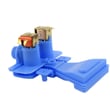
| Won’t fill or fills incorrectly | Washer water inlet valve assembly WH13X26535 | Controls hot/cold water flow |
| Lid won’t lock, cycle won’t start/spin | GE washer lid lock assembly WH08X37938 | Confirms lid is locked for operation |
Quick checks before replacing parts
- Confirm both faucets are fully open; check inlet screens for debris.
- Inspect hoses for bulges, cracking, or seepage; replace on a 5-year schedule.
- If the washer won’t drain, check for a kinked drain hose and listen for the pump running.
- If it shakes or bangs, verify the washer is level and loads are not overloaded.
- If the lid won’t lock, check the striker alignment and look for broken plastic.
Why it matters
Catching early wear (especially hoses, drain components, and suspension) helps prevent water damage, repeat out-of-balance errors, and unnecessary control or motor replacements. For model-specific operating and care guidance, use the GTW465ASN2WW owner’s manual.
Last updated: February 2026