Owner’s manual
 Error Codes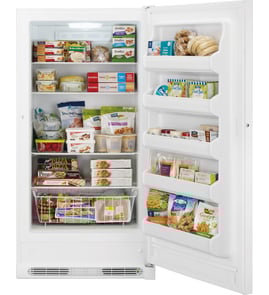

Is it worth getting an upright freezer?
Yes, an upright freezer is worth it when you want easy access and better organization. With a Crosley upright freezer like model WCV20F1, shelves and baskets make it simpler to sort food, and the smaller footprint can fit tighter spaces than many chest freezers.
- You want shelves, door bins, and (on some models) a slide-out basket for smaller items.
- You open the freezer often and want quick visibility of what you have.
- You prefer less bending and easier reach compared to digging into a chest freezer.
- You need a tall, narrow footprint for a pantry, garage corner, or utility room.
Upright freezers are convenient, but they can lose more cold air when the door is opened, which can affect efficiency compared to a chest freezer.
| Feature | Upright freezer | Chest freezer |
|---|---|---|
| Organization | Strong (shelves, sections) | Moderate (often baskets, stacking) |
| Footprint | Smaller floor space, taller | Larger floor space, shorter |
| Access | Easier, less digging | More digging/stacking |
| Door-open cold loss | Higher | Lower |
We recommend following the placement and electrical guidance in the owner's manual. Key points include:
- Place it indoors, not outdoors.
- Use a properly grounded 115V, 60 Hz, 15 or 20 amp circuit; avoid extension cords.
- Allow airflow clearance (commonly 3 inches on top and sides, 1 inch at the back).
- Keep it away from heat sources (ovens, radiators).
- Let it get fully cold before loading it with food.
A freezer that is level, well-ventilated, and on the right electrical supply runs more consistently; that helps reduce temperature swings that can lead to freezer burn and wasted food.
Last updated: February 2026
What is the average lifespan of an upright freezer?
An upright freezer typically lasts 10 to 15 years. With good airflow clearance, steady indoor temperatures, and routine cleaning, many units run 15 to 20 years. For your Crosley WCV20F1, following the care and setup guidance in the owner's manual helps maximize service life.
Most upright freezers fall into these practical ranges:
- 10 to 15 years: common average lifespan
- 15 to 20 years: well-maintained, used in stable indoor conditions
- Under 10 years: more likely with poor ventilation, heat exposure, or electrical issues
| Condition | What it usually does to lifespan | What we recommend |
|---|---|---|
| Indoor, temperature-controlled room | Extends lifespan | Keep it away from heat sources |
| Tight clearances around cabinet | Shortens lifespan | Maintain proper spacing for airflow |
| Heavy warm-food loading | Adds compressor strain | Pre-chill when possible; load gradually |
| Dirty condenser/poor cleaning habits | Reduces efficiency over time | Clean surfaces and keep airflow paths clear |
Your manual calls out several setup and use habits that directly affect longevity:
- Use a proper grounded 115V, 60 Hz, 15 or 20A electrical supply on a dedicated circuit
- Do not use an extension cord
- Install indoors, away from flammables and away from heat sources (oven, radiator)
- Allow airflow clearance: 3 in. top, 1 in. back, 3 in. each side
- Let the freezer cool 6 to 8 hours before filling; cool overnight before adding large amounts
- Avoid overloading with unfrozen food (a common guideline is 2 to 3 lb per cubic foot at a time)
Freezer lifespan is mostly about compressor run time and heat removal. Good ventilation and controlled room temperature reduce strain, help the freezer hold around 0°F, and prevent the unit from running continuously.
Last updated: February 2026
Is Crosley a good freezer brand?
Crosley upright freezers like model WCV20F1 are a solid value choice for everyday home storage when they’re installed correctly and maintained well. In our experience, owners get dependable freezing performance by following the placement, electrical, and loading guidance in the owner's manual.
A “good” freezer brand is one that delivers stable temperatures, fits your space, and is easy to keep running. For Crosley upright freezers, we focus on these practical factors:
- Proper installation and leveling so the door seals consistently
- Correct location away from heat sources and in a suitable room temperature range
- Reliable power supply on a grounded, dedicated circuit
- Good door gasket seal to prevent warm air leaks and frost issues
- Routine cleaning of the interior and door gasket
The biggest difference between “great” and “frustrating” freezer ownership is setup. Here are the key requirements called out for this type of unit:
| Item | What to do | Why it matters |
|---|---|---|
| Electrical | Use a grounded 115V, 60 Hz, 15 or 20A circuit; avoid extension cords | Prevents nuisance shutdowns and electrical issues |
| Clearance | Leave space around the cabinet (top, back, and sides) | Helps airflow and efficiency |
| Room temp | Keep the freezer where ambient temps are typically 40°F to 90°F | Supports efficient, stable operation |
| First load | Don’t load food until it has time to get properly cold | Improves freezing results and food safety |
Most “brand problems” we see are actually installation, airflow, or power problems. When your Crosley WCV20F1 is level, has proper clearances, and is on the right electrical supply, it runs more efficiently and holds temperature more consistently.
Last updated: February 2026
What is the disadvantage of an upright freezer?
The main disadvantage of an upright freezer (including the Crosley WCV20F1) is that it loses cold air faster when you open the door, so it typically runs more often than a chest freezer. Uprights also store bulky, awkward items less efficiently because shelves and bins limit usable space.
- More temperature swing during door openings: Cold air spills out when the door is open; keep door-open time short and organize by “grab-and-go” zones.
- Less usable space for large items: Shelves and door bins can make it harder to fit turkeys, big roasts, or large boxes; use flatter packaging when possible.
- More frost management on manual-defrost styles: If your model is manual defrost, plan periodic defrosting to keep airflow strong.
- Placement matters more: Uprights need clearance around the cabinet for airflow; follow the spacing guidance in the owner's manual.
- Can be noisier during recovery: After loading warm food or frequent openings, the compressor may run longer to pull temps back down.
| Feature | Upright freezer | Chest freezer |
|---|---|---|
| Organization | Shelves, bins, easier sorting | Stacking, baskets, more digging |
| Door-open cold loss | Higher | Lower |
| Bulky item storage | Harder | Easier |
| Footprint | Smaller floor space | Larger floor space |
If you open the freezer often, an upright’s convenience is a big win, but the extra door-open cold loss can increase run time and make temperature recovery slower. Good organization and correct installation clearances help your WCV20F1 stay efficient and protect food quality.
- Install indoors, away from heat sources
- Use a dedicated, grounded 115V circuit (no extension cord)
- Leave recommended clearances (top, sides, and back)
- Let the freezer get fully cold before loading a lot of food
Last updated: February 2026
What is the most reliable brand of upright freezer?
There is no single “most reliable” upright freezer brand for every home; reliability depends on how the freezer is used and where it’s installed. For long-term dependability, we see the best results when you choose a well-supported brand and install and operate it within the temperature and electrical requirements in your owner's manual.
When you compare upright freezers, these factors usually predict fewer problems over time:
- Stable room temperature: Upright freezers run most efficiently when the area stays about 40°F to 90°F.
- Frost-free vs. manual defrost: Frost-free adds convenience but includes more components (heater, timer/control, defrost thermostat).
- Door seal quality: A tight gasket prevents warm air leaks that cause long run times and frost.
- Alarm and indicator features: Helpful for catching temperature rises early.
- Parts availability and serviceability: Common components (thermostat/control, evaporator fan, door gasket) should be easy to source.
Your Crosley WCV20F1 upright freezer is designed for dependable service when it’s properly installed, leveled, and used indoors. The manual also notes that some models include features like Fast Freeze (continuous run for rapid pull-down) and a temperature monitor alarm that sounds if the freezer rises above about 10°F; those features can help protect food when used correctly.
| What to check | Target | Why it matters |
|---|---|---|
| Location temperature | 40°F to 90°F | Reduces compressor stress and temperature swings |
| Door closing and seal | Fully closes, no gaps | Prevents frost and warm-air intrusion |
| Loading practices | Don’t overload with warm food | Avoids long recovery times |
| Fast Freeze use | 24 to 48 hours max when needed | Helps freeze large loads without overworking long-term |
Most “unreliable freezer” complaints trace back to installation conditions (heat sources, unheated spaces, poor leveling) and airflow or door-seal issues, not just brand. Following the setup and operating guidance for your specific model is the most direct way to get reliable performance.
Last updated: February 2026