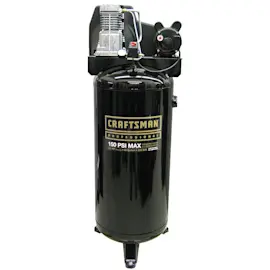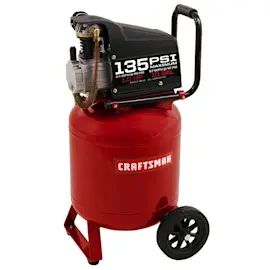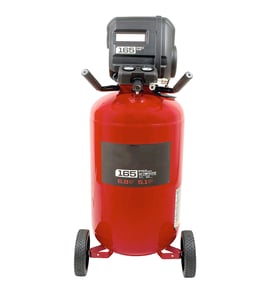

How to find air compressor model number?
On a Craftsman air compressor like model 10217048, the model number is printed on the unit’s identification label (often a metal or foil placard) attached to the tank or frame; it’s usually stamped or clearly printed near other specs like PSI and voltage.
Check these common label locations first:
- On the air tank near the handle or wheel side
- On the frame/base rail under the motor or pump
- Near the pressure switch cover area
- By the power cord entry point or control panel
- On the rear of the tank opposite the gauges
Most air compressor ID labels include a few key fields. Use the model number (not tank size or PSI) when searching parts.
| Label field | What it’s used for | Example of what it looks like |
|---|---|---|
| Model number | Finding the correct parts list | 10217048 |
| Serial number | Identifying production run | Letters and numbers |
| Electrical rating | Matching motor/power requirements | Volts/amps/Hz |
| Max PSI | Operating limit reference | 125 PSI, 150 PSI |
- Write the model number exactly as shown, including any dashes or suffixes.
- If the label is worn, take a photo and zoom in; stamped characters can be faint.
- Don’t use “Craftsman” alone; many compressors share similar tanks and pumps.
The model number ties your compressor to the correct parts diagrams and repair information. Using the wrong model can lead to ordering the wrong pressure switch, regulator, gauge, or check valve.
For troubleshooting that often comes up while you’re locating the label, use our DIY help for air compressor won't start or browse the air compressor common questions.
Last updated: February 2026
What company makes Craftsman air compressors?
Craftsman air compressors (including model 10217048) have been built by more than one manufacturer over the years. The maker depends on the specific model and production era; common OEMs include DeVilbiss Air Power and Campbell Hausfeld on many older units, while newer Craftsman-branded compressors are often produced under Stanley Black & Decker’s brand ownership.
The most reliable way is to use the identification information on the compressor itself (not just the Craftsman name on the tank).
Check these spots:
- The data plate or rating label on the tank or frame
- The model and serial tag near the motor/pump area
- Any OEM code, factory number, or “MFG” line on the label
- The pressure switch cover label (sometimes lists an OEM)
- The parts diagram and parts list for your model on Sears PartsDirect
Craftsman is a brand name that has been sourced from different OEMs. That matters because parts, pump designs, and pressure switch settings can vary even when two compressors look similar.
| Component area | What can differ | Why it matters |
|---|---|---|
| Pump and reed valves | Head design, gasket layout | Affects rebuild kits and leak symptoms |
| Pressure switch | Cut-in/cut-out range, mounting | Impacts “won’t start” and cycling issues |
| Check valve/unloader | Thread size, style | Impacts hard-start with a full tank |
| Regulator/gauges | Port sizes, gauge range | Impacts output pressure control |
These DIY guides help narrow the system involved (electrical start, pressure control, or air delivery):
Knowing the actual OEM behind a Craftsman compressor helps you match the correct replacement parts (pressure switch, check valve, regulator, gauges) and avoid ordering look-alike components that do not fit or do not match the original pressure settings.
Last updated: February 2026
Is a 20 gallon air compressor big enough for air tools?
Yes. A 20-gallon air compressor like the Craftsman 10217048 is big enough for many common air tools in a home garage because the tank provides a useful air reserve for short bursts; the key is matching the compressor’s CFM at 90 PSI to the tool’s demand.
A 20-gallon tank is a good “buffer” for intermittent tools; the compressor can cycle and recover between bursts.
- Brad/finish nailers and staplers
- Blow gun, inflator, and light air cleaning
- Small impact wrench used in short bursts
- Small spray jobs (touch-ups) if you pause for recovery
- Ratchets and other light-duty pneumatic tools
Tank size helps, but continuous-use tools are limited by pump output (CFM), not gallons.
- Die grinders and cut-off tools (often continuous draw)
- DA sanders and sandblasters
- HVLP spray guns for long, continuous spraying
- Extended grinding or sanding sessions
Use this as a practical way to decide if your 20-gallon setup will keep up.
| Tool type | Typical air demand | 20-gallon result (typical) |
|---|---|---|
| Nailers | Low | Runs easily |
| Impact wrench | Medium | Works in bursts; may cycle often |
| Grinder/sander | High | Often outruns the pump |
| Spray gun | Medium to high | Short jobs OK; long jobs may struggle |
These steps reduce pressure drop and help the tank reserve last longer.
- Check the tool’s required CFM at 90 PSI and compare it to your compressor rating
- Use a larger diameter air hose (3/8-inch is common) to reduce restriction
- Keep hose runs short and avoid multiple quick-connects
- Set the regulator correctly; do not run higher pressure than needed
- Drain tank moisture regularly to protect the tank and improve air quality
If the tool needs more CFM than the compressor can produce, the tank will empty, pressure will drop, and the tool will slow down or stop. For steady performance, CFM match matters more than tank size.
For more help diagnosing performance issues, use our DIY guide: air compressor can't adjust the output air pressure.
Last updated: February 2026
What is the most common cause of air compressor failure?
The most common cause of air compressor failure is poor maintenance that leads to overheating and internal wear. On a Craftsman 10217048 air compressor, the biggest preventable drivers are restricted airflow (dirty intake/filter area), running hot, and lubrication-related wear (on oil-lubricated designs).
- Overheating from blocked cooling fins, poor ventilation, or long run times
- Restricted intake airflow from a dirty filter or debris around the pump/motor
- Moisture and contamination in the tank and air lines (rust, sludge, stuck valves)
- Air leaks that force the compressor to run longer and hotter
- Electrical stress (weak power supply, failing pressure switch, worn start components)
- Unplug the compressor; let it cool fully before inspecting.
- Clean dust and debris off the pump, motor, and cooling areas.
- Drain the tank after use to reduce internal corrosion and water carryover.
- Listen for hissing; fix leaks at fittings, regulator, drain valve, and hose connections.
- If it struggles to start or trips a breaker, troubleshoot the start circuit and pressure controls.
| What you notice | Most likely cause | What to do next |
|---|---|---|
| Won’t start | Power issue, pressure switch, start components | Use air compressor won't start |
| Runs but won’t build pressure | Leak, worn pump seals/valves, bad check valve | Use air compressor won't build tank pressure |
| Starts hard with a full tank | Check valve or unloader issue | Use air compressor won't start with a full air tank |
| Gauge reads wrong | Faulty tank gauge | Use air compressor air tank pressure gauge isn't working |
Heat and contamination accelerate wear on the pump and motor. When the compressor runs hotter or longer than designed (often due to leaks or restricted airflow), internal parts wear faster and failures become much more expensive than routine upkeep.
Last updated: February 2026
Are air compressor parts interchangeable?
Most parts on a Craftsman 10217048 air compressor are not interchangeable because they’re matched to the compressor’s design and performance requirements (pump style, motor specs, PSI cut-in/cut-out range, and airflow). Some external fittings can interchange if the thread type and size match exactly.
These parts are typically model-specific because fit and operating specs must match:
- Pump and pump head components (cylinder, piston, reed valves)
- Motor and start components (capacitor, centrifugal switch, overload)
- Pressure switch (cut-in/cut-out settings and port layout)
- Regulator/manifold assemblies (port spacing, internal passages)
- Check valve and unloader tube routing (thread size plus sealing style)
- Tank-mounted gauges and safety valve (pressure range and connection type)
Some common air system connections are standardized, but only when you match both thread and coupler profile:
- NPT threaded fittings (common sizes: 1/8-in, 1/4-in, 3/8-in)
- Quick-connect couplers and plugs (industrial/M-style, automotive/T-style, ARO-style)
- Air hose ends and basic adapters
- Thread sealants (PTFE tape or pipe dope rated for air)
Use this as a practical “yes/no” test before swapping parts.
| Part type | Often interchangeable? | What must match | Common risk if mismatched |
|---|---|---|---|
| Quick-connect coupler/plug | Sometimes | Coupler profile + NPT size | Leaks, won’t connect |
| Gauge | Sometimes | Thread size + pressure range | Wrong readings, leaks |
| Pressure switch | Rarely | PSI settings + ports + amperage rating | Won’t shut off, won’t start |
| Pump/motor | No | Mounting + RPM + airflow + duty cycle | Overheating, poor output |
Air compressors rely on tightly matched components to control pressure safely and to prevent hard-starting, air leaks, and premature pump or motor failure. A “close enough” swap often turns into repeated tripping, slow pressure build, or constant leaking.
If your Craftsman 10217048 has a symptom like not starting, not building pressure, or leaking air, use a symptom-based guide to narrow the exact part type first: air compressor won't start.
Last updated: February 2026