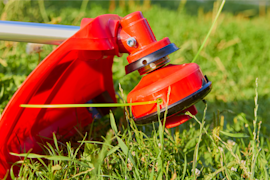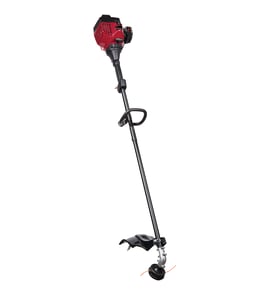

How to change trimmer line on a gas trimmer?
On the Weed Eater FL25C gas line trimmer, you change the trimmer line by removing the spool cap, taking out the spool, winding new line in the correct direction, then reinstalling the spool and snapping the cap back on so the line feeds smoothly.
Before you start
- Shut the engine off and let it cool completely.
- Disconnect the spark plug wire to prevent accidental starting.
- Clean grass and debris off the trimmer head so the cap tabs and notches are easy to see.
- Use the correct line diameter for your trimmer head (most light-duty gas trimmers use about 0.065 to 0.080 inch line).
Steps to replace the line (typical bump-feed head)
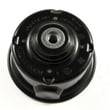
- Remove the spool cap: Press the two locking tabs (or unscrew the cap, depending on head style) and lift the cap off.
- Pull out the spool: Note how the old line is routed through the eyelets.
- Cut new line: Most heads take two equal lengths (commonly 10 to 20 feet each), or a single long length folded in half.
- Wind the line: Wind tightly and evenly in the direction of the arrow on the spool. Keep the line in the spool grooves/notches to prevent unraveling.
- Reinstall: Feed the line ends through the eyelets, seat the spool, then reinstall the cap until it locks.
- Set line length: Pull both ends to release them from the notches; trim to a practical length if needed.
Quick troubleshooting if the line will not feed
- Line wound the wrong direction: rewind to match the spool arrow.
- Line crossed or loose on the spool: rewind with tight, even wraps.
- Spool not seated or cap not fully locked: reinstall until it clicks.
- Eyelets packed with debris: clean the head and eyelets.
Line replacement checklist
| What to check | What “good” looks like | What to fix |
|---|---|---|
| Winding direction | Matches spool arrow | Rewind correctly |
| Wrap tension | Tight, even layers | Rewind tighter |
| Cap fit | Fully snapped/locked | Reseat cap |
| Line size | Typical 0.065 to 0.080 inch | Use correct diameter |
Why it matters
Correctly wound line prevents constant breakage, reduces vibration, and lets the bump-feed mechanism advance line reliably, which protects the trimmer head and improves cutting performance.
If your trimmer head is damaged or the cap will not lock, we recommend ordering the correct replacement parts for your FL25C from the parts list for this model, or searching by model number on Sears PartsDirect.
Last updated: February 2026
What size is the Weedeater fuel line?
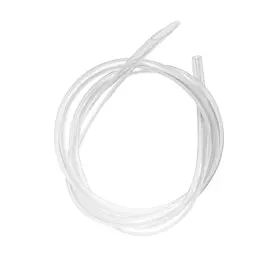
For the Weed Eater FL25C gas line trimmer, the fuel line size depends on which line you’re replacing: the smaller return line or the larger supply line. This model commonly uses two different diameters, so matching the correct line to the correct tank fitting is what matters most.
Which fuel line does your FL25C need?
Most 2-cycle trimmers like the FL25C use:
- Small line: typically the return line back to the tank
- Large line: typically the fuel supply line from the tank to the carburetor
- A fuel filter inside the tank attached to the supply line (not listed in the parts shown here)
On this model’s parts list, we show both sizes:
- Poulan lawn & garden equipment fuel line, small 530069247
- Ayp lawn & garden equipment fuel line, large 530069216
How to confirm the correct size (quick, reliable method)
We recommend confirming by fit, because printed size specs vary by brand and batch.
- Pull the old line and compare its outside diameter to the tank hole or grommet.
- The correct line pushes through firmly and seals without splitting.
- If the line slides in easily, it’s too small.
- If it will not feed through with steady pressure, it’s too large.
- Replace lines as a set if they feel stiff, cracked, or swollen.
Typical sizing guide (what you’ll see on many 2-cycle trimmers)
These are common ranges for small-engine fuel tubing; use them as a reference when checking fit.
| Line role | Common I.D. range | Common O.D. range |
|---|---|---|
| Supply (tank to carb) | 1/8 in to 3/16 in | 1/4 in to 5/16 in |
| Return (primer to tank) | 3/32 in to 1/8 in | 3/16 in to 1/4 in |
Why it matters
Fuel line that is even slightly off-size can cause air leaks, hard starting, poor priming, surging, or fuel seepage. Correct sizing keeps the fuel system sealed so the carburetor can draw fuel consistently.
Ordering the right part
We recommend ordering by model and part listing to ensure the best match for your FL25C. You can order the small and large fuel lines from the parts list for this model, or search by model number on Sears PartsDirect.
Last updated: February 2026
Which is better, .080 or .095 trimmer line?
For a Weed Eater FL25C gas line trimmer, .095 trimmer line is better for durability and cutting thicker weeds, while .080 is better for lighter trimming and cleaner edging. The “best” choice is the thickest line your trimmer head is designed to feed reliably.
Quick comparison: .080 vs .095
- .080 inch: lighter line; easier on the engine; cleaner edging on grass
- .095 inch: thicker line; longer wear; better on heavy weeds and tougher growth
- If your head struggles to feed (line won’t advance or breaks inside the head), step down in size
- If line breaks constantly in normal use, step up in size (if compatible)
| Feature | .080 line | .095 line |
|---|---|---|
| Best for | Light trimming, edging | Heavy trimming, thicker weeds |
| Wear life | Shorter | Longer |
| Load on engine | Lower | Higher |
| Typical feel | More precise | More aggressive |
How we recommend choosing for the FL25C
Use these practical rules so the trimmer runs smoothly and the line advances correctly:
- Choose .080 if you mostly edge sidewalks, trim around fences, and cut light grass.
- Choose .095 if you regularly hit thicker weeds and want fewer line changes.
- If you notice bogging down, excessive vibration, or poor acceleration, use a thinner line.
- If you notice rapid line wear or frequent snapping, use a thicker line (when the head allows it).
Why it matters
Line diameter affects more than cutting power; it changes how hard the engine works and how well the bump-feed (or fixed head) can advance line. Matching the line size to your trimming conditions helps prevent stalling, poor cutting, and wasted line.
Related maintenance tip (fuel system)
If your FL25C runs weak or dies under load, the issue is often fuel delivery, not line size. Common fixes include replacing cracked fuel lines such as the poulan lawn & garden equipment fuel line, small 530069247 or the ayp lawn & garden equipment fuel line, large 530069216. You can also search parts by model on Sears PartsDirect.
Last updated: February 2026