
What is the column on a drill press?
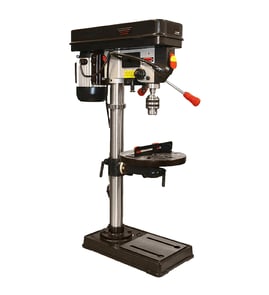
On the Craftsman 113213840 13" floor model drill press, the column is the tall, round vertical tube that connects the base to the head. It supports the table and head so the drill stays aligned and stable while you drill.
What the column does
- Provides the main structural support between the base and the head
- Keeps the head and table aligned for straighter holes
- Serves as the mounting surface for the table support (rack and clamp area)
- Helps reduce vibration by keeping the drill press rigid
- Sets the working height and reach of the table along the drill press
Where you will see it on your drill press
Most floor-model drill presses (including Craftsman model 113213840) are built around three main vertical sections:
| Drill press section | What it attaches to | What it supports |
|---|---|---|
| Base | Floor/bench surface | Entire drill press weight and stability |
| Column | Base and head | Table support and head alignment |
| Head | Top of column | Motor, pulleys, spindle/quill, chuck |
Why it matters
If the column is dirty, rusty, or loose at the base, the table can slip, the head can shift slightly, and holes can wander. A clean, secure column is one of the biggest factors in accurate drilling on a 13-inch floor model drill press.
Quick care tips (safe, practical)
- Unplug the drill press before cleaning or adjusting anything
- Wipe the column clean and remove light rust with a non-scratching pad
- Apply a thin coat of paste wax or light machine oil to help the table slide smoothly
- Check that the base-to-column bolts are tight
- If the table clamp slips, clean the clamp area and re-tighten evenly
For more general DIY safety guidance before working around moving parts and electrical components, see are diy appliance repairs safe.
Last updated: February 2026
What part of the drill press holds the bit?
On the Craftsman 113213840 13" floor model drill press, the part that holds the drill bit is the chuck. The chuck clamps onto the bit shank using jaws so the bit stays centered and secure while the spindle turns.
What the chuck does (and how it works)
The chuck mounts to the drill press spindle (often through an arbor) and grips the bit when you tighten it.
- Holds the drill bit straight (reduces wobble and runout)
- Keeps the bit from slipping under load
- Centers the bit for accurate holes
- Lets you swap bits quickly
- Transfers rotation from the spindle to the bit
Common chuck types you may see
Most floor model drill presses use a keyed chuck, but some setups use keyless chucks.
| Chuck type | How it tightens | Best for |
|---|---|---|
| Keyed (geared) chuck | Uses a chuck key to tighten jaws | Strong grip for larger bits and tougher drilling |
| Keyless chuck | Hand-tightens without a key | Faster bit changes for light to medium work |
Quick checks if the bit will not stay tight
If your bit slips or wobbles, the issue is usually the chuck, arbor fit, or the bit shank.
- Tighten a keyed chuck in all three key holes (if equipped)
- Clean oil and dust from the bit shank and chuck jaws
- Inspect jaws for rounding, chips, or uneven wear
- Reseat the chuck on the arbor (a loose taper fit causes wobble)
- Try a different bit (bent shanks cause runout)
Why it matters
A properly gripping chuck is the difference between clean, accurate holes and problems like chatter, oversized holes, broken bits, and unsafe workpiece grabbing.
For help confirming you have the correct model number before ordering parts, use how to find your appliance model number (and what it means for parts).
Last updated: February 2026
What to look for in a bench top drill press?
When we help customers compare a bench top drill press, we focus on capacity, accuracy, and speed control first. Even though your Craftsman 113213840 is a 13-inch floor model drill press, the same buying checklist applies to bench models because the core parts and adjustments (quill, table, pulleys, depth stop) work the same way.
Key features to compare
- Quill travel: Look for longer travel for drilling deeper holes without repositioning; many shoppers target 3-1/2 inches or more.
- Speed range and changes: A wider RPM range helps with wood, metal, and plastics; confirm how speeds are changed (belt and pulley access).
- Depth stop design: Choose a style you can set repeatably (common styles are locking nut or turret stops).
- Runout and rigidity: A stiffer head and table support reduce wobble; check spindle play and table flex.
- Table adjustment: Smooth height changes, solid tilt locks, and a usable crank (if included) matter for day-to-day work.
- Motor power and voltage: Match power to your typical bit sizes and materials; avoid underpowered units if you drill larger holes often.
Quick comparison guide
| What you do most | What to prioritize | Why it helps |
|---|---|---|
| Woodworking (Forstner bits, hole saws) | Lower speeds, rigid table, good depth stop | Cleaner holes and less chatter |
| Light metal drilling | Broad speed range, solid quill, easy belt changes | Better control and bit life |
| Repetitive drilling | Depth stop you can set fast and repeat | Consistent hole depth |
| Small precision work | Low runout, smooth quill feed | Straighter, more accurate holes |
Setup and ownership costs to think about
- Bench space or a dedicated stand (many owners place a cabinet under a heavier bench model for stability and storage)
- Vise or clamps for workholding (critical for safety and accuracy)
- Common wear items over time: belts, bearings, switches, and cords
Why it matters
A drill press that is rigid, has the right quill travel, and offers usable speeds drills straighter holes with less vibration. That improves accuracy, reduces bit breakage, and makes repeat work (like shelf pins or metal brackets) much easier.
For help finding the correct model number format when ordering drill press parts or diagrams, use how to find your appliance model number (and what it means for parts).
Last updated: February 2026
Where is the model number on a Craftsman drill press?
On the Craftsman drill press model 113213840, we typically find the model number on the identification plate (data plate) attached to the base near the column. Use that full model number when looking up diagrams and ordering replacement parts.
Where to look first (fast checks)
- Check the front or side of the base casting near where the column mounts.
- Look for a metal plate or adhesive label with “MODEL” and a number.
- Wipe off dust and oil; the print can be faint under grime.
- Use a flashlight and look at a low angle to make stamped numbers easier to see.
- If the plate is missing, check the rear of the base and the column for a secondary label.
What the model number label looks like
Most Craftsman floor drill presses use a small plate or label that includes the model number and sometimes electrical details.
| What you see on the plate | What it means | Why you need it |
|---|---|---|
| “MODEL 113.213840” (or similar) | The full model identifier | Ensures correct parts match and fit |
| Voltage/amps/Hz | Motor electrical rating | Helps confirm motor and switch compatibility |
| Serial number | Production identifier | Useful for service history and identification |
Why it matters
Craftsman drill press parts can vary by model series and production run. Using the exact model number (like 113213840) helps us match the correct belts, pulleys, quill parts, switches, and guards for your specific 13-inch floor model drill press.
Next step if you are ordering parts
Use the model number to search and confirm diagrams in how to find your appliance model number (and what it means for parts).
Last updated: February 2026