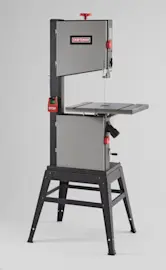
Owner’s manual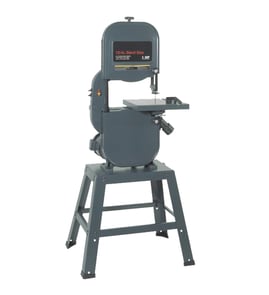

What is the 4 inch rule for bandsaw?
On the Craftsman band saw model 12432607, the 4-inch rule is a safety best practice: we keep our hands and fingers at least 4 inches away from the moving blade during cutting, guiding, and cleanup to reduce the risk of contact.
How we apply the 4-inch rule safely
- Use a push stick, push block, or a scrap “handle” when the cut line brings your fingers close to the blade.
- Keep your hands to the sides of the cut path, not in line with the blade.
- Stop the saw before removing offcuts or scrap from the table.
- Feed stock at a moderate, controlled speed; forcing the cut pulls hands closer.
- Use proper support for stock that is not flat so it does not rock or twist.
Setup checks that help you keep distance
The 4-inch rule is easier to follow when the saw is adjusted correctly. For the Craftsman 12432607, we follow these basics from the safety and operation guidance in the owner's manual:
| What to check | What “good” looks like | Why it helps safety and cut quality |
|---|---|---|
| Blade size and type | Matched to material thickness and type | Reduces binding and sudden grabs |
| Blade tension | Properly tensioned | Helps prevent wandering and stalling |
| Blade tracking | Blade runs centered on wheels | Helps prevent the blade from walking off |
| Feed rate | Moderate, steady | Keeps hands from creeping toward the blade |
Why it matters
Most band saw injuries happen during close-in guiding, clearing scraps, or when material binds and your hands react. Keeping a 4-inch buffer, plus stopping the saw before clearing scraps, directly reduces those high-risk moments.
Parts and repair help
If your saw is hard to control (wanders, binds, or cuts slowly), correct blade selection and adjustments usually fix it. For repair and troubleshooting content and to search parts by model number, start with the model parts list and Sears PartsDirect.
Last updated: February 2026
What is the 3-tooth rule for bandsaws?
The 3-tooth rule means you choose a band saw blade pitch (TPI) so at least 3 teeth are in the cut at all times. On your Craftsman 12432607 band saw, this improves control, reduces tooth snagging, and helps the blade cut cleaner and last longer; see the blade selection and operation guidance in the owner's manual.
How to apply the 3-tooth rule (quick steps)
- Estimate the material thickness where the blade is actually cutting.
- Pick a blade pitch so 3 or more teeth span that thickness.
- For thicker stock, use fewer TPI (coarser teeth).
- For thinner stock, use more TPI (finer teeth).
- Feed at a moderate speed and keep the work supported and flat.
Practical TPI guide (common band saw ranges)
Use this as a starting point, then fine-tune based on cut quality and motor load.
| Material thickness | Typical blade pitch (TPI) | What you’ll notice |
|---|---|---|
| 1/8 in. or less | 14 to 24 TPI | Less tooth snagging on thin stock |
| 1/8 to 1/2 in. | 10 to 14 TPI | Smoother cuts with good control |
| 1/2 to 2 in. | 6 to 10 TPI | Faster cutting, better chip clearing |
| Over 2 in. | 3 to 6 TPI | Best for thick wood, aggressive feed |
Why it matters on the Craftsman 12432607
When too few teeth contact the work, the blade tends to grab, chatter, and wander. When too many teeth contact the work, sawdust packs in the gullets, the blade heats up, and cutting slows. Our manual also calls out using the proper blade size and type for the thickness and material, and feeding at a moderate speed for safer, straighter cutting.
If your saw is still cutting slowly or not straight
These checks solve most performance complaints:
- Confirm the blade is installed with teeth pointing downward.
- Set correct blade tension and tracking before cutting.
- Reduce feed pressure so the blade does not bend.
- Replace a dull blade; dull teeth are a top cause of slow cutting.
- Adjust blade guides and set the table square to the blade for straight cuts.
For step-by-step troubleshooting, use our DIY symptom guide: band saw cutting slowly. For replacement parts by model number, start with the parts list for Craftsman 12432607, or search more broadly on Sears PartsDirect.
Last updated: February 2026
How do I know the size of my bandsaw blade?
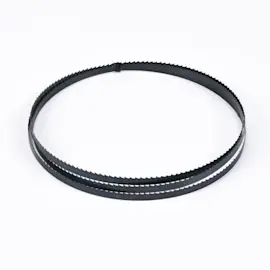
For the Craftsman 12432607 band saw, the blade size is defined by length and width: it uses a 99-3/4 inch blade length and accepts 1/4 inch to 3/4 inch blade widths. We recommend confirming the exact blade specs and installation steps in the owner's manual.
What “blade size” means (and what to measure)
When you shop for a replacement band saw blade, match these key specs:
- Blade length: the total loop length (this model is 99-3/4 inches)
- Blade width: measured across the blade body (this model accepts 1/4 inch to 3/4 inch)
- TPI (teeth per inch): affects speed and cut quality
- Tooth direction: teeth should point downward and toward you where the blade passes through the table
Quick spec table for Craftsman 12432607
| Spec | What to buy/verify | Why it matters |
|---|---|---|
| Blade length | 99-3/4 in | Wrong length will not tension or track correctly |
| Blade width range | 1/4 in to 3/4 in | Too wide will not turn tight curves; too narrow can wander |
| TPI (typical guidance) | ~4 TPI thick wood; ~14 TPI thinner/harder wood | Controls feed rate and finish quality |
How to confirm your blade size on the saw
Use these checks before ordering:
- Look for the blade length and width range listed on the saw’s spec section
- If the old blade is still installed, read the printing on the blade (many blades list length, width, and TPI)
- If the blade is off the saw, lay it flat and measure the width with a ruler or caliper
- After installing a new blade, set tension and tracking so the blade runs centered on the wheels
Why it matters
Using the correct 99-3/4 inch blade length and staying within the 1/4 inch to 3/4 inch width range helps your Craftsman band saw track properly, cut straighter, and reduces issues like slow cutting or the blade slipping off the wheel.
If you need to find replacement blades or other parts by model number, start with the parts list for Craftsman 12432607, or search by model on Sears PartsDirect.
Last updated: February 2026