 Owner’s manual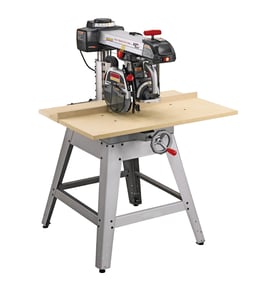


Are radial arm saws worth anything?
Yes. A Craftsman radial arm saw like model 113196380 is worth something if it’s complete, runs smoothly, and can be tuned to cut accurately; value is driven mostly by condition and local demand, not age alone.
What typically affects value most
- Working condition: motor starts, reaches speed, and doesn’t bog down under load
- Accuracy and adjustability: the arm locks firmly and can be squared for clean crosscuts
- Completeness: guards, table/fence pieces, and wrenches included
- Wear items: arbor threads, bearings, and power cord condition
- Size and shop fit: radial arm saws take more floor and wall space than a miter saw
Typical resale ranges (real-world expectations)
These are common private-party ranges for 10-inch radial arm saws in the U.S.; your local market can swing higher or lower.
| Condition | What it usually means | Typical range |
|---|---|---|
| Needs work | missing parts, rough bearings, unsafe cord, won’t align | $0 to $75 |
| Usable | runs, basic guards present, can be tuned | $75 to $200 |
| Clean and dialed-in | smooth travel, accurate cuts, well maintained | $200 to $400 |
Quick checks we use before calling it “worth it”
- Unplug the saw and verify the carriage travel is smooth with minimal play.
- Confirm the arm can be set to 0° miter and locked firmly.
- Inspect the arbor nut and threads; this model uses left-hand motor shaft threads, so the nut tightens opposite of many tools.
- Look for a solid, flat table and a straight fence; these affect accuracy as much as the saw itself.
- Plan to do a full alignment; the manual notes that adjustments are “fine tuning” and often need repeating to get right.
Why it matters
Radial arm saws can be excellent for repeatable crosscuts and certain jig-based cuts, but they only earn their keep when they’re aligned, guarded, and used with the correct feed direction and support. The owner's manual for model 113196380 is the best reference for safe setup, alignment steps, and recommended cutting aids.
Last updated: February 2026
What are the common problems with radial arm saws?
Common problems with the Craftsman 113196380 radial arm saw include inaccurate cuts from misalignment, binding or smoking during ripping, rough carriage travel, and safety issues like kickback or thrown workpieces. Most of these are fixed with cleaning, alignment, and correct feed technique as outlined in the owner's manual.
Common problems you may notice
- Crosscuts are slightly out of square (arm not square to the fence)
- Workpiece binds, smokes, or the motor slows or stops during ripping
- Board pulls away from the fence while ripping
- Radial arm, yoke, bevel, or rip settings slip even when “locked”
- Blade carriage does not travel smoothly (dirty track, worn track, or bearing issues)
- Lower guard jams or sticks (needs cleaning with power off)
Quick checks that solve many issues
- Unplug the saw before any adjustment; do not plug in during alignment.
- Clean and lightly lubricate the track; dirt on the track commonly causes rough travel.
- Confirm the blade is installed correctly; the motor shaft uses left-hand threads, so tighten the arbor nut correctly (snug, not over-tight).
- Re-align the saw if cuts are off; alignment steps often need repeating to “fine tune.”
- Slow the feed rate when ripping; feeding too fast commonly causes binding and motor slowdown.
Troubleshooting guide (symptom to likely cause)
| Symptom | Common cause | What to do |
|---|---|---|
| Binding, smoke, motor slows/stops (ripping) | Blade out of alignment, feed too fast, dull/incorrect blade, loose carriage | Re-align, slow feed, service blade, adjust carriage bearings then re-align |
| Workpiece strikes riving knife (ripping) | Riving knife not in line with blade | Align riving knife to blade |
| Carriage travel is rough | Dirty track, bearings too tight, worn track/bearing | Clean/lube track; adjust bearings; replace worn parts as needed |
| Arm/yoke/bevel/rip slips when locked | Lock not adjusted for wear | Adjust the lock mechanism for wear |
Why it matters
Radial arm saw issues are not just about cut quality. Misalignment, binding, and poor technique increase the risk of kickback, outfeed-zone hazards, and thrown workpieces. Keeping the saw aligned and the carriage moving smoothly helps you cut accurately and reduces injury risk.
Last updated: February 2026
What is the best brand of radial arm saw?
There is not one single “best” brand for every shop; the best radial arm saw is the one that stays accurate, has solid guarding, and fits how you cut. For a Craftsman 113196380 10-inch radial saw, we focus on safe setup, alignment, and using the right blade so the saw performs at its best (regardless of brand). See the owner's manual for safety rules, alignment checks, and operating guidance.
What to look for in a “best” radial arm saw
- Rigid arm and column: less flex means better crosscut accuracy.
- Repeatable adjustments: bevel and miter settings should lock firmly.
- Guarding and anti-kickback features: essential for safer ripping and crosscutting.
- Parts support: common wear items (switches, cords, guards, hardware) should be obtainable.
- Blade compatibility: standard 10-inch blades with the correct arbor size for the saw.
How to judge a used saw quickly (practical checklist)
- Check that the carriage rolls smoothly without play.
- Verify the arm locks and index points hold position.
- Inspect the lower guard and hardware for cracks or missing pieces.
- Confirm the power cord and switch are in good condition.
- Make a test cut and check for square and repeatability.
Brand comparison (what matters most)
| What you care about | What to prioritize | Why it helps |
|---|---|---|
| Accuracy | Tight locks, minimal play, easy alignment | Keeps cuts square and repeatable |
| Safety | Complete guard system, proper technique | Reduces risk of contact and kickback |
| Longevity | Solid castings, serviceable wear parts | Extends usable life |
| Versatility | Smooth travel, stable table/fence setup | Improves crosscuts and dados |
Why it matters
Radial arm saws can do excellent crosscuts, but they demand correct guarding, sharp blades, and periodic alignment checks. The Craftsman manual specifically emphasizes safety risks (including severe cuts, thrown workpieces, and shock) and recommends practices like using sharp blades and checking alignment periodically. Use the owner's manual to set up your 113196380 correctly before deciding whether you need a different brand.
Last updated: February 2026
Why are radial arm saws no longer made?
Radial arm saws are uncommon in new production because most shoppers moved to tools that do the same everyday cuts with simpler setups and fewer high-risk operations. The Craftsman 113196380 manual also highlights major ripping hazards (kickback, outfeed zone hazard, and wrong-way feed), which pushed many users toward miter saws and table saws for typical shop work.
What changed in the market
For most DIYers and pros, other saw types became the default because they are easier to use for common tasks.
- Sliding compound miter saws handle fast, accurate crosscuts and miters with a compact footprint
- Table saws became the go-to for ripping with widely adopted guarding and fence systems
- Many users did not need the radial arm saw’s versatility (crosscut, miter, bevel, dado) often enough
- Setup and alignment demands are higher; accuracy depends on keeping the arm, yoke, and blade aligned
- Shops shifted to dedicated tools for each job instead of one multi-purpose saw
Safety and why ripping is a big factor
A radial arm saw can be used safely, but ripping on a radial arm saw has specific hazards that require strict technique and correct setup.
Common risk drivers called out in the manual
| Operation | What tends to go wrong | What reduces the risk |
|---|---|---|
| Ripping | Kickback and wrong-way feed | Correct feed direction, sharp blade, proper guards and anti-kickback setup |
| Ripping | Outfeed zone hazard | Keep the outfeed area clear; support long stock |
| Any cut | Inaccuracy leading to binding | Periodic alignment checks and correct fence condition |
For model-specific safety rules, guard setup, and feed direction diagrams, follow the owner's manual.
Why it matters
When a tool category becomes harder to use safely for the average owner, demand drops. As demand drops, manufacturers focus on higher-volume tools (miter saws and table saws) that match how most people build projects today.
Last updated: February 2026