
How many square feet will a 80,000 BTU gas furnace heat?
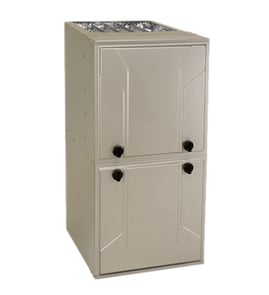
An 80,000 BTU gas furnace like the Ducane MPGA-B-B typically heats about 1,600 to 2,400 square feet, depending on your climate, insulation, ceiling height, and the furnace’s efficiency (AFUE). For accurate sizing, we match BTU output to your home’s heat loss, not just square footage.
Quick sizing rule of thumb (what 80,000 BTU usually covers)
Use these common planning ranges for a typical home with 8-foot ceilings:
- Warm climates / newer insulation: ~20 to 30 BTU per sq ft
- Moderate climates / average insulation: ~30 to 40 BTU per sq ft
- Cold climates / older or leaky homes: ~40 to 50 BTU per sq ft
- High ceilings (9 to 12 ft): reduce coverage by ~10% to 25%
- Lots of windows or drafts: reduce coverage further
Estimated coverage table
| Home heat-loss level | Typical BTU per sq ft | 80,000 BTU estimated coverage |
|---|---|---|
| Low (tight, well-insulated) | 25 | ~3,200 sq ft |
| Medium (average) | 35 | ~2,285 sq ft |
| High (drafty, colder region) | 45 | ~1,780 sq ft |
What to check before you size by square feet
Square footage alone can oversize or undersize a furnace. We recommend checking:
- AFUE rating (higher AFUE usually means more usable heat for the same input)
- Ductwork condition and sizing (leaks and restrictions reduce delivered heat)
- Insulation and air sealing (attic, rim joists, weatherstripping)
- Ceiling height and open floor plans (more air volume to heat)
- Local winter design temperature (colder areas need more BTU per sq ft)
Why it matters
Correct furnace sizing helps your Ducane MPGA-B-B run longer, steadier cycles for better comfort and efficiency. Oversizing often causes short cycling and uneven temperatures; undersizing can leave rooms cold during the coldest weather.
Parts and repair help
If you are troubleshooting heating performance (weak heat, short cycling, blower issues), we recommend starting with the parts list for the Ducane MPGA-B-B and then searching by model number on Sears PartsDirect for compatible replacement parts.
Last updated: February 2026
How to reset furnace error code?
For a Ducane MPGA-B-B gas furnace, the most reliable way to reset an error code is a full power reset: turn the furnace off at the service switch or breaker for 5 to 10 minutes, then restore power. If the code returns, fix the underlying issue before continuing to run the furnace.
Safe reset steps (power cycle)
- Set the thermostat to OFF.
- Turn OFF power to the furnace at the service switch (or the circuit breaker).
- Wait 5 to 10 minutes so the control board fully powers down.
- Turn power ON.
- Set the thermostat to HEAT and call for heat.
- Watch the furnace through one full ignition cycle; note any blinking light pattern or code.
What a reset does (and does not do)
A reset clears many temporary lockouts, but it does not correct the condition that triggered the fault. If the furnace immediately faults again, focus on airflow, venting, ignition, or safety switches.
| What you see after reset | What it usually means | What to check first |
|---|---|---|
| Code clears and heat runs normally | Temporary fault or power glitch | Replace/clean filter; confirm vents are open |
| Code returns quickly | Active safety or ignition problem | Filter, intake/exhaust venting, flame sensor area |
| Blower runs but no heat | Heat call not completing | Thermostat settings, door switch, limit switch trip |
Common causes that trigger recurring codes
- Dirty air filter causing high temperature and limit switch trips
- Blocked return or supply vents reducing airflow
- Intake/exhaust vent restriction (snow, debris, sagging pipe, bird nest)
- Loose wiring or failing connection at the control board or safety switches
- Ignition or flame-sensing issues (burner not lighting consistently)
Why it matters
Repeatedly resetting a furnace that is tripping a safety circuit can lead to no-heat situations and can stress components like the igniter, inducer, and control board. A reset is best used as a diagnostic step, then you correct the root cause.
Parts and help for MPGA-B-B
We list replacement parts by model so you can match the correct control, switch, or ignition component for your Ducane MPGA-B-B. If you need to broaden your search by model number or category, use Sears PartsDirect.
Last updated: February 2026
What is the life expectancy of a ducane furnace?
A Ducane gas furnace like model MPGA-B-B typically lasts 15 to 20 years. Reaching the high end depends on correct installation, clean airflow (filter and ducts), and keeping key safety and ignition components in good working order.
Typical lifespan and what affects it
Most furnaces fail early because of overheating, short cycling, or neglected maintenance. The biggest factors are:
- Maintenance consistency (annual inspection and cleaning)
- Airflow (clean filter, open registers, clean blower compartment)
- Duct condition (leaks and restrictions increase run time and heat stress)
- Electrical reliability (tight connections, healthy control board and wiring)
- Combustion health (clean burners, stable flame, proper venting)
Quick checklist to help your MPGA-B-B reach 20 years
For a Ducane MPGA-B-B gas furnace, these steps reduce wear on the heat exchanger, blower motor, and ignition system:
- Replace or clean the air filter on schedule (often every 1 to 3 months)
- Keep supply and return vents unblocked (furniture and rugs cause overheating)
- Confirm the blower runs smoothly (no squealing, grinding, or heavy vibration)
- Watch for short cycling (frequent on/off can point to airflow or limit-switch issues)
- Keep the area around the furnace clean and dust-free
Repair vs. replace: a practical guide
Use age plus symptoms to decide whether a repair is worth it.
| Furnace age | If it needs a minor repair | If it needs a major repair |
|---|---|---|
| Under 10 years | Usually worth repairing | Often worth repairing |
| 10 to 15 years | Repair if performance is stable | Compare repair cost vs. replacement |
| 15 to 20 years | Repair only if low-cost and reliability is good | Replacement is usually the better value |
Why it matters
A furnace near end-of-life can become less reliable and less efficient, and repeated no-heat calls often trace back to the same root causes (restricted airflow, weak ignition, or electrical issues). Planning ahead helps avoid an emergency breakdown during cold weather.
Finding the right parts
When you are ready to look up replacement parts by model number, start with the parts list for Ducane MPGA-B-B, or search by model on Sears PartsDirect.
Last updated: February 2026
What is the most common part to fail on a furnace?
On a Ducane MPGA-B-B gas furnace, the most common “failure” we see is a dirty air filter causing overheating and safety shutdowns; after that, flame sensor and hot surface igniter issues are among the most frequent no-heat causes. For parts lookup by model, use the parts list first, then search by model on Sears PartsDirect.
Most common furnace failures (in order)
These are the items that most often stop heat because they either wear out or trigger safety lockouts:
- Air filter: Clogs restrict airflow, the furnace overheats, and the limit switch shuts burners off.
- Flame sensor: Gets coated with oxidation; burners light briefly, then shut off.
- Hot surface igniter (or spark igniter): Cracks or opens electrically; furnace will not light.
- Thermostat or low-voltage wiring: No call for heat reaches the control board.
- Capacitor or blower motor issues: Poor airflow can trip limits and cause short cycling.
- Control board or relay problems: Less common, but can prevent ignition sequence.
Quick checks you can do safely
Before replacing anything, these checks often pinpoint the problem fast:
- Replace the air filter and confirm return vents are not blocked.
- Verify the thermostat is set to Heat and the temperature is raised above room temp.
- Check the furnace service switch and the home breaker.
- Look for a status light on the control board (blink codes help narrow the failure).
- Inspect the flame sensor and igniter area for obvious soot, corrosion, or damage.
Symptom-to-part cheat sheet
| What the furnace does | Most likely culprit | What it means |
|---|---|---|
| Blower runs, no heat | Flame sensor, igniter, gas valve circuit | Ignition sequence is failing or flame is not being proven |
| Heats briefly, then shuts off | Flame sensor, dirty filter, limit switch trip | Safety shutdown due to flame loss or overheating |
| Nothing happens at all | Thermostat, door switch, control board, power | No call for heat or no power to controls |
| Starts and stops frequently | Dirty filter, airflow restriction, thermostat | Overheating or control cycling |
Why it matters
On gas furnaces like the Ducane MPGA-B-B, many “bad parts” are actually safety responses to airflow or flame-proving problems. Fixing the root cause (filter, airflow, sensor cleaning) prevents repeat shutdowns and protects the heat exchanger and blower.
For electrical testing, we recommend using a meter correctly; see how to use a multimeter to test electrical parts video.
Last updated: February 2026