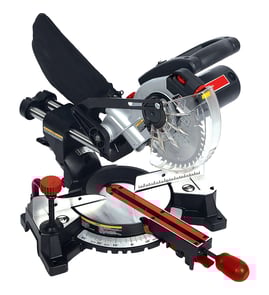

Is the Delta 36-075 belt driven?
The Delta 36-075 miter saw is not a belt-driven tool; miter saws in this class use a direct-drive motor that spins the blade arbor without a separate drive belt. If you are chasing vibration or weak cutting, we focus on the blade, arbor, and motor condition instead of belt tension.
How to confirm it on your saw
- Unplug the saw and remove the motor cover only if it’s designed to be service-accessible.
- Look for a belt path: a belt-driven saw has two pulleys and a rubber belt between them.
- On direct-drive designs, the motor sits in line with the blade arbor area and there is no belt or pulley set.
- Check for a belt-tension adjustment (slotted motor mount or tension screw); direct-drive units do not use one.
If it’s vibrating or cutting weak, check these first
- Blade condition: dull, warped, or wrong tooth count for the material
- Blade installation: correct direction, clean flanges, blade seated flat
- Arbor and bearings: play at the blade, grinding noise, or wobble
- Motor issues: slow start, burning smell, or intermittent power
- Mounting: saw base not secured, stand/bench flexing
Belt-drive vs direct-drive (what changes)
| Feature | Belt-driven saw | Direct-drive miter saw (typical for 36-075) |
|---|---|---|
| Power transfer | Belt and pulleys | Motor drives arbor directly |
| Common wear item | Belt | Arbor bearings, brushes (if equipped) |
| Typical adjustment | Belt tension/alignment | Blade alignment, fence/bevel settings |
Why it matters
If you assume a belt is slipping, you can miss the real cause of poor performance. On a direct-drive miter saw, most “loss of power” and vibration complaints trace back to the blade, arbor bearings, or motor health.
For replacement parts, use the model lookup and diagrams for Delta 36-075, or search by model number on Sears PartsDirect.
Last updated: February 2026
What is 33.9 on a miter saw?
On a miter saw, 33.9° usually refers to the bevel angle (the blade tilt) used for cutting crown molding using the common “nested” method. For a typical 52°/38° crown profile, you set about 33.9° bevel and 31.6° miter to create tight inside or outside corner joints.
What the numbers mean (miter vs. bevel)
- Bevel (33.9°): the blade tilts left or right from vertical.
- Miter (31.6°): the table rotates left or right to change the cut direction.
- These two settings work together to “compound” the cut so crown molding fits a corner.
- On your Delta 36-075 miter saw, the bevel scale is on the saw head; the miter scale is on the turntable.
Quick setup checklist for crown molding cuts
- Unplug the saw before adjusting or test-fitting.
- Confirm you are reading the correct scale: bevel vs miter.
- Nest the crown molding the same way for every cut (against fence and table).
- Make a test cut on scrap and dry-fit the corner.
- Fine-tune 0.5° at a time if the joint opens at the top or bottom.
Typical crown molding settings (common 52°/38° crown)
| Crown method | Bevel setting | Miter setting | Notes |
|---|---|---|---|
| Nested (crown against fence) | 33.9° | 31.6° | Most common “33.9 / 31.6” reference |
| Flat on table | Varies | Varies | Depends on spring angle and chart |
Why it matters
Using the correct bevel and miter angles prevents gaps at the ceiling or wall edge, reduces rework, and helps your Delta 36-075 make repeatable, accurate trim cuts.
Parts and diagrams
If you need a replacement fence, miter detent parts, bevel lock components, or other Delta 36-075 items, start with the model parts diagrams and then search by model number on Sears PartsDirect.
Last updated: February 2026
What should you never cut with a miter saw?
On a Delta 36-075 miter saw, never cut material that is unstable, unsupported, or outside the saw’s intended use. Avoid tiny offcuts near the blade, rip cuts (with the grain), ferrous metals, masonry, and any freehand cut; these situations commonly cause binding, kickback, or loss of control.
Never cut these materials or setups
- Very small pieces that put your fingers close to the blade (use a clamp or a purpose-built jig instead).
- Rip cuts (cutting lengthwise with the grain); a miter saw is designed for crosscuts and miters, not ripping.
- Ferrous metals (steel, iron) unless your saw is specifically equipped and rated for metal cutting.
- Masonry (brick, concrete, tile); abrasive dust and the wrong blade type make this unsafe.
- Warped, twisted, or round stock that cannot sit flat and stay stable against the fence.
- Anything not fully supported on both sides of the cut line.
Safer alternatives (what to do instead)
- For ripping boards: use a table saw with a rip fence, or a circular saw with a straightedge guide.
- For small parts: clamp the workpiece and use a stop block, auxiliary fence, or a holding jig.
- For metal: use a dedicated metal chop saw or the correct tool rated for the material.
Quick “OK vs not OK” guide
| Task/material | OK on a miter saw? | Better choice |
|---|---|---|
| Crosscutting 2x lumber | Yes | Miter saw |
| Ripping a 1x6 board | No | Table saw or circular saw guide |
| Cutting steel angle | No | Metal chop saw |
| Cutting brick/tile | No | Masonry saw or angle grinder (rated wheel) |
Why it matters
Most miter saw injuries and damage happen when the blade binds or the workpiece shifts. Keeping the stock flat to the table, tight to the fence, and fully supported reduces kickback risk and improves cut accuracy.
Parts and diagrams
If you need replacement guards, fences, switches, or other components for your Delta 36-075, start with the model parts diagrams and lists, or search by model on Sears PartsDirect.
Last updated: February 2026